A supermarket is a troublesome place to try something new. The customer wants to finish shopping. The operator wants the checkout to keep moving. Somewhere between those two perfectly reasonable ambitions, a startup founder arrives with a promising invention and asks permission to experiment. HIPE Innovation Center, in Curitiba, built a working supermarket to make that conversation easier. The question behind it is wonderfully practical: who supplies the first place where a retail idea can meet ordinary shopping?
- A retail-focused workspace connects founders, suppliers and store operators.
- The supermarket lab launched in 2022 with a reported R$2 million investment.
- Its testing route moves from controlled conditions to a live Verde Mais store.
Someone has to say yes to the pilot
HIPE’s answer starts with a problem its then COO, Ricardo Pontes, described at the laboratory launch: finding a supermarket willing to assume the risk of testing a new solution. It is easy to understand the hesitation. A demonstration can be scheduled, rehearsed and restarted. A store has customers who did not arrive to help debug anything. The founder needs access to an operating environment; the retailer needs a reason to provide it.
In November 2022, Instituto HIPE Lab introduced a functional supermarket with 25 technologies and a reported R$2 million investment. That sum belonged to the laboratory project. It bought a setting for research, demonstrations and tests, rather than serving as a published valuation of HIPE. The attraction was that people could encounter retail technology alongside products, equipment and the familiar sequence of choosing goods and paying for them.
Among the technologies was Nextop’s smart shopping cart, described as identifying items, adding up purchases and taking payment. Delphos supplied a business-intelligence solution for analysing store data. These were supplier products presented within the lab, rather than inventions HIPE claimed as its own. The centre’s contribution was to assemble a place where the retail market could see, discuss and try them.
“Besides testing innovations, we can demonstrate each new development practically and realistically.”Ricardo Pontes, then COO, 2022 · translated from Portuguese
The second supermarket matters
The most interesting part of the plan was what happened after the first test. HIPE described its on-site, controlled environment as Level 1. A solution would then move to Level 2: a supermarket operated by Verde Mais, a laboratory associate. The sequence made an explicit distinction between trying something under supervision and trying it amid the demands of a trading store.
For a reader designing a business pilot, that is the part worth borrowing. Arrange the second environment before becoming too pleased with the first. A lab can help reveal whether a product works in the conditions assembled around it. A live store asks whether it can earn its place within somebody else’s operation. The published route is a useful design principle; it should not be mistaken for a guarantee that every participating technology succeeded.
Its usefulness also depends on the partner. Without a retailer prepared to host the next test, the route stops at a demonstration. Without agreed measures of performance, a successful presentation may tell the operator little about reliability or the customer experience. Those are implications of the model, and sensible questions for anyone approaching HIPE with a product to validate.
The neighbourhood around the experiment
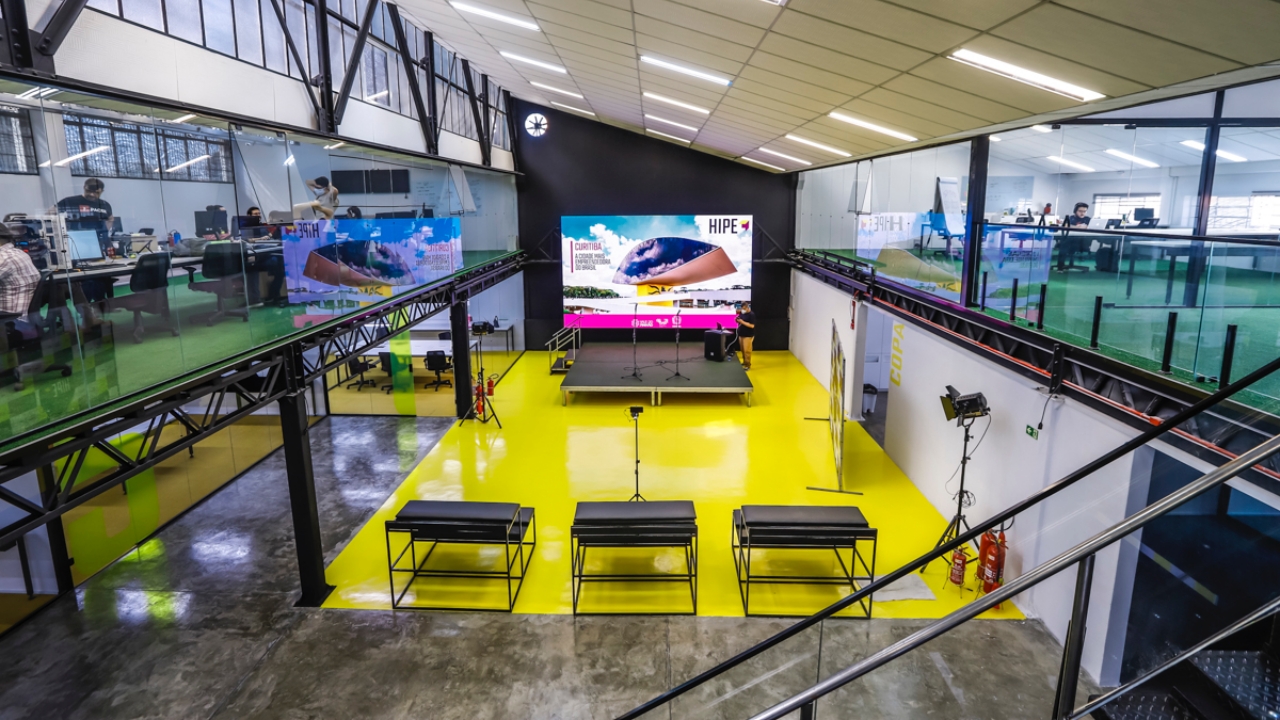
The laboratory sits within a broader effort to gather the retail crowd. HIPE formally opened on 30 September 2021 in Rebouças, within Curitiba’s Vale do Pinhão innovation ecosystem. Its sponsors were RP Info, a retail management and automation systems company, and SigaCred, a financial-services administrator. Mariane Pocai was identified as CEO in the opening coverage, with Pontes as COO.
Earlier that September, the city reported 17 startups already working on site. The approximately 2,000-square-metre collaborative space had capacity for 300 work positions and up to 30 startups. These were opening figures and capacity measures. Their significance was the mix the building could accommodate: established businesses, young companies and professionals working close enough to exchange a question without booking a conference.
The roster was not confined to supermarket gadgets. Pacer, mentioned in the city’s opening account, worked on technology to reduce airport boarding time. HIPE’s retail orientation therefore described its centre of gravity, rather than a rule that every resident must sell something for a grocery aisle. A specialised community can still have interesting neighbours.
A desk, a mentor, a test site
HIPE Space offers private rooms, shared working areas, meeting rooms and event facilities. Alongside that physical setting, its published programs include incubation for structuring and validating technology businesses, acceleration, and a venture builder for developing retail technologies. The practical appeal is having several kinds of help within one network: somewhere to work, people to learn from, and potential routes into the market.
There is an organisational distinction worth understanding. HIPE’s terms identify the centre as a limited company, while Instituto HIPE Lab is a separate private nonprofit association. Lab associates take on financial obligations such as membership fees or contributions under their chosen arrangements. The ecosystem combines commercial services and startup development with an institute organised around shared research and experimentation.
A founder can approach the startup programs or workspace. A supplier can explore laboratory association and technology demonstrations. A retailer can encounter tools in a setting designed for evaluation. An event organiser can use the venue. These are different reasons to enter the same building, which is precisely the point of assembling them.
The conversation leaves Curitiba
The meeting space has a life beyond product trials. HIPE hosted Curitiba’s Pitch Live final in May 2024. In July 2025, it was named alongside RP Info and SigaCred as organiser of the sixth Super Inova, scheduled in Fortaleza for supermarket professionals. That December, it was also the announced venue for an RP Info discussion of retail tax reform.
Those activities place HIPE between technology development and the everyday concerns of operating a retail business. General coworking can provide a desk; a supplier can provide a demonstration; a retailer can run its own pilot. HIPE brings those functions into a retail-focused network. Its appealing proposition is concrete: make it easier for an idea to reach the people, equipment and operating conditions that can give it a meaningful test.
Explore HIPE
Visit the official website, explore HIPE Space and HIPE Lab, or read the company blog.
Follow LinkedIn, Instagram and Facebook. Watch the HIPE YouTube channel.
Further reading: the 2021 opening and Super Inova in Fortaleza.