Before Daniel Scandian sold furniture, he raced cars. In December 2001, he finished third in the final race of the South American Formula 3 Light season in Brasília and took the championship. Winning the season without winning its last race is a useful detail. It leaves room for a kind of success measured across many afternoons, rather than by the photograph of a single finish.
Twenty-five years later, Scandian is still concerned with performance. The machinery has changed considerably. He is CEO and co-founder of MadeiraMadeira, the Brazilian home-products business based in Curitiba. Its daily problems include suppliers, software, delivery routes and the small matter of persuading someone to buy a wardrobe they have never touched. His stated ambition reaches further still: he wants the company to last a hundred years.
There is something pleasantly unreasonable about asking a furniture retailer to outlive its founders. A sofa can become unfashionable before the final instalment clears. Yet the ambition makes sense against Scandian’s history. He has already watched a family business disappear. Building something durable carries a particular meaning when the first lesson was how quickly a seemingly solid enterprise could come apart.
A factory closes. A browser opens.
Scandian left racing in 2003 to work in the family’s wood-flooring business, NovoPiso. He came from an industrial world, where a sale involved a manufactured product and a customer on the other side of a border. The United States was central to the business. A new factory in Curitiba increased its exposure just before the financial crisis of 2008 demolished demand.
He later recalled that the new plant was only in its third month of production when the crisis arrived. The business failed. Daniel and his brother Marcelo put a website together to sell machinery from the factory. Recovering money was the immediate task. They were dealing with the leftovers of an enterprise, without the luxury of treating them as an inspirational origin story.
That website offered a way forward. The brothers knew flooring manufacturers; they could put those manufacturers’ catalogues online and purchase products after customers placed orders. MadeiraMadeira began in 2009. Robson Privado became the third co-founder. The company’s own history places the first operation in a house in São José dos Pinhais, in the Curitiba metropolitan area. The surroundings were modest, and the product was emphatically physical.
One early account describes Scandian selling an apartment in central Curitiba to provide R$300,000 for the venture. Another recalls a borrowed house, a salesperson and two interns. These are revealing details because they explain the initial design of the business. An inventory-heavy retailer would have required cash the founders did not have. They built around the constraint.
Early capital from selling an apartment in Curitiba. A home helped finance a business selling products for other people’s homes.
Customers ordered; the company then bought from suppliers, who could deliver directly. Holding fewer goods reduced the money tied up in stock. It also placed considerable responsibility on coordination. A catalogue could grow faster than a warehouse, but a disappointed customer would still have a very ordinary question: where is my order?
The wardrobe refuses to become digital
The appeal of internet retail is easy to grasp from a screen. Browse, compare, pay. Furniture adds complications that the screen politely leaves out. Dimensions matter. Materials matter. A purchase may need assembly. Delivery involves objects that resist being tucked under an arm. In this business, a smooth interface is only the beginning of the customer’s experience.
Scandian recognised that software would have to reach into the operation itself. By 2016, the company was having difficulty finding outside technology providers able to supply everything it needed. It began building more in-house. By the time its software transformation was described in 2018, 17 of 25 systems had been developed internally, covering services that included logistics management and payments.
This gives the familiar description of Scandian as a technology entrepreneur some texture. He was working on the meeting point between a digital order and a manufacturer’s capacity to fulfil it. MadeiraMadeira expanded into a marketplace, opening its platform to sellers. More choice brought more relationships to manage. Technology mattered because each added relationship could otherwise introduce another opportunity for confusion.
- 01CustomerPlaces the order
- 02PlatformCoordinates the purchase
- 03SupplierFulfils the product
The original model kept inventory commitments low. The coordination problem remained very real.
Investors joined as the business grew. In 2019, a US$110 million round led by SoftBank supported technology, logistics and customer experience. The same year, MadeiraMadeira created BulkyLog, its logistics operation. The name at least has the virtue of candour. A wardrobe is bulky, however elegant the photograph of it may be.
Scandian’s background supplied a useful combination: direct familiarity with manufacturers and a willingness to reconsider how their products reached buyers. He had seen American customers develop online businesses while the export operation struggled. The question became whether similar demand could be served in Brazil, with local measurements, local suppliers and local expectations.
The online retailer acquires a front door
For a while, physical shops were outside the plan. In an early interview, Scandian described a business focused entirely on virtual sales. Later, he changed course. Furniture customers wanted to examine products, try them and ask questions. A showroom could offer those experiences while the purchase still ran through the online platform.
The founders looked beyond Brazil for examples. They travelled to India to study Pepperfry, another online furniture business with physical stores. Scandian described the aim as adapting the model so MadeiraMadeira could operate across both channels with the same prices. The journey offers a more interesting portrait of a founder than a slogan about disruption: he was willing to go and inspect somebody else’s solution.
Guide shops became the company’s physical expression. Visitors could experience selected products and arrange delivery to their homes. MadeiraMadeira opened ten in 2020 and ended 2021 with more than 110 operations, according to its account at the time. Those are historical figures, from a particular burst of expansion; the story has continued to change.
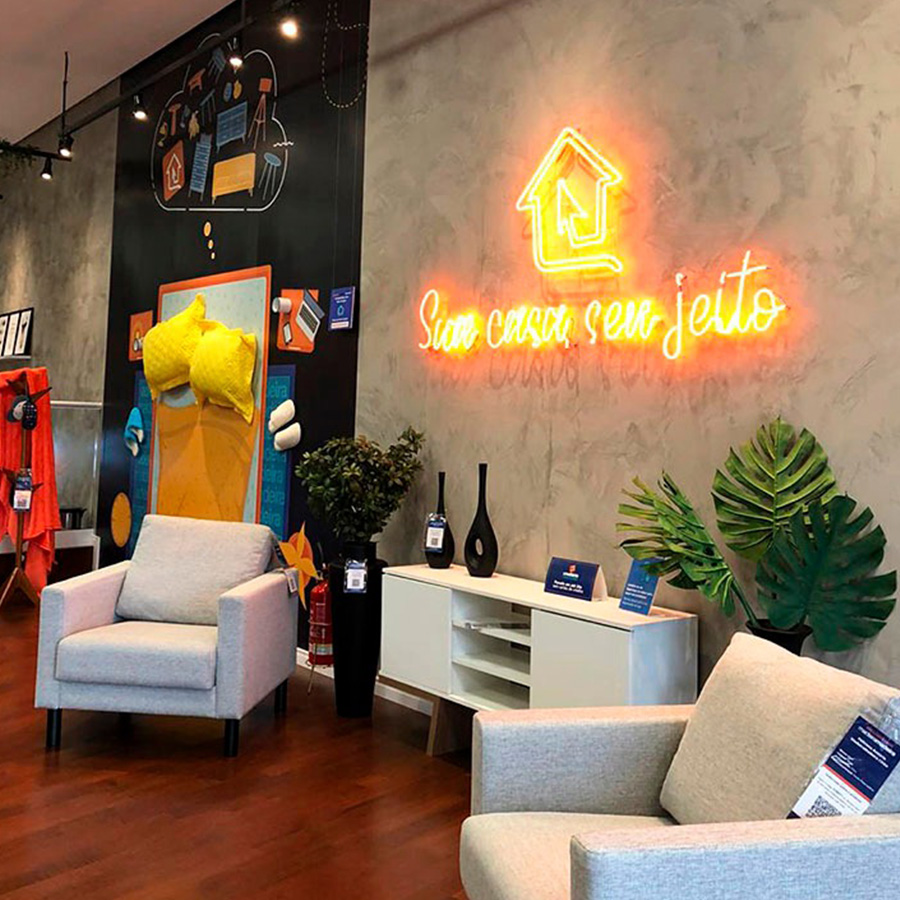
In July 2026, a Guide Shop 2.0 opened at Minas Shopping in Belo Horizonte. Customers could inspect items sold online, try Madeira Originals products and obtain free 3D projects from specialist consultants. The evolution is practical. A person furnishing a room may need help deciding how its parts fit together, as well as a way to pay for them.
Seen across those decisions, Scandian’s career has involved repeated revisions. The industrial executive became an online retailer. The retailer built software. The online business opened shops. Each revision responded to a problem in the previous arrangement. Keeping the first plan intact would have been a rather expensive form of consistency.
When speed makes the organisation slower
January 2021 brought the milestone that made MadeiraMadeira widely recognisable in startup circles: a US$190 million round led by SoftBank and Dynamo, valuing it above US$1 billion. Platform sales had increased 120% in 2020, after 80% growth the previous year. Investments previously scheduled for 2022 were being brought forward.
The figures belong to the company, rather than Scandian’s personal fortune. They also mark a moment, rather than a permanent condition. A funding announcement measures what investors are prepared to finance. The subsequent years ask whether the organisation can handle what that money makes possible.
2001Formula 3 Light championship
2009MadeiraMadeira begins
2021US$190m funding round
By March 2024, Scandian was discussing a company that had become slower as it grew more complex. Its earlier agility had been difficult to preserve. The adjustment included job cuts, fewer management layers and experienced executives joining the organisation. He compared the transition to a teenager becoming responsible for their own expenses. Growing up is an awkward metaphor for a business, which is precisely why it works.
His ambitions for an eventual stock-market listing remained ambitions. The immediate work involved efficiency and cash generation. These less glamorous subjects sit comfortably beside the origin of the company. The young retailer had learned to operate without lavish inventory funding. The larger business needed to recover a comparable seriousness about how it used resources.
“Nós pensamos muito no longo prazo, em como construir uma empresa centenária e que vá muito além dos fundadores.”
Daniel ScandianThinking about the long term: a hundred-year company that goes well beyond its founders.
A longer race, with more people in it
In March 2026, Scandian described a more mature business, with stronger processes and management. MadeiraMadeira reported 21% growth in gross revenue during 2025 and a 208% increase in EBITDA compared with 2024. The percentages measure different things: sales growth and a change in an earnings measure. They should not be mistaken for interchangeable evidence.
He linked the operating model to more than 700 suppliers and the ability to direct capital toward logistics, technology and services. The original refusal to tie up scarce cash in large owned inventories had become part of the company’s continuing explanation of its performance. The scale had changed. The financial problem it was trying to solve remained recognisable.
His personal learning has continued alongside the business. His LinkedIn profile records study at Stanford’s Graduate School of Business in 2016, 2018 and 2023, and a Kaszek Innovation and Leadership programme credential in 2025. In podcast conversations, he connects sport with recovering from a bad day and being ready for the next one. It is a modest lesson, and a useful one.
In a March 2026 video interview, he returned to the idea of an enterprise bigger than its founders. The discussion ranged from racing to management systems, including lessons drawn from Toyota and Amazon. Scandian said he did not want to become a serial entrepreneur. His ambition was to keep building this company, over a much longer stretch of time.
The championship in Brasília had an ending. A hundred-year company offers no comparable finish for the person who starts it. Other people must eventually take responsibility for the next laps. For Daniel Scandian, who began this business by finding buyers for the remains of another one, that is a concrete ambition: leave an organisation able to continue when its founders are no longer the ones driving.
Follow the conversation
Interviews, reporting and places to follow Daniel’s work.
- Daniel Scandian on LinkedIn
- MadeiraMadeira - company website
- Watch: Contramão, March 2026
- Listen: Café com ADM 248
- The factory-to-marketplace origin
- The 2001 Formula 3 Light championship
- The software behind the furniture business
- The 2024 management reset
- 2025 results and the 2026 expansion plans
- Belo Horizonte’s new guide shop
- MadeiraMadeira on Instagram
- MadeiraMadeira on YouTube