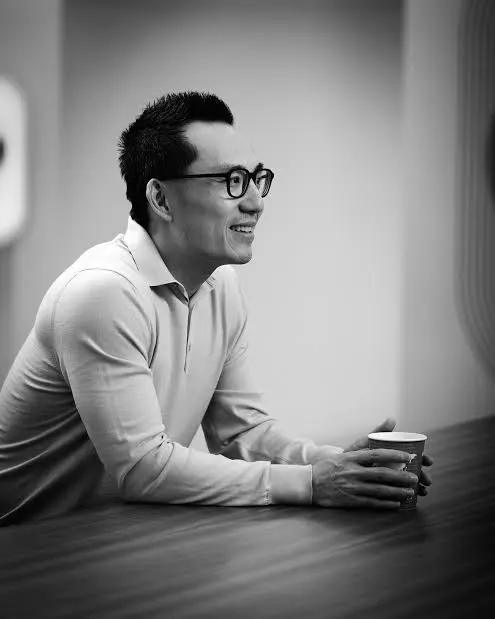
The Delivery Man at the Top of the Chain
He still makes deliveries. Not because anyone asks him to - he requires it. Every salaried employee at DoorDash must complete four delivery shifts a year, and Tony Xu leads from the front, pulling up to San Francisco restaurants in his car, picking up orders, handing them to strangers. One session, he earned $19 in tips. The man running a $100 billion company pocketed nineteen dollars and called it research.
That's the shortest possible version of who Tony Xu is: someone who refuses to let the distance between the person giving the order and the person carrying it become theoretical. Most CEOs manage delivery through dashboards. Xu managed it through dashboards and his own hands - and he built the dashboard by first using his hands.
"If you're in technology and you are not making improvements, you are actually decaying. Until it's over all of a sudden."- Tony Xu
Nanjing to Palo Alto, via a Chinese Restaurant Kitchen
Xu was born Xu Xun in Nanjing, China, in the early 1980s. His father was an aerospace engineer with a PhD. His mother was a physician. They immigrated to the United States when Xu was around four years old, and everything they had built professionally had to start over.
His mother - who speaks about her work ethic the way other parents speak about sacrifice as love - couldn't practice medicine in America. She worked three jobs for twelve years. One of them was at a Chinese restaurant. Xu, as a kid, washed dishes alongside her there. He has never stopped talking about it. Not because it was remarkable hardship, but because it was ordinary hardship - the specific, granular, unglamorous grind that the gig economy was supposedly designed to smooth out for people like her.
"DoorDash exists today to empower those like my mom who came here with a dream to make it on their own," he wrote in his IPO letter. It's a mission statement dressed up as a son's promise.
Stanford, a Website, and a Very Big Bet
Xu arrived at Stanford's Graduate School of Business in 2011 having already worked at McKinsey, eBay, PayPal, and Square. He wasn't a kid with a vague idea about disruption. He was someone who had spent years watching how systems worked and where they fell apart.
The insight behind DoorDash wasn't sophisticated. It was uncomfortable. Xu and his classmates - Andy Fang, Evan Moore, and Stanley Tang - started doing customer discovery interviews in Palo Alto. A macaroon store owner told them her biggest problem was delivery. They built a website that afternoon. PaloAltoDelivery.com was live within hours.
U.S. Food Delivery Market Share (2025)
Estimated U.S. consumer spend market share. Sources: public estimates, company filings.
They did the first deliveries themselves. Then they kept doing them. For the first year and a half, Xu personally made hundreds of deliveries, systematically mapping the process. He identified more than twenty distinct steps in a single order's journey. DoorDash's first version of driver tracking was iPhone's Find My Friends app. Not a product decision born of elegance - a product decision born of necessity, which is the only kind that usually sticks.
The Year It Almost Ended
In 2016, DoorDash had less than one month of operating runway left. The fundraising environment was brutal. Xu had spent years making deliveries, iterating on a model that still hadn't proven it could scale profitably. He called it "playing the game on extra hard mode."
They survived. The breakthrough, when it came, came from an unusual direction. While competitors were fighting over dense urban cores - Manhattan, San Francisco, downtown Chicago - DoorDash went to the suburbs. Strip malls. Chain restaurants. Families who couldn't get Uber Eats to work in Scottsdale. It turned out the suburbs weren't a consolation prize. They were the market.
"DoorDash exists today to empower those like my mom who came here with a dream to make it on their own. Fighting for the underdog is part of who I am and what we stand for as a company."- Tony Xu, DoorDash IPO Prospectus Letter
The IPO, the Board Seat, and the Jiu-Jitsu Sparring Partner
December 2020. DoorDash goes public at $102 per share, raising $3.4 billion. Xu becomes a billionaire at 36. In an on-air interview with CNBC's Jim Cramer the morning of the IPO, he talks about his mother. He doesn't talk about hockey-stick growth or TAM. He talks about his mother.
Two months later, he joins Meta's board of directors. Tony Xu - the guy who used Find My Friends to track drivers - is now in the room where Facebook's strategic decisions happen. He also trains jiu-jitsu with Mark Zuckerberg. Silicon Valley is a peculiar neighborhood.
The acquisitions came next. In 2022, DoorDash bought Wolt, the Finnish delivery platform, for $8.1 billion - its largest deal ever, giving it a presence across Europe and the Middle East. In 2025, DoorDash acquired Deliveroo for $3.9 billion, adding the UK and more than 40 countries to the map. The company that started as a Palo Alto PDF menu now operates on five continents.
What He Actually Wants to Build
Xu's stated ambition isn't delivery dominance. It's infrastructure. "For a restaurant or retailer, our aspiration is to be your first phone call, for any business issue," he told Fortune. The vision is DoorDash as the operating layer for local commerce - the thing that sits beneath every merchant, absorbing whatever problem surfaces next.
Delivery happened to be where they started. Xu is not particularly precious about that. What he is precious about is the operational reality that makes any of it work - the twenty steps in the delivery process, the driver waiting outside, the restaurant getting the order right, the customer's Tuesday night that goes or doesn't go well based on a set of variables he has mapped, timed, and run himself.
Autonomous delivery, he says, has been "filled with lots of pain and suffering." He does not make this sound like failure. He makes it sound like what happens when you take something genuinely hard seriously.
The Things That Don't Change
He named himself Tony after Tony Danza. The sitcom Who's the Boss? aired in 1984. Xu was roughly four years old, newly in America, and Danza's character was the kind of American that felt legible to a kid who needed English in a hurry. He has been Tony ever since. His parents named him Xu Xun. He picked Tony. That small biographical fact says something about how he moves through the world - practical, pragmatic, adapting without losing the thread of where he came from.
He and his wife Patti met at a church at UC Berkeley during their undergraduate years. They married in 2013 - the same year DoorDash launched. They have signed the Giving Pledge and donated substantially to UC Berkeley, Northwestern University, and AAPI community organizations.
He runs. Or used to - he has done marathons. Now he does jiu-jitsu. He watches the Golden State Warriors whenever he can. He attributes much of his English fluency to television and basketball.
The boy who learned America through a TV screen now sits on the board of the company that owns a significant slice of the American internet. He still makes deliveries. He still talks about his mother. The twenty steps in the delivery process haven't changed that much. Neither has he.