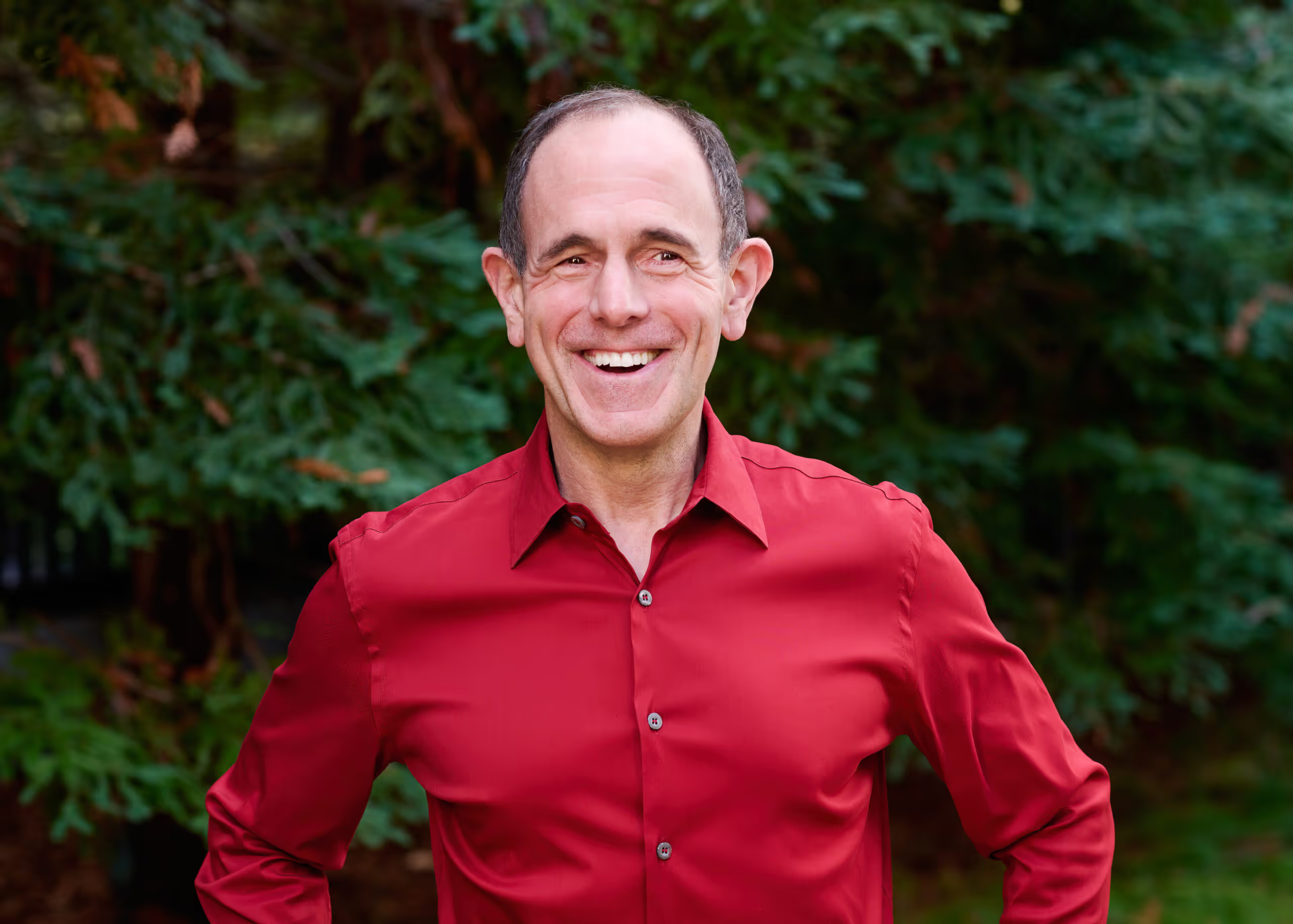
Contrarian, and Usually Right
Somewhere in Miami Beach, there is a 5,600-gallon saltwater aquarium inside a house that Keith Rabois bought for $28.9 million and listed for $65 million. That detail, more than any venture fund logo or Forbes rank, tells you something true about the man. He moved to Miami in November 2020 when moving to Miami was not yet the thing to do. He bought conspicuously. He tweeted constantly. Within months, a stranger at a Barry's Bootcamp class told him he'd relocated to Florida "because of some guy Keith on Twitter." When Rabois revealed himself, the man nearly fell off the machine.
That is Keith Rabois at work. Not the polished press release version. The loud, opinionated, occasionally combustible version who has an uncanny ability to identify where things are going - and then say so, loudly, before it's polite or comfortable.
He is 57 years old now, born in Edison, New Jersey, educated at Stanford in political science (where he met Peter Thiel and contributed to the provocateur student newspaper The Stanford Review), then at Harvard Law School with honors. He clerked for a federal appeals court and spent nearly four years at Sullivan and Cromwell before concluding that law was, as he later put it, not the place for people who want to change things. He advised Dan Quayle's doomed 2000 presidential campaign. Then he joined PayPal.
It's easy to be contrarian. It's extremely rare or difficult to be contrarian and right.
- Keith RaboisPayPal in 2000 was not yet the PayPal of legend. It was a chaotic payments startup trying to survive. Rabois joined as Executive Vice President of Business Development and Public Policy, the political fixer in a company full of engineers. Under Peter Thiel's direction, he helped navigate the regulatory and business development terrain that made PayPal's $1.5 billion eBay acquisition possible in 2002. That transaction minted the PayPal Mafia - the loose alumni network that would go on to found Tesla, LinkedIn, YouTube, Palantir, Yelp, and Yammer, among others. Rabois was a founding member.
He was the 20th employee at LinkedIn in 2005, arriving when the professional network was still a strange concept. He helped build LinkedIn Answers, developed the public profile infrastructure, and opened new advertising revenue streams before leaving in 2007. At Slide, Max Levchin's social gaming platform, he ran strategy and business development. By 2010, he had earned a reputation rare in Silicon Valley: a genuine operator, someone who had actually run things, not just advised people who ran things.
Jack Dorsey brought him to Square as COO in 2010. It was the job that positioned him for everything that followed - and the one that temporarily derailed him. In January 2013, Rabois resigned amid allegations from a male employee he had hired and had a relationship with. He called it a shakedown. Square's internal investigation found no evidence of harassment but concluded he had exercised poor judgment. No lawsuit was ever filed. The incident cost him months of public silence and nearly his reputation. He has never fully apologized in the way that would make the story go away, and it has not gone away.
The team you build is the company you build.
- Keith RaboisIn March 2013, Khosla Ventures hired him as a partner. What followed was a remarkable run. He led the first institutional investment in DoorDash, when food delivery was widely considered too crowded and commoditized. He backed Affirm before buy-now-pay-later was a category. He invested in Faire when wholesale marketplaces for independent retailers seemed like a niche bet. He had already made early personal bets on Stripe and YouTube before the world understood what they were. The thesis connecting these investments was consistent: find a large, highly fragmented industry with low net promoter scores, then vertically integrate to simplify the value proposition. He tweeted this formula like a mantra. Hundreds of business school case studies quoted it back.
In 2014, he co-founded Opendoor with Eric Wu and JD Ross. The idea - that a company could buy your house instantly, in cash, for a small fee, rather than requiring you to stage it and host strangers on weekends - sounded obvious once they said it and naive until they proved it. Opendoor went public via SPAC in 2020. In September 2025, Rabois returned as non-executive chairman when former Shopify COO Kaz Nejatian was named CEO, and promptly stated publicly that the company of 1,400 employees needed approximately 200. The remark circulated immediately. That is also Keith Rabois at work.
In 2019, he left Khosla for Founders Fund, Peter Thiel's vehicle. While there, he co-founded OpenStore in Miami - a Shopify brand aggregator that raised $75 million at a $970 million valuation at the height of e-commerce aggregator fever. By 2025, the market had collapsed. OpenStore was worth roughly $50 million. A 95% decline. He does not appear to have dwelled on it publicly. He was already back at Khosla Ventures, returning in January 2024 as one of five managing directors.
Rabois Investment Formula (Pinned Tweet)
"Find large highly fragmented industry with low NPS; vertically integrate a solution to simplify value product."
The Miami chapter deserves its own accounting. Rabois announced his move in November 2020 on Twitter, citing the density of interesting people he was meeting compared to a locked-down San Francisco. He became the loudest voice in a chorus that included Paul Graham, Palihapitiya, and eventually dozens of founders and funds. He partnered with Miami Mayor Francis Suarez, who had gone viral by tweeting "How can I help?" at the tech community. The city became, briefly, a serious alternative narrative to Silicon Valley. Some of that has faded. Rabois himself moved toward Washington, D.C. following his husband Jacob Helberg's December 2024 appointment as U.S. Under Secretary of State for Economic Growth, Energy, and the Environment.
The husband matters to the story. Rabois and Helberg married in Saint Barthélemy in 2018, in a ceremony officiated by Sam Altman - now CEO of OpenAI. They met at a TechCrunch awards event in 2015. Helberg, a China hawk and Google policy veteran, later recalled that he had no idea Rabois was "a ruby-red Republican" when they first met. Rabois is gay, openly so, and has spent the better part of a decade being politically conservative in a milieu that considers those positions incompatible. He hosted a JD Vance fundraiser for Donald Trump's 2024 campaign. He praised Florida's Parental Rights in Education Act. He defended the Israeli military in explicit terms. His feed is not a safe space.
In January 2026, after a Border Patrol agent shot American citizen Alex Pretti in Minneapolis, Rabois posted on X that no law enforcement agent had ever shot an innocent person. The comment drew immediate backlash. Khosla partner Ethan Choi publicly distanced himself. Then Vinod Khosla - the firm's founder and his employer - posted publicly that the remarks reflected "Macho ICE vigilantes running amuck empowered by a conscious-less administration." A VC firm founder publicly disavowing a managing director's comments is not a thing that happens often. It happened. Rabois is still at Khosla Ventures.
Every successful company is a cult. What a cult really means is you have a view about the world that's different than other normal people, and you're right.
- Keith RaboisWhat makes him genuinely useful to founders is harder to describe. There are plenty of investors who once ran operations. Fewer who can recall, in real time, what it felt like to be in the middle of a decision matrix with incomplete information, under time pressure, with people watching. His 2014 Stanford lecture, "How to Operate," delivered as part of Sam Altman's How to Start a Startup course, has been cited in more startup decks than most investors' total output. The core frameworks - manager as editor not writer, barrels versus ammunition, task-relevant maturity, the decision matrix - are taught in business schools now. He gave the lecture for free, on camera, at Stanford. He did not write a book.
The barrels-versus-ammunition model is the one that spread farthest. His argument: most employees are ammunition - skilled, capable, ready to be loaded and fired. But rare employees are barrels - the people who can take a project from abstract idea through ambiguity to completion without being managed, who expand the throughput of an entire organization. The job of a CEO, Rabois argued, is to find barrels and then figure out what to do with them. Ammunition, no matter how much of it you have, cannot substitute.
He applied this framework to his own investment practice. On Lenny's Podcast in 2025, he predicted that AI would eliminate the product manager role entirely - not reduce it, eliminate it. The claim generated hundreds of responses. He did not walk it back. That particular combination - specific, falsifiable claim, stated with complete confidence before the evidence is in - is the Rabois signature. He has been wrong. He owned OpenStore for three years while its valuation fell 95%. But his hit rate on large calls - DoorDash, Affirm, Stripe, Opendoor, the Miami bet - is high enough that the market, and the press, and 421,000 followers on X keep paying attention.
His investment in Roam, the assumable-mortgage startup, in April 2025 - the latest expression of his housing thesis, post-Opendoor - was described by him as "the future of the housing market." He has made that kind of statement before. The aquarium in Miami Beach has already been sold, or will be. The next address will be Washington, D.C. The opinions will travel with him.
How to Operate - The Frameworks
Stories Worth Knowing
After moving to Miami in late 2020, Rabois began attending Barry's Bootcamp classes - not for the workout, though the workout was useful, but for the density of interesting people he was meeting. At one class, someone told him they'd moved to Miami "because of some guy Keith on Twitter." Rabois said that was him. The person was stunned. He later tweeted the story. It crystallized something: Twitter had become Miami's tech recruiter, and Rabois was running it without an office.
Keith Rabois and Jacob Helberg married in Saint Barthélemy in 2018. The ceremony was officiated by Sam Altman, now CEO of OpenAI. At the time, Altman was running Y Combinator. Helberg later recalled being surprised to discover that Rabois - the interesting, mysterious man he'd met at TechCrunch's Crunchies awards in 2015 - was "a ruby-red Republican." They married anyway. The wedding itself became a kind of accidental snapshot of Silicon Valley's social architecture: a gay Republican VC, a China hawk policy expert, and the person who would later build GPT, bound together in a ceremony on a French island in the Caribbean.
In 2020, Rabois purchased a waterfront home in Miami Beach for $28.9 million. The home was roughly 15,000 square feet. Among its features: a 5,600-gallon saltwater aquarium. In early 2025, after Helberg's appointment to the State Department, the couple listed the property for $65 million - a 125% premium over the purchase price. The aquarium came with the house. Whether the aquarium stayed with the buyers is unknown.
In January 2026, following a Border Patrol agent's shooting of American citizen Alex Pretti in Minneapolis, Rabois posted on X that "no law enforcement has shot an innocent person." Khosla partner Ethan Choi posted a public distancing response. Then Vinod Khosla - founder of Khosla Ventures, Rabois's employer - posted: "Macho ICE vigilantes running amuck empowered by a conscious-less administration." A VC firm founder publicly disavowing a managing director's comments in real time, on the same platform, in the same news cycle, is a rare event. Rabois did not leave the firm. The posts remain on X. The work continues.
Personality at Work
The throughline from PayPal to Khosla is not money or logos. It is the conviction that the interesting bet is always the one the market has not yet made. DoorDash when food delivery was "too crowded." Opendoor when iBuying was unproven. Affirm before BNPL was a category. Miami before Miami was a category. Roam and assumable mortgages before anyone had explained them to a mainstream audience. Being contrarian is easy. He says it himself. Being contrarian and right is the job. The record suggests he has done it more often than not.