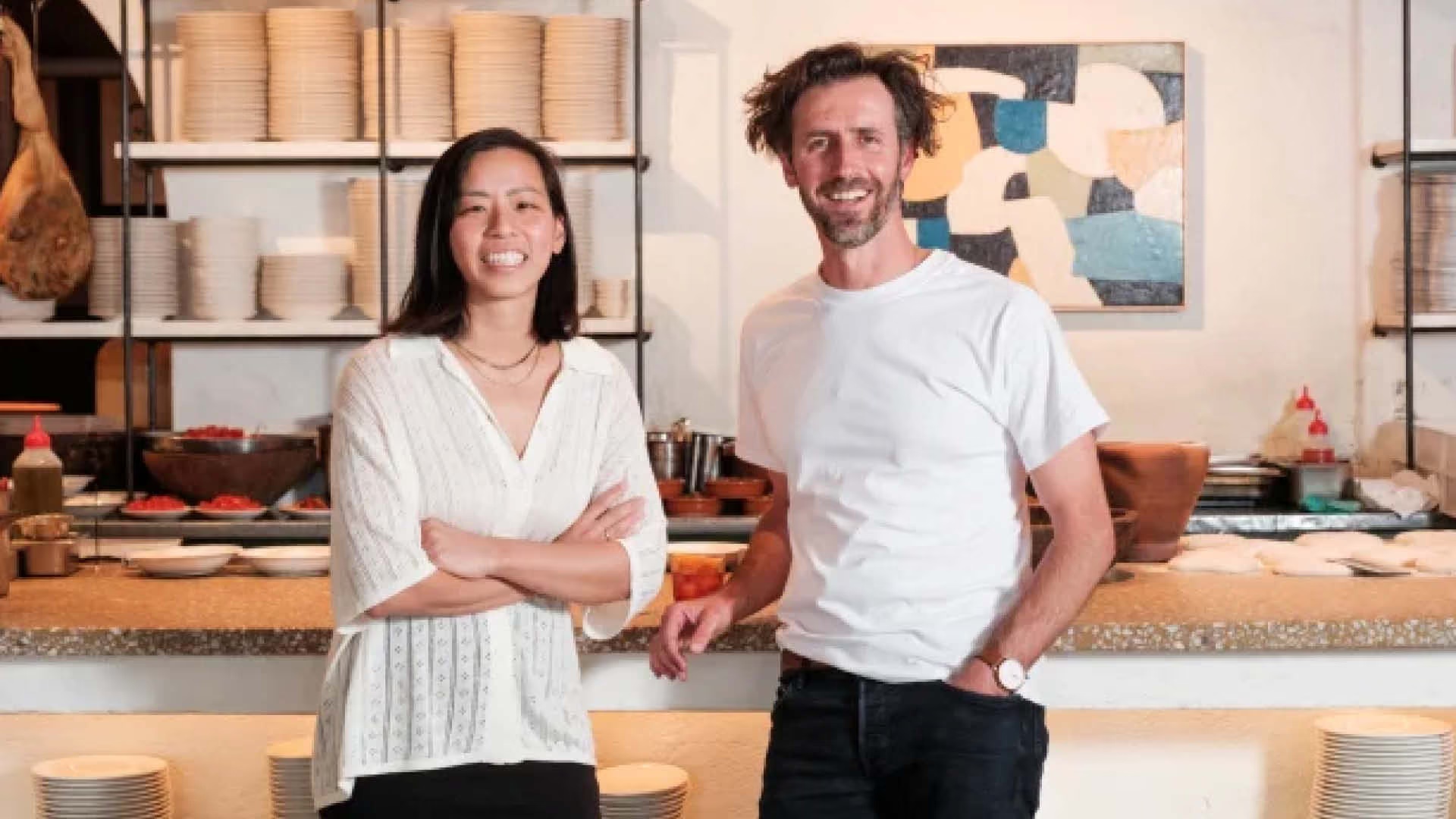
At a restaurant in Sydney in February 2023, Kim Teo sat down with a competitor. For years, her company, Mr Yum, and Stevan Premutico’s me&u had pursued the same hospitality customers. Now they were sharing a table at Totti’s. There are businesses in which a dinner with the opposition would seem an odd way to begin a negotiation. In hospitality technology, at least somebody had chosen an appropriate meeting room.
The conversation helped set a merger in motion. By November, Teo would lead the combined company under the me&u name. For a founder who had spent years persuading venues to choose Mr Yum, that required a substantial change of mind. It also gave her a new version of a familiar problem: how to bring people together around something they had not yet learned to want.
Her career has repeatedly turned on that question. A corporate job, an unlaunched food business, a menu full of pictures, a rival turned colleague. The continuity lies in her willingness to reconsider the mechanism while holding on to the ambition. Dinner, in this story, keeps being more consequential than it looks.
Before the menu, the family table
Teo was born in Singapore and lived in several Australian cities while growing up and through her twenties. At home, her parents’ businesses were part of the dinner-table conversation. Entrepreneurship arrived as something people actually did, with all the practical complications that implies. It was close enough to observe before it became a career choice.
She graduated from Monash University in 2009, took a graduate role at JP Morgan, and worked in management consulting. Alongside that corporate path, she tried Simply Borrowed, a bridesmaid dress rental business. In 2015 she met Adrian Osman and Kerry Osborn. Together they developed Neighbour Flavour, intended to connect home cooks with buyers. The economics failed to work; the product never launched.
The three went on to establish Pitchblak, helping other early-stage founders work through their ideas. Mr Yum emerged from that environment. Failure had left them with collaborators and a better set of questions. A project can end without making everything spent on it useless. In Teo’s case, the next business began with people who already knew how the others worked.
A menu for people with eyes
The original insight was wonderfully ordinary. Printed menus asked diners to choose from words, while diners were already looking at pictures on Instagram or inspecting dishes across the room. Teo called the habit “food perving”. This is an unusually accurate description of restaurant behaviour, and rather more cheerful than calling it consumer research.
Mr Yum launched in late 2018 with Teo, Osman, Osborn and technical co-founder Andrei Miulescu. A visual menu could put the photograph beside the dish, without requiring guests to download an app. The phone was already there. So was the curiosity. The work was to shorten the distance between them.
Venue operators then asked for ordering and payment through the menu. In Teo’s account, their needs expanded the idea beyond attractive pictures: margins were tight, labour was expensive, and efficiency mattered. Her early responsibilities included product and partnerships. The apparent simplicity of the customer interface concealed a much larger negotiation with the people serving the food.
That distinction matters to understanding her. She was listening to both sides of the table. A diner wants to see the chips. An operator wants the order to arrive in the right place, paid for, without creating another task. A photograph gets attention; a working service earns a place in the restaurant.
Nine days to move outside the dining room
In 2020, venue closures exposed how narrowly Mr Yum’s revenue depended on people sitting inside restaurants. Teo described the business at that point as entirely focused on in-venue table ordering. When venues lost their trade, the company lost its revenue too. The same dependence that had made the product useful now made its future precarious.
The team built delivery and pickup features in nine days. That is the sort of number that usually gets polished into a founder legend. Its practical meaning is more interesting: the company had to make the product useful at a moment when its original setting was unavailable. Customers still needed to sell meals, but the route from kitchen to guest had changed.
A restaurant technology company has little room for elegant delay when the restaurant itself is waiting. This episode explains the value of a small team with a specific problem in front of it. There was no need to invent a new appetite. There was a need to connect an existing appetite with businesses trying to keep trading.
A capital raise, and a pink couch
In November 2021, Mr Yum announced a US$65 million Series A, reported at the time as AU$89 million. Teo’s own account of the process included more than 100 Zoom calls and investor meetings across American cities and London. Much of the raise began while Melbourne and Sydney were closed to normal trading, leaving recent revenue a poor advertisement for the long-term plan.
The more intimate detail was a small, uncomfortable pink couch in London. Teo and Osman, her partner in business and life, spent hours there deliberating towards the end of the process. Her description included laughter and tears. Finance had become a domestic scene, with inadequate seating.
An announcement compresses all that work into a currency symbol and a number. The couch restores the human scale. A funding round asks founders to sell confidence while privately sorting through consequences. More money expands what a business can attempt. It also raises the cost of being mistaken. Teo’s later comments about capital efficiency make more sense with that earlier exhilaration in view.
The spreadsheet was less photogenic
Asked in 2022 about her biggest mistake, Teo pointed to the absence of a central data system and the delay in building an operations function. Sales and account management had been reporting separately. Information was scattered across systems. A business selling a smoother customer journey was discovering the inconvenience of its own internal handoffs.
It is a revealing admission because it lacks the glamour of a failed expansion or a dramatic product bet. Disconnected reporting produces quieter trouble: people spend time reconciling numbers, decisions become harder to compare, and capital is allocated with an incomplete picture. She said clearer metrics could have helped distinguish priorities from pleasant extras.
Her lesson was about the machinery that makes other people effective. Operations and enablement roles could remove work from founders’ plates and keep the organisation moving. The menu might look good in a demonstration; nobody applauds a reconciled dataset. Yet a company eventually has to make its internal decisions with the same care it gives the experience it sells.
Learning which version of the CEO to be
When Michael Batko asked how she did the CEO job, Teo answered: “I just wing it.” The remark was funny because the explanation that followed was so deliberate. She described a role that changed as the company changed, requiring her to adjust pace, messages and behaviour. Sometimes the team needed encouragement; sometimes it needed a firmer encounter with reality.
She also distinguished between places moving at different speeds. An established operation and a newer international team could not always make decisions on the same timetable. Leadership, in that account, required judging the situation rather than distributing one preferred style everywhere.
Her approach to mentoring follows a similar logic. She has described sharing the reasoning and data behind decisions so people can develop their own judgement. Earlier in her career, leaders had promoted her into roles she did not yet feel ready to fill, then backed her. That experience gave her a concrete model of confidence being lent before it was earned.
There is candour in how she talks about colleagues, too. She has credited Osborn with teaching her to be more gracious and described herself as still learning. Teo has also challenged the assumption that women founders are non-technical. For someone whose remit included product, the assumption erased work that was central to the business.
“I just wing it.”Kim Teo, on doing the CEO job
The rival becomes part of the team
The merger completed on November 29, 2023. At the announcement, the companies said they worked with more than 6,000 food brands and processed over $2 billion in annual dining transactions. That transaction figure describes money flowing through the platform, rather than company revenue. It is a measure of how many meals and drinks the software had become involved in.
Ending the rivalry did not end the work. Teams, systems and customers had to be brought together. Teo later described a costly first year, followed by profitability in the second half of 2025. In her March 2026 account, more than 1,000 venues had been migrated onto the continuing technology platform.
The cultural changes were tangible: a shared Slack space, a fresh identity in the offices, and values developed with staff from both businesses. These were ways to give the merged team something to join together. For Teo, the strategic test was whether the combined network could support products neither side could build alone. Putting two names on one slide would have been the easy part.
Back to the beginning, with a larger table
By August 2026, that product ambition had reached reservations, an AI voice assistant and function management. Teo said the new me&u Res product had been developed from an idea in a text message over roughly a year, financed from revenue while the business remained profitable. She credited engineers and hospitality partners, including Solotel and Artemus Group, for helping shape it.
The premise had widened from the moment of ordering to the moments surrounding it. A booking, a telephone enquiry, a function and a meal all involve the same guest, yet operators often manage them through separate systems. Teo’s current bet is that bringing those encounters together will make the work more manageable.
That bet also changed how the team worked. In an August interview, she described an April pause in non-essential engineering and product design so staff could learn and experiment with AI tools. The point was to make a new working method familiar inside the company. Even rapid development still needed people to understand what they were doing and why.
Teo began with the observation that people wanted a better look at dinner. She now runs a business trying to remember more of the evening. The questions have grown, along with the number of people who must agree on the answers. Her story keeps returning to a table: somewhere to notice a problem, reconsider a rival, or work out the next thing together.
Continue the conversation
- me&u
- Kim Teo on LinkedIn
- Monash biography
- The original product and international growth
- The capital raise, in her own words
- The biggest-mistake interview
- The changing CEO job
- The merger and company culture
- Her 2026 merger retrospective
- The August 2026 interview
- Watch: international growth conversation on YouTube
- Watch: the Series A interview on Vimeo
- Watch: personalised dining on Vimeo