At lunchtime in the City of London, Vita Mojo once asked office workers to do something odd: build lunch like a spreadsheet. Choose the ingredients. Adjust the grams. Watch the calories, macronutrients and price move on screen. Pay without cash. There was no cashier to misunderstand the extra avocado because there was no cashier at all. The result was a healthy bowl, certainly, but the more consequential thing being assembled was hidden behind the counter - a piece of software that knew the menu, the customer, the payment and what the kitchen should make next.
Nick Popovici and Stefan Catoiu, high-school friends who founded Vita Mojo in 2015, opened three restaurants and used them as working laboratories. Popovici came from finance; Catoiu had experience including organic farming. They added chef Paul Davies and nutritionist Helene Patounas to the early consumer proposition. Their premise was personal: if people could customise dinner at home, why should a restaurant force everyone into the same fixed dish?
The first version cost more than nerve. A 2017 crowdfunding campaign reportedly raised £1.6 million, passing its £1.5 million target within a day. Customers were among the investors. The company had three leases, kitchens, ingredients, staff and the pleasingly brutal feedback loop of a noon queue. What it did not have was the luxury of treating a frozen screen as a minor bug.
The first product was lunch. The keeper was control.
The restaurants were not presented as a failure. They did something more useful: they revealed a larger market. Other hospitality operators saw the kiosks, ordering flow and kitchen logic and asked to license the technology. Vita Mojo initially added software customers alongside its own venues. Demand from those operators changed the founders' minds about what company they were building. By 2019, the restaurants had closed and the team was concentrating on software.
That distinction matters. This was less a rescue from an unwanted product than a decision to follow the part customers pulled hardest. The original nutrition-heavy idea narrowed into a broader, less glamorous problem: modern restaurants had accumulated a thicket of tills, delivery tablets, menu tools, loyalty systems and kitchen screens that often disagreed with one another.
Many doors in. One order record underneath.
Vita Mojo's answer is a cloud platform spanning point of sale, self-service kiosks, web and mobile ordering, click and collect, delivery aggregation, menu management, kitchen displays, loyalty and analytics. A price change can begin in one central menu rather than being retyped into several systems. An order from a kiosk and one from Deliveroo can arrive in the same kitchen flow. Customer behaviour from different touchpoints can land in one record.
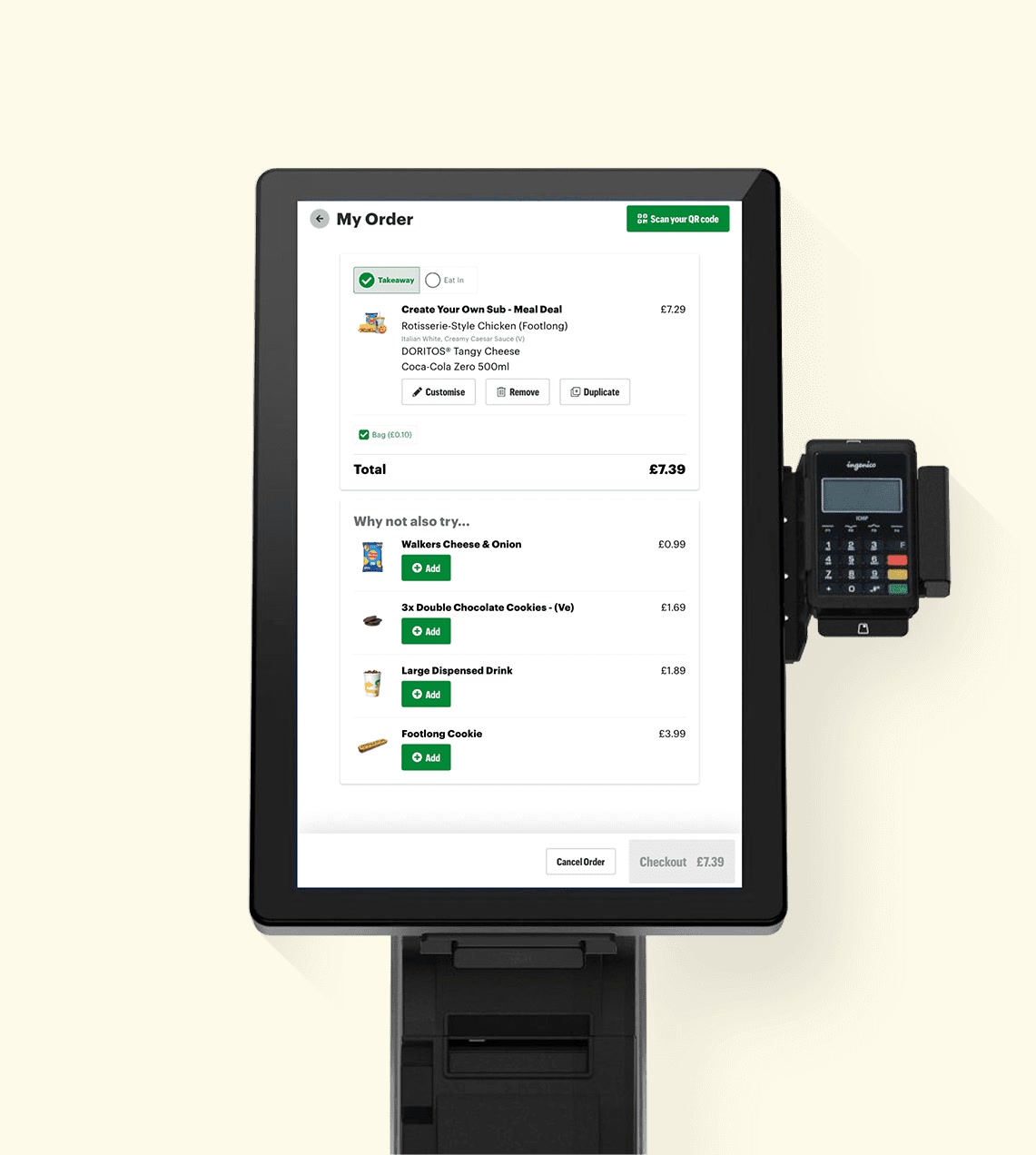
The kiosk is the shop window, not the moat
Kiosks photograph well. The defensible argument sits behind them: a shared data model and fewer hand-offs. DF Tacos offered a neat example of the alternative. Its customer-facing ordering software looked good, but errors bounced between the POS supplier and digital-ordering provider. Menu changes had to be repeated two or three times. Nobody quite owned the problem. Vita Mojo's pitch is accountability as much as functionality - one onboarding team, one operating layer and fewer vendors pointing across the room.
That puts the company between broad POS suites such as Toast, Lightspeed, Oracle MICROS and Square, digital-order specialists such as Flipdish and QikServe, and connective products such as Olo and Deliverect. Vita Mojo is not simply a payments company or a kiosk designer. Its wager is that a growing QSR would rather make one system the operational spine than employ people to reconcile a collection of good but separate products.
The audience is specific: multi-site quick-service and fast-casual brands with enough channels and locations for fragmentation to hurt. Vita Mojo says it now works across more than 3,100 locations for over 150 brands. Its customer list includes LEON, YO!, GAIL's, Honest Burgers, Black Sheep Coffee, Wenzel's and The Salad Project. Subway chose it for self-order kiosks in the UK, Finland and Germany after a selection process lasting almost three years, then added kitchen displays and order-ready screens.
Proof arrives in percentages, with caveats
Restaurant tech is sold in the dialect of average order value, throughput and labour. Vita Mojo's published case studies speak it fluently. CUPP reported a 9.7 percent rise in average order value. Tossed reported 21 percent. HOP Vietnamese reported a 35 percent reduction in labour costs. Cornish Fish & Chips connected Vita Mojo transaction data to Impact Data's TalkBox marketing system and reported £39,126.92 in gross sales from 1,336 redeemed vouchers over six months.
Those numbers are evidence, not a rate card for destiny. They come from different brands, configurations and baselines. Kiosks can raise spend because the screen consistently suggests extras and gives customers room to browse. They can also move work rather than remove it: a faster ordering channel is useful only if the kitchen, collection point and menu design can absorb the new demand. A screen that creates a queue of unmade burgers has merely moved the queue indoors.
Pricing is not public. Vita Mojo sells through demos and tailored implementations, so the real cost depends on locations, product modules, hardware, integrations and rollout support. The business model is recurring B2B cloud software, professional services and paid additions. Scout, its newest AI analyst, is an add-on for Analytics Pro customers. The company raised a $30 million Series B led by Battery Ventures in June 2022 to develop the product and expand geographically. No current valuation has been disclosed.
The operating system has started asking questions
In 2026, Vita Mojo moved up a layer. VM Hub replaced two older management panels with one self-service place to change settings, schedule updates, inspect history and restore earlier versions. Scout lets an operator ask ordinary questions of cross-channel data: which locations profit from the final trading hour, why Tuesday fell, which product deserves promotion. It shows its reasoning rather than returning only a polished answer. The next planned step, Smart Menu, aims to alter what customers see according to signals such as time, place and weather.
This is a logical extension of the original restaurant. The 2015 interface let a customer interrogate lunch - more protein, fewer calories, what happens to the price? Scout lets the operator interrogate the estate. The raw advantage is not the chat box. It is that the system already contains the menus, transactions, channels and locations that a generic AI tool would need someone to gather and explain.
What another founder can steal
Vita Mojo's method is wonderfully concrete. First, build beside the job, not beside a whiteboard. Second, measure the bottleneck: queue length, preparation capacity, repeated menu edits, abandoned orders. Third, watch for outside pull. The decisive signal was not applause for a futuristic restaurant; it was other operators asking to buy the machinery. Fourth, be willing to drop the photogenic business for the scalable one.
It travels when...
The problem repeats across many locations, one data model can serve several channels, the buyer values fewer integrations, and the team can support a high-stakes rollout.
Leave the stack alone when...
A venue is small and simple, the existing tools work, switching risk exceeds the savings, or specialist systems matter more than one-vendor accountability.
There are conditions where the model will not work. A single independent café with one till may gain little from an enterprise operating layer. Operators outside Vita Mojo's core UK and European footprint should examine support and integration coverage. Inventory, stock and some CRM functions rely on partners, so “one platform” does not literally mean one piece of software for everything. And consolidation creates its own concentration risk: when one system becomes the spine, its uptime, offline behaviour and support response matter more.
That may be why Vita Mojo talks so much about peace of mind. In 2024 it says median support-ticket resolution time fell 68 percent, while the team shipped 58 ideas submitted by clients on a fortnightly release cadence. The product is being sold into a room where a five-minute outage is not an abstract service-level violation. It is a line of hungry people watching the screen.
Vita Mojo's story lands because the pivot did not erase the first company. The old restaurants remain inside the software: the impatience of the lunch crowd, the awkward modifier, the kitchen counter, the customer who wants no cucumber and extra chicken. The bowls disappeared. Their operational memory became the product.