An unavailable menu item is a small thing, until someone tries to buy it. At True Food Kitchen, guests could put unavailable food into their online baskets. Some orders then failed to transmit. The restaurant had attracted a customer, inspired a choice and reached checkout, only to lose the sale at the point where software was supposed to help.
- Olo connects restaurant ordering, payments, delivery and guest marketing.
- Its specialty is coordinating the systems behind multi-location brands.
- The practical lesson: count failed transactions before chasing more traffic.
This is a revealing place to begin a company story. Restaurant technology is usually presented through the diner’s screen: handsome food, a convenient button, a cheerful confirmation. Olo’s opportunity sits behind that screen. Somebody has to make the menu agree with the register. Somebody has to get the ticket into the right kitchen.
A checkout is a chain of promises
True Food Kitchen already used Olo infrastructure but had a custom ordering experience layered with other tools. Its difficulties persuaded it to move to Serve, Olo’s branded ordering front end. The rollout took under 90 days. In Olo’s published case study, the restaurant reported an 8.5% sales increase and a 52% reduction in ordering errors. Those are customer results, rather than a controlled experiment; the combination of changes matters.
The useful insight is the sequence. A restaurant might respond to disappointing digital sales by buying advertising. Here, the machinery needed attention first. More visitors cannot repair a broken checkout. An operator can copy the diagnostic: inspect unavailable items, transmission failures and abandonment, then decide whether the problem is demand or the path demand must travel.
Portillo’s offers a second version of the lesson. It moved from a custom front end to Serve in early 2022 and optimized its menu, including default item sizes. Olo’s case study reports that cart conversion doubled. The lesson is useful precisely because it is unromantic: a default selection and a shorter route to payment can be business decisions. An operator testing similar changes should measure completed baskets alongside average tickets, rather than assuming a prettier interface explains the result.
The coffee arrived before the iPhone
In 2005, Noah Glass founded Olo around a straightforward question: could someone order and pay for coffee by phone, then collect it on arrival? This was before the iPhone. The attractive part was skipping the wait. The difficult part was everything required to make the coffee ready.
Today, Olo sells that coordination to restaurant brands. Its September 2026 announcement described more than 800 brands, over 90,000 locations and 3.5 million daily orders. The company’s expertise is the awkward meeting point between software and a physical business: franchise menus, payment authorization, delivery handoffs and a kitchen that cannot accelerate merely because a website accepts another order.
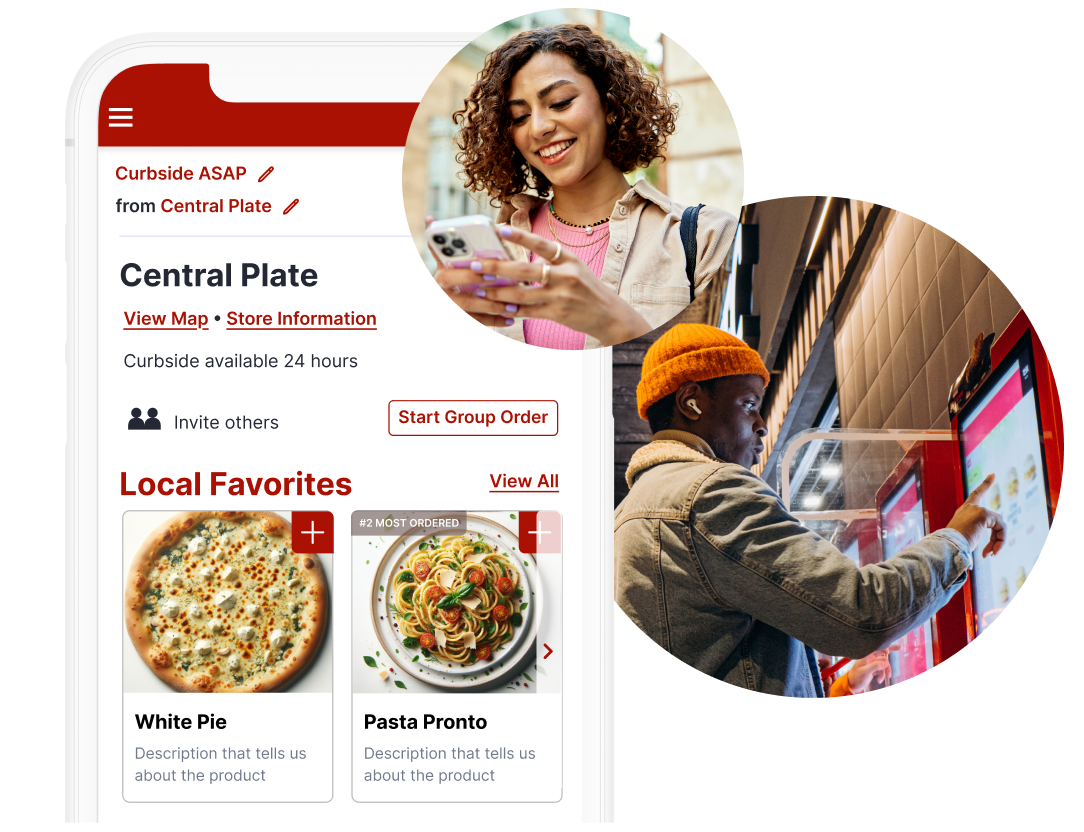
Several doors. One kitchen.
Ordering supplies the underlying digital ordering system. Serve gives restaurants a configurable storefront. Rails connects marketplace orders to restaurant systems; Dispatch coordinates delivery for orders placed through a restaurant’s own channels. The distinction is easy to miss. One brings an outside order in. The other sends a direct order out.
Pay adds payment processing and fraud controls. Guest data and marketing tools help restaurants recognize people across visits. Catering+ handles large orders; Host covers reservations and waitlists. Olo extended the relationship further by acquiring loyalty provider Spendgo in December 2025, following its earlier purchase of guest-intelligence business Wisely.
The market offers other routes. Toast combines online ordering with its POS ecosystem. PAR sells ordering and guest engagement software. Restaurants can also build their own experience. Olo’s positioning rests on connecting an existing collection of tools: its current materials describe over 450 integration partners. For a chain with established systems, that flexibility can make the choice consequential.
The bill behind the button
Olo earns subscriptions and transaction fees. Its June 2025 filing described contracts typically starting at three years or longer. Order and Engage contribute subscriptions; Pay and ecosystem services contribute transaction revenue. Selling at brand headquarters lets Olo reach many locations through one commercial relationship. Expansion can mean another module, another restaurant opening or more transactions.
There is an appealing number on Serve’s product page: zero setup and ongoing maintenance costs for the front end. The scope matters. Restaurants still need the underlying ordering service and must evaluate payment and other contracted charges. A sensible comparison includes integration work, support, processing and internal engineering time. A storefront price alone cannot tell an operator what dinner costs to sell.
“We’re saving a great deal on chargeback costs”John Paul Thomas · VP of Operations, honeygrow · quoted by Olo
Simplicity had an internal cost
Olo has encountered its own coordination problem. In June 2023, Glass told employees that a business-unit structure adopted after Wisely and the launch of Pay had introduced complexity and duplicated work. The company reorganized around Order, Pay and Engage, eliminating 81 jobs, or 11% of its workforce. Connecting products on a sales page had proved easier than organizing the people behind them.
The business kept growing. Revenue reached $284.9 million in 2024. Thoma Bravo completed its acquisition in September 2025 for roughly $2 billion in equity value, paying shareholders $10.25 per share. Olo ceased trading publicly. That was a purchase of the company, rather than a $2 billion funding round for its operations.
Who gets the next visit?
In 2026, Olo advanced a shared-network proposition: an app where guests can order across restaurant brands while those brands retain guest data. Olo advertises commission-free orders through the app. It is an attempt to combine discovery with a direct customer relationship. The unresolved commercial test is whether diners will make room for another ordering destination.
The same limit applies to the broader platform. Connected software helps when systems and checkout are the constraint. It cannot cook an unavailable ingredient, create kitchen capacity or guarantee repeat visits. The durable lesson is smaller and more useful: trace the order all the way through. A restaurant has not earned the next dinner simply because it won the first click.