The next time a kiosk politely asks whether you would like fries, consider the machinery behind the question. The screen knows the menu at this location, which modifiers are legal, what the kitchen can accept, how you want to pay and, perhaps, which extra you are most likely to add. It must send a clean ticket to a point-of-sale system that may predate the iPhone. Then it must remember enough to make your next visit easier without making the experience creepy. Tillster lives in that gap between a tap and a meal.
The Los Angeles company sells enterprise restaurant commerce software to multi-unit chains. Its platform connects self-service kiosks, branded websites and mobile apps, delivery marketplaces, menus, payments, loyalty programs, promotions, customer data and analytics. Burger King, Baskin-Robbins, Jollibee, Godfather's Pizza and Pollo Campero are among the customers it names. Today, Tillster says it supports more than 100 global and regional brands, 40,000-plus locations and more than 180 million orders a year.
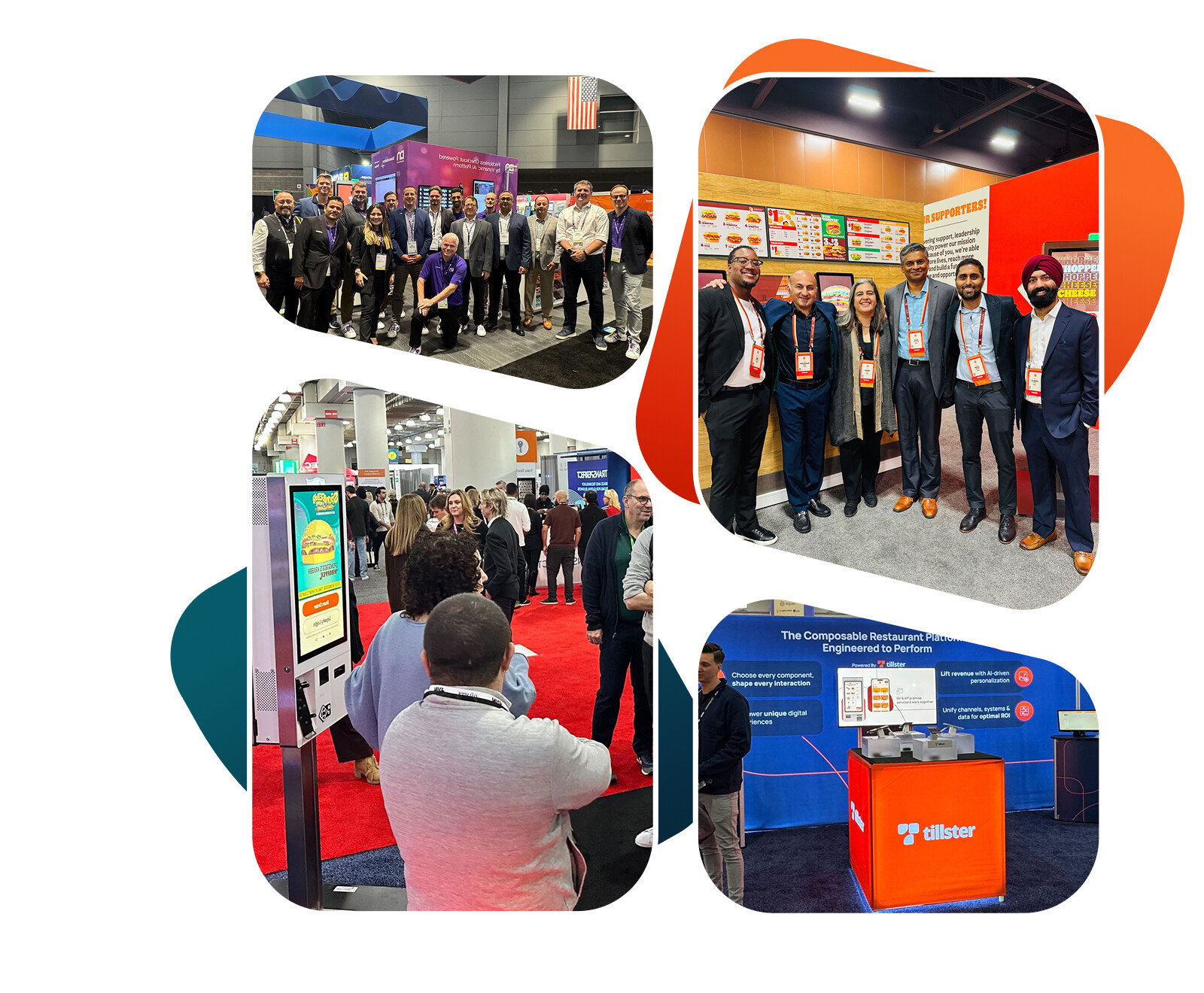
The screen was only the opening course
Tillster's ancestor was EMN8, founded in 2002 by designer and entrepreneur Paul Sidlo to build interactive self-service systems. The original problem was physical and immediate: automate ordering and payment at the point of transaction while giving large brands better control of what appeared on the screen. In 2013, EMN8 acquired Snapfinger, an online-ordering specialist, and the combined operation adopted the Tillster name that November.
That acquisition tells the company story better than any slogan. The restaurant was escaping the restaurant. Orders were moving onto browsers and phones, then delivery marketplaces. A vendor that stayed attached to a kiosk would see only one slice of the customer. Tillster followed the transaction outward, then connected the pieces inward. It added mobile and web ordering, delivery orchestration, loyalty and a customer-data layer while keeping the in-store system as part of the same map.
Web
App
Payment
Kitchen
Profile
Loyalty
Order
The distinction matters in a crowded market. Restaurants can buy ordering from Olo or Lunchbox, loyalty from Paytronix, Punchh or Thanx, and point-of-sale software from Toast, PAR or Oracle. They can also stitch those products together. Tillster's pitch is that a brand can activate one module or the entire stack, keep its own visual identity and connect existing systems through open APIs. Its integration catalog spans modern cloud products and the sturdy old POS families still humming under thousands of counters.
“Technology should have maximum utility.”Perse Faily, Tillster CEO
What they actually changed
A Tillster case study involving an unnamed national fast-casual chain is unusually concrete. The company redesigned navigation through a large menu, built mobile ordering, localized stores and menus, and folded rewards into the app. It then used behavioral data for email and push campaigns. Over 15 months, the client reported a 500 percent gain in digital revenue and 2.5 times as many online customers and transactions. Half of order errors disappeared, and 75 percent of main items produced more revenue per item.
The clever part is also the copyable part: Tillster did not begin with a grand demand for more engagement. It removed friction from a sprawling menu, collected useful events and communicated when those events suggested an actual reason. In one campaign described by data partner Twilio Segment, recording a cake purchase and its timing allowed a restaurant brand to send a reminder near the next likely celebration. Cake repurchase more than tripled. A different campaign offered bonus points to try mobile ordering and produced a greater than 50 percent increase in adoption.
By 2026, the method had become more surgical. Tillster ran a “frequency challenge” across three quick-service brands, three countries and more than 40,000 participants. Rather than discounting every order, the campaign rewarded incremental behavior. People who completed the challenge were 2.3 times more likely to increase their ordering frequency; 75 percent ordered above their own average, creating more than 6,000 additional orders. Coupon redemption was 10 percent, concentrating promotional cost among the customers who did the desired thing.
What failed first: the assumption
Restaurant technology often fails before the software does. A franchise operator using Tillster kiosks in a rural market expected an older customer base to resist the machines. The first move was not an algorithm. For 30 to 40 days, the operator stationed an employee by the kiosks to invite people out of the line and guide them through an order. Repeat visits turned instruction into habit; the operator reported that customers came to prefer the kiosk.
That episode supplies the missing cost line in many software proposals. Tillster does not publish standard pricing, and an enterprise contract can bundle software, integrations, implementation, support and optimization. But the invoice is not the whole expense. Adoption costs staff time. Integration costs attention from technology and operations teams. A beautiful upsell flow is worthless if the kitchen cannot absorb its promise time or a store manager cannot tell that one screen has gone dark. Tillster's newer Beacon app, shown in 2026, monitors kiosk health because the glamorous interface eventually becomes a fleet-maintenance problem.
Instrument meaningful events, not every twitch. “Cake purchased” plus timing can be more useful than a swamp of undirected clicks.
Put a person beside a new interface until the behavior becomes ordinary. Rollout is part of the product.
Reward incremental behavior instead of subsidizing orders customers already intended to place.
Keep one source of menu and order truth, then let each channel express the brand without inventing its own data.
AI that remembers it works in a restaurant
Tillster uses AI and machine learning for recommendation and optimization, but the practical version is less cinematic than the label. Basket contents, time of day, location and a known guest's history can determine whether the useful suggestion is a drink, a side or nothing. Based on 2025 client performance, Tillster reports an average 24 percent check-size uplift from AI-powered recommendations and a 33 percent conversion increase from data-science optimization. Its kiosk page reports a 26 percent average ticket increase from intelligent upsells. These are documented client outcomes, not promises that every deployment will reproduce them.
The company's advantage is context. A generic recommendation engine can predict that people like fries. A restaurant-aware system must know the fries are unavailable at one store, incompatible with one meal, slow during the rush, differently priced in another country and already included in the customer's bundle. Tillster can pull those decisions across ordering, menu, POS and customer systems. The intelligence is valuable because the plumbing is there.
When this playbook does not work
Tillster is built for chains with multiple locations, channels and systems. A single independent restaurant seeking a cheap, instant ordering page may be buying an aircraft carrier to cross a pond. The platform also cannot rescue weak food, bad service, inaccurate menus or a rollout that leaves guests to teach themselves. Personalization fails when the data is thin, permissions are careless or the offer feels more watchful than helpful.
Where Tillster fits now
Tillster sits between narrow point solutions and the fantasy of replacing everything. That middle is commercially attractive and operationally uncomfortable. Every new channel creates another integration, every country adds payment and language requirements, and every restaurant brand insists that its app should not look like everybody else's. The company answers with modular software, brand-specific interfaces, multilingual global support and local kiosk resilience that can keep core ordering running during a cloud outage.
It is a negotiated enterprise business, not a self-serve subscription with a tidy pricing card. Roughly 300 people work across the company, with teams spanning North America, Latin America, Europe and Asia-Pacific. Portugal became a product and engineering hub in 2019. Public funding records are messy, but a $50 million venture round was reported in June 2013, the same year as the Snapfinger acquisition and rebrand. The company's valuation is not public; a supplied third-party estimate puts annual revenue near $57.3 million.
Its culture statement favors customer outcomes, collaboration, innovation, data, ownership and measurable results. Those values sound standard until placed beside the product. Restaurant infrastructure is an accountability business. If a promotional email misfires, it is annoying. If an order disappears between a phone and a kitchen during lunch, someone is hungry, an employee is apologizing and a franchisee is losing money in real time.
That is why Tillster's story is not really about replacing the cashier with a screen. It is about turning the order into a continuous loop: intention, transaction, fulfillment, memory and a better next visit. The company followed that loop for 24 years. The interface keeps changing. The useful work - joining the pieces without letting the seams show - does not.