There is a small social negotiation inside every restaurant order. Someone waits while you decide. A queue inches forward. You remember an alteration just after saying you are finished. A touchscreen changes that negotiation: the guest gets time to browse, while the restaurant gets another chance to offer a side. Bite has built a software business around making those moments work.
- Bite supplies restaurant ordering software, including kiosks and staff-operated Linebuster tools.
- Its recommendation engine suggests additions; its integrations connect orders, rewards and payments.
- The lesson from customer rollouts: placement, staff guidance and usable loyalty rewards shape adoption.
The interesting question is where the hospitality goes. A cashier can welcome a regular and rescue a confused visitor. A cashier can also be busy, tired or trying to hear over a blender. Bite’s argument is that separating order entry from other service tasks can give people more room to be hospitable. The screen takes the transaction; the team still owns the visit.
A screen with restaurant manners
Chief executive Brandon Barton comes to that argument through restaurants. His career includes Union Square Hospitality Group and restaurant technology companies Avero and Resy. In an interview with Expedite, he described the kind of operator he wanted to serve: “We want to partner with brands that want to make a beautiful guest experience.” That is an unusually revealing buying criterion for a software company.
Bite dates to 2015 and identifies Jeff Hong and Stas Nikiforov as co-founders, with Nikiforov serving as CTO. Its stated mission is to elevate hospitality everywhere. The practical translation is less lofty: help guests choose, customize and pay without making restaurant staff transcribe every preference. Its customers span quick-service restaurants, fast-casual brands, convenience stores and foodservice venues.
The software is the product
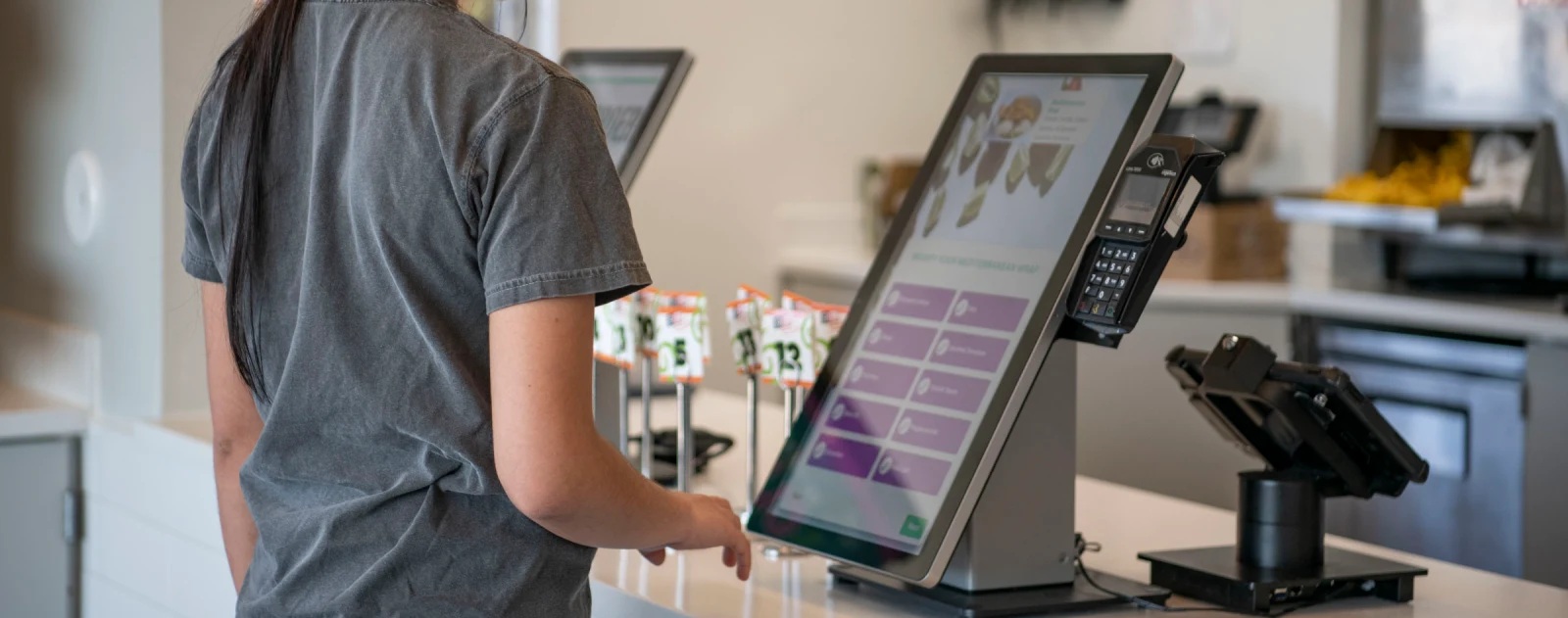
Bite sells a business-to-business software platform. Restaurants can customize the interface to their brands, connect it to existing systems and offer self-service ordering. Linebuster puts ordering tools in staff members’ hands so they can serve guests waiting in a queue. The company describes its software as hardware agnostic, operating across tablets and larger displays. Operators are buying an ordering experience, with hardware choices around it.
The proprietary recommendation engine, Bite Lift, analyzes transactions in real time and suggests menu additions using ordering information and contextual factors. Bite says this produces higher average checks than cashier ordering. The plausible attraction is consistency: a programmed recommendation does not forget to appear during a rush. Whether guests accept it depends on the offer, the menu and the moment.
Menu + choices→Recommend
Bite Lift→Complete
Pay + route order
The less glamorous work lives behind the screen. Bite’s partner directory includes POS, loyalty, payments and hardware companies. An order must reach the restaurant’s workflow; a reward must be recognized; an unavailable item should not become a kitchen surprise. Specialists such as GRUBBRR and POS suppliers such as Toast compete for this territory. Toast offers kiosks integrated directly with its POS; Bite emphasizes connections across a wider partner directory. Bite’s pitch rests on customization, recommendations and connections, alongside deployment support.
The cookie is not the whole calculation
Consider Urbane Cafe. Bite’s March 2026 case study reported a $23.14 kiosk check against $19.01 at the cashier across 16 locations during a three-month period. That is about 22% higher. Kiosks handled roughly 26% of orders, and the report described a 5.6% total sales lift. The distinction matters: only some customers were using the channel with the bigger basket.
Loyalty access had been a barrier. Guests could not conveniently use their rewards at the kiosk; the Thanx integration removed that friction. Urbane also placed kiosks near entrances and trained staff to help guests use them. Those are details an operator can copy. A check comparison alone cannot establish how much of the difference came from recommendations rather than customer selection.
Seven days changed the vendor conversation
Tiki Taco’s story begins with a decision against Bite. CEO Eric Knott had tested Bite and another provider at a previous restaurant company, found similar results and selected the competitor with the earlier deployment. Later, reliability and responsiveness became frustrations. At Tiki Taco, a group-ordering request brought the difference into focus: the competitor’s development timetable stretched into weeks; Bite promised a working enhancement in one week.
“We’ll get this out to you in a week.”Bite’s response, recalled by Tiki Taco CEO Eric Knott
The vendor-published case study says Bite delivered. It reports a three-month payback period per kiosk, using data from four active kiosks between January and October 2025. That is a customer-specific outcome, not a price list. A restaurant evaluating the purchase needs its own hardware, installation, software and payment costs, then a margin calculation. Extra revenue and extra profit are different creatures.
The next order starts at this one
Starbird shows another use for the same screen. Its Bite rollout began with a 2019 pilot and accelerated during COVID-19, including outdoor kiosks for contactless ordering. Later, an Attentive integration let customers opt into marketing messages during checkout. The December 2025 case study reported more than 108,000 kiosk-generated SMS opt-ins and 60-70% of in-store orders going through kiosks.
This makes the ordering channel useful beyond the current basket. With permission to contact a guest, the restaurant can make another offer later. Bite’s integration work has continued: it announced Olo Connect Platinum status in December 2025 and an Aurus payments partnership in June 2026. Its April 2024 announcement of a $9 million Series A described plans to expand deployments and invest in technology.
Install the habit, too
For an operator, the transferable method is to measure the whole visit. Track adoption alongside check size. Make rewards work before asking loyal guests to switch. Put help within reach, and ensure the kitchen can handle the orders. If a screen is hard to find, payment fails or staff cannot rescue a stuck guest, the sales argument loses its footing.
Bite’s customer accounts suggest that the touchscreen succeeds inside a carefully arranged restaurant. The intriguing part is how much of that arrangement remains human. Someone chooses the placement, teaches the first hesitant guest and hands over the food. The software can ask about the cookie. Hospitality still has to deliver lunch.
Take another bite
Bite website ↗ · LinkedIn ↗ · X ↗ · Facebook ↗
The Spoonful blog ↗ · Urbane Cafe story ↗ · Tiki Taco story ↗ · Barton in Expedite ↗
▶ Watch: Restaurant Tech Trends with Brandon Barton