A customer taps “order.” To the customer, the difficult part is over. To a restaurant running several delivery apps, the administrative adventure may just be beginning: a tablet pings, someone reads the order, someone copies it into the till, and only then does the kitchen get its instructions. Somewhere in that journey, “no onions” has an opportunity to become onions.
- The job: connect digital orders to the restaurant’s existing systems and keep menus consistent.
- The business: sell operators software subscriptions, then add direct ordering, dispatch and in-store tools.
- The lesson: a new sales channel is useful only if the kitchen can absorb it.
Deliverect built a company around that unglamorous interval between a sale and a usable kitchen ticket. Its proposition is easy to understand if you have ever watched a busy employee act as a human cable between two computers. The computers are doing their jobs. The employee is doing the connection’s job.
A successful order can still be a failed handoff
The original problem was fragmentation. Delivery marketplaces supplied demand, but each could introduce another screen, another menu to maintain and another stream of orders to transcribe. The restaurant’s point-of-sale system, or POS, remained the place where those orders needed to land. Winning another customer could mean adding another small piece of clerical work at precisely the wrong moment.
Deliverect Restaurants connects those channels to a compatible POS, consolidates incoming orders and returns status updates. Operators can manage digital menus, availability and reporting centrally. The expertise lies in making unlike systems agree about the same meal: its price, its modifiers, its availability and the location preparing it.
That explains its place in the market. Deliverect sits between ordering channels and restaurant operations. Its competitive pitch is a broad integration network and a set of connected services around that network. Otter and Checkmate offer alternatives for aggregation; Olo and Lunchbox overlap in enterprise ordering. Buyers need to compare the actual connections their restaurants use, rather than admire the length of any vendor’s feature list.
The founders had already stood behind the counter
Zhong Xu’s introduction to restaurant technology came through his father, who built a POS business serving Asian restaurants in Belgium. As a teenager, Xu made restaurant websites. He later told Startups Magazine that he had created more than a thousand of them, with an affectionate lack of respect for their appearance.
Xu and Jan Hollez went on to build POSiOS, an iPad-based point-of-sale business acquired by Lightspeed in 2014. Deliverect followed in 2018, founded with Jelte Vrijhoef and Jérôme Laredo. The founders had already spent years learning how restaurant software meets restaurant life. A dinner rush is an unusually persuasive product review.
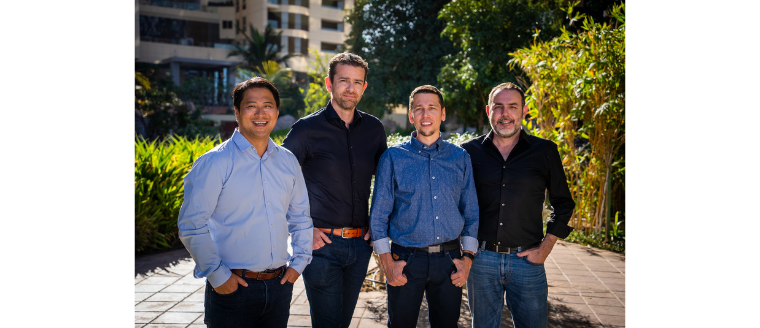
That background matters because replacing a restaurant’s existing system is a considerable request. Connecting it to new channels is a different proposition. Deliverect could sell a way to accommodate changing customer habits while allowing a compatible till to keep doing the work staff already understood.
Growth arrived carrying a stack of tablets
The company preceded pandemic lockdowns. COVID-19 then changed the urgency of its customers’ problem. When dining rooms closed, online ordering became a route to continued trade. In April 2020, Deliverect said it had waived setup fees and introduced cancellable monthly subscriptions instead of annual commitments. The documented change was in how restaurants could buy the service, as well as how quickly they needed it.
Investment followed: €16.25 million in Series B funding in 2020, $65 million in Series C in 2021, and more than $150 million in Series D in January 2022. That last round put the valuation above $1.4 billion and reported total funding at $240 million. These are historical financing figures; the value of meals passing through the platform is a separate measure.
Reported locations served
Company and investor announcements, April 2021, January 2022, December 2024 and September 2026. Rounded lower bounds; locations are not distinct brands.
A smaller customer illustrates the mechanics better than a funding round. Paris restaurant Dim Sum’s published case describes growing order volumes followed by errors and counter bottlenecks. It adopted a combination of Deliverect’s ordering, management, dispatch, direct and kiosk tools. The case reports an 80% reduction in order errors after centralizing management and five extra orders handled per hour.
“Centralizing all orders and solutions within a single tool makes management simpler, more efficient, and better structured.”
Michel Zhang, Director, Dim Sum
Those are results in a vendor-published customer account, not a promise for every kitchen. Still, the sequence is instructive. Demand increased; coordination became harder; the restaurant changed how work moved between systems. The first strain appeared in handling the orders it already had.
The menu gets one editor
Menus are where the integration problem becomes particularly fussy. An item may be available at one location and sold out at another. A modifier must reach the POS correctly. A price change needs to reach the channels selling the item. Central control reduces repeated editing, while the local configurations still need to reflect the restaurant on the ground.
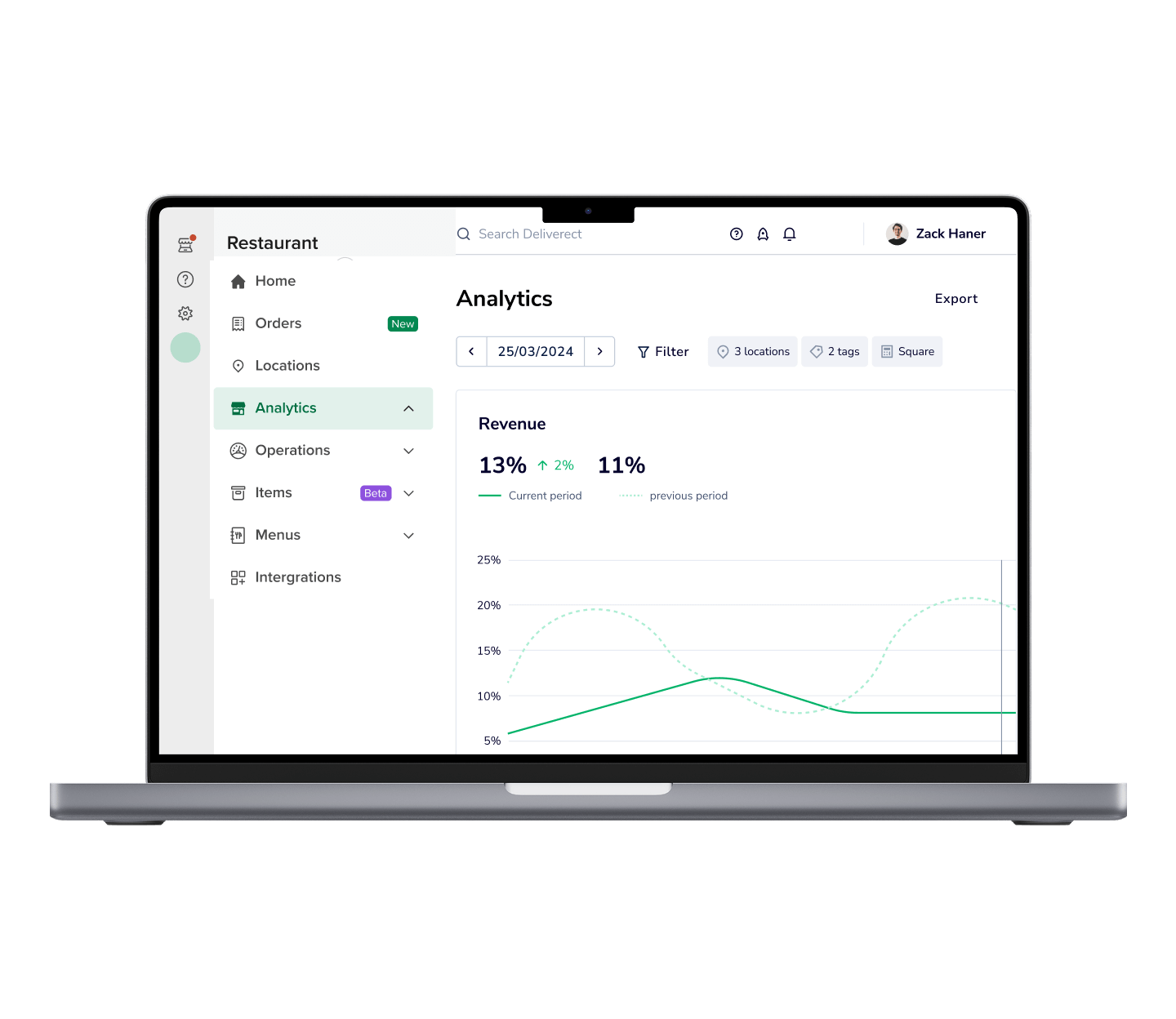
The product family now follows more of the order’s life. Direct provides branded ordering experiences and marketing tools. Dispatch selects delivery providers using rules such as cost, speed, distance and preferred partner; the Courier App supports an operator’s own drivers. Retail handles digital catalogs and stock synchronization, with Quest supporting picking workflows.
Acquisitions extended the same logic. ChatFood, announced in May 2023, brought social, direct and QR table ordering plus loyalty capabilities. Tabesto, acquired in December 2024, added ordering and payment kiosks. A counter kiosk and a delivery app look different to diners. To the operator, both need an accurate menu and a dependable path into fulfillment.
A subscription is only part of the bill
Deliverect sells software to businesses through subscriptions. Its current pricing page says quotes depend on location, the scale of digital operations, the number of sites and the products selected. A public U.S. policy price list gives a concrete reference: $119 monthly for the 0-350-order band, alongside a listed $0.30 transactional fee. Higher monthly bands list $199 and $249. An operator should confirm which schedule and charges apply to the proposed contract.
The useful calculation goes beyond the license. Count staff time spent copying orders, editing several menus and coordinating drivers. Add the cost of mistakes and refunds. Then compare that burden with the subscription, onboarding, payment and delivery charges relevant to the setup. Direct ordering still needs customers to find the restaurant, and couriers still have to be paid.
For a low-volume business using one channel that already connects neatly to its POS, the saved work may be modest. For a chain repeating the same edits across many locations, the arithmetic can look quite different. Software can remove a transcription bottleneck; it cannot increase the size of the grill.
The next order may arrive by voice
The 2026 announcements show where Deliverect is taking its connections. In March, Papa Johns announced a phased U.S. rollout of Smart Dispatch and Delivery Management, with participating locations targeted for completion by the end of 2027. The task is to coordinate in-house drivers and third-party fleets through one delivery workflow. It is a deployment plan, with work still ahead.
In July, a SoundHound AI partnership connected voice ordering to Deliverect’s menu and order-management infrastructure. The listed integration supports the U.S. and Canada and requires subscriptions to both services. August brought a Bounteous partnership linking its NomNom digital-experience platform to Deliverect ordering and fulfillment.
September returned to the original, practical problem: KPOT announced aggregation and menu management for its 140-plus-location U.S. network. Deliverect’s announcement reported more than 85,000 locations served worldwide. Whether a customer speaks, taps a kiosk or opens an app, an order still has to arrive in a form the kitchen understands.
Deliverect AI adds menu assistants and autonomous support agents, with permissions and configurations set by operators. Its advertised tasks include fixing order-flow issues and helping maintain menu content. Those controls deserve attention: an automated edit affects something a guest may actually buy.
Count the handoffs
The transferable lesson is quite practical. Follow an order from the customer to the cook. Mark every point where a person retypes, checks another screen or repeats an update. Choose a bottleneck, confirm the specific POS and channel support, then measure errors and staff time before expanding the rollout. Test awkward modifiers and sold-out items, too. Easy orders flatter software.

Deliverect’s careers pages emphasize ownership, open communication and collaboration. Its stated vision is to help the food-service community thrive in the digital age. The most convincing expression of that ambition is smaller than the slogan: an order reaches the kitchen without making someone stop and type it again. Hospitality has plenty of work for people. Copying the burger need not be among it.