pos-integration
(29)
Bite makes the case for a more hospitable screen
The restaurant kiosk company sells a better way to order. Its customer stories reveal why the real work begins before anyone touches the glass.

OneDine and the art of keeping a tab open
At bartaco, paying after every order became a reason to stop ordering. OneDine’s answer reveals a useful truth about restaurant technology: the smallest interruption can have a very expensive appetite.
Deliverect’s billion-dollar cure for tablet hell
Delivery apps brought restaurants more orders. They also brought a small orchestra of beeping tablets. Deliverect built its business by teaching those screens to talk to the kitchen.

PAR Punchh found the money at the register
A loyalty app stumbled over the simplest restaurant ritual: paying the bill. Connecting to the register helped turn Punchh into a $500 million acquisition - and explains its next move beyond loyalty members.
DTiQ and the Case of the Vanishing Refund
A camera can record a whole shift and explain very little. DTiQ connects the footage to the till, then gives busy operators a reason to look.

Lunchbox and the customer who got away
Restaurants cook the meal. Delivery apps often keep the relationship. Lunchbox wants to put both back on the restaurant’s side of the table.

The $10,000 Beer Tap That Became an Operating System for Every Pour
Jose Hevia spent about $10,000 putting self-pour beer on a restaurant table. The real business appeared later: software that can identify a drinker, price every ounce and tell an operator what is happening inside thousands of ordinary dispensers.

Delegasi
Delegasi is an Indonesian fintech startup (Y Combinator S22) building an automated accounting service for small businesses, starting with restaurants and cafes. Owners connect their POS and food-delivery data and upload receipts and bank statements, and Delegasi generates financial statements and tailored business analysis without manual data entry or accounting knowledge. It bills itself as the first virtual financial manager in Indonesia.

Grubtech
Grubtech is a Dubai-based restaurant technology company that builds a unified operating system for food and beverage and quick-commerce businesses. Its middleware platform, gOnline, connects fragmented software touchpoints - POS systems, ERP, delivery aggregators like Talabat, Deliveroo, Careem and Uber Eats, kitchen displays, dispatch and analytics - into a single dashboard so restaurants, cloud kitchens, grocers and pharmacies can run online and in-store operations without juggling multiple screens. Founded in 2019, the company has raised $33.4M and operates across roughly 18 markets.

mx51
mx51 is a Sydney-based fintech that provides a bank-grade, cloud-native Payment-as-a-Service platform. Spun out of Assembly Payments in 2020, it gives banks, acquirers and payment providers white-label, multi-channel payment infrastructure - in-store terminal software, merchant and support dashboards, analytics and 150+ point-of-sale integrations - so they can serve merchants without building the technology themselves. Its customers include Commonwealth Bank and Westpac, and the platform has processed billions of dollars in transactions across the Asia-Pacific region.

AppCard, Inc.
AppCard is a New York-based loyalty marketing and shopper analytics platform built for independent grocers and multi-location retailers. It captures SKU-level purchase data at the point of sale, then uses machine learning to deliver personalized offers, digital coupons and automated campaigns that help brick-and-mortar stores retain customers and grow sales. Founded in 2011 by ICQ co-founder Yair Goldfinger, the company serves thousands of independent grocers reaching tens of millions of shoppers, and has expanded into co-branded payment cards.
Checkmate
Checkmate (ItsaCheckmate.com Inc.) is a New York-based restaurant technology company that connects digital ordering channels to a restaurant's point-of-sale system. Founded in 2016 by Vishal Agarwal, its platform pipes orders from third-party marketplaces like DoorDash and Uber Eats directly into the POS, lets operators manage menus across dozens of channels from one dashboard, and now extends into first-party web and app ordering, self-service kiosks, voice AI for phone and drive-thru, catering, loyalty, and accounting reconciliation. The company reports more than 23,000 live restaurant locations and 130+ integrations, and raised a $10M Series B led by Tiger Global in October 2024.

Rinsed
Rinsed is a New York-based vertical SaaS company that builds a customer relationship management (CRM) platform purpose-built for the car wash industry. It plugs into a wash's existing point-of-sale hardware and helps operators grow and retain unlimited-wash membership subscriptions through automated email and text marketing, online sign-ups, churn-reduction tools, salesperson coaching, and business analytics. Founded in 2019 and backed by Founders Fund, Bedrock Capital, VMG Technology and Y Combinator, Rinsed serves more than 3,000 car washes across the U.S. and Canada.

Vistify, Inc
Vistify, Inc is a Santa Ana, California restaurant-technology company whose flagship platform, vMenu, turns static digital menu boards into centrally controlled, software-defined menus for multi-unit and quick-service restaurant brands. The cloud platform lets operators design menus with a drag-and-drop Menu Builder, push changes to thousands of screens in real time, sync pricing with point-of-sale systems in under 30 seconds, and monitor what is actually displaying across every location. Founded in 2015 as Embed Digital and rebranded to Vistify in March 2025, the company serves brands including Craveworthy Brands, WaBa Grill, Urban Plates and Urbane Cafe, and is led by CEO Michael Mathieu.
LinkToAny
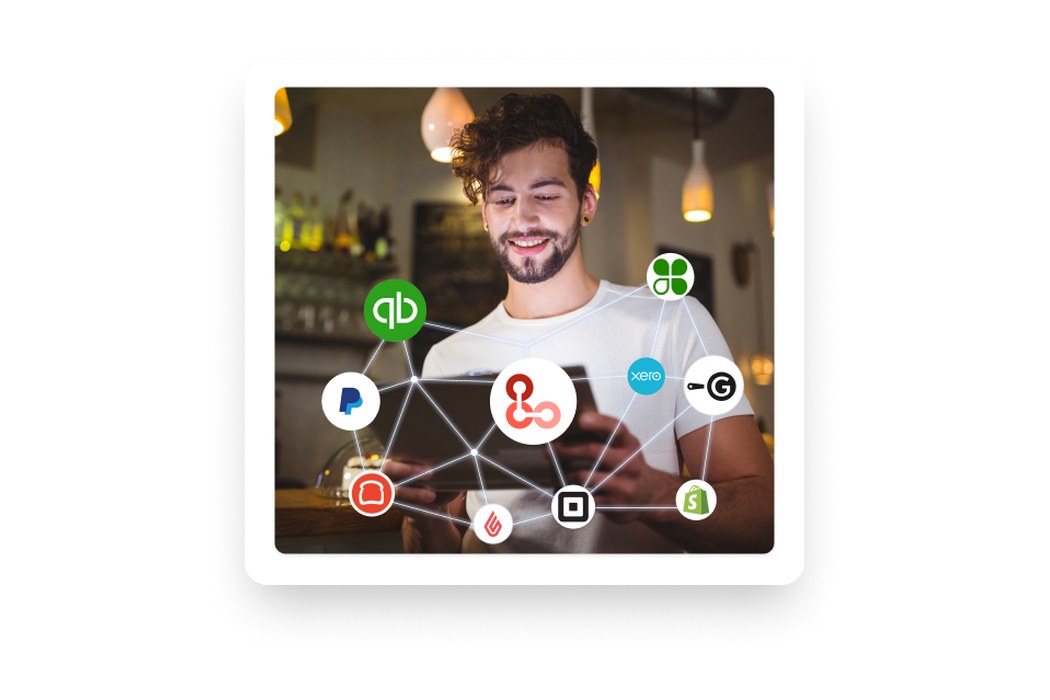
LinkToAny (formerly ShoppinPal) is a Los Angeles-based integration platform that helps commerce software providers onboard merchants, migrate data between systems, and connect the apps a business already runs. Its iPaaS-style platform links point-of-sale, ecommerce, accounting, loyalty and ordering systems - working with names like Shopify, Lightspeed, Clover, Intuit/QuickBooks, Square, GoDaddy and PayPal - so platforms can go live with new merchants in days rather than weeks, with an increasingly AI-native approach to onboarding and migrations.
Kickfin
Kickfin is an Austin-based fintech that automates how restaurants and hospitality businesses calculate and pay out tips. Instead of managers counting cash and stuffing envelopes at the end of each shift, Kickfin pushes gratuities in real time straight to employees' existing bank accounts - no cash, no cards, no waiting. Founded in 2017, the company was the first end-to-end digital tip management platform and has since paid out more than $2 billion to over 250,000 restaurant workers, integrating with major POS and payroll systems to eliminate manual uploads and reduce tip errors.

LeafLink
LeafLink is a B2B wholesale platform for the legal cannabis industry - often called 'the Salesforce of bud.' It connects thousands of cannabis brands, distributors and retailers through a single marketplace that handles ordering, payments, banking, logistics and market data. Founded in 2016, LeafLink processes roughly $5 billion in annual gross merchandise value (about $9 billion including its acquired Leaf Trade platform), representing a large share of U.S. wholesale cannabis commerce across roughly 30 markets.

Vishal Agarwal
Vishal Agarwal is the founder and CEO of Checkmate (itsacheckmate.com), a New York restaurant technology company that pipes online orders from delivery apps straight into restaurant point-of-sale systems and centralizes menu management across platforms. He started the company in 2016 after waiting too long for a check at a San Francisco airport restaurant, and grew it from a bill-splitting idea into a full digital operations suite used by brands from independent eateries to Arby's and Wendy's. A former Citigroup analyst and Choxi.com marketing chief, Agarwal built Checkmate past 100 million processed orders and, backed by Inspire Brands, expanded into kiosks, reconciliation, and voice AI.

Incept AI
Incept AI is a New York-based voice AI company building order-taking systems for quick-service restaurants, starting with the two hardest environments in the business: the drive-thru and the phone. Founded in 2024 by former Amazon and Presto Automation engineers, Incept pairs a proprietary neural audio engine that strips out background noise, echo and crosstalk with foundation models and POS integrations, so the AI can complete restaurant orders end-to-end without a human stepping in. The company says its system reaches 95%+ order completion without human intervention, well above the roughly 83% where most competitors escalate to a person, and raised a $3 million pre-seed round led by Rally Ventures in early 2025.

Loman AI
Loman AI is an Austin-based voice AI platform that answers restaurant phones 24/7. Its AI agent takes pickup and delivery orders, books reservations, answers menu and hours questions, processes payments, and syncs tickets directly into POS and reservation systems like Toast, Square, Clover and OpenTable. Founded in 2024 by Christian Wiens, the company pitches a simple economic case: a ringing phone that no one answers is lost money, so it turns every call into a captured order. Loman raised a $3.5M seed round in August 2025 and says it handles millions of calls and tens of millions in order volume, with early traction concentrated in the pizza category.

OrderOut
OrderOut is a Miami-based restaurant integration company that pipes orders from third-party delivery apps - Uber Eats, DoorDash, Grubhub, ChowNow and more - directly into a restaurant's point-of-sale system. Instead of a countertop crowded with buzzing tablets and mismatched printers, OrderOut gives operators a single queue and one dashboard, plus a developer API and an AI operations layer that POS companies and aggregators can resell under their own brand.

Jim Williams
Jim Williams is a serial entrepreneur and CEO of MustHaveMenus, a Bend, Oregon-based platform serving 10,000+ restaurants, hotels, and food service businesses with cloud-based menu design, digital signage, and menu management tools. Before MustHaveMenus, he sold email-marketing startup MarketHome to ClickAction for $15 million in 1999, co-founded church-tech platform Sharefaith (acquired by Ministry Brands in 2018), and made an early angel investment in HotelTonight (acquired by Airbnb in 2019). An English major who started his first business at age 11, Williams embodies the accidental founder: perpetually optimistic, deeply curious about design, and committed to building software that solves genuinely unglamorous problems.

Gluon Solutions, Inc.
Gluon Solutions is a Livermore, California software company building IoT and cloud platforms that quietly run the unglamorous back office of fuel stations, convenience stores, and auto-parts sellers. Its three product lines - Petromo (c-store and fuel-station management), Gluon Auto (vehicle and fleet monitoring), and EZ Lister (auto parts catalog and marketplace listing) - stitch together pumps, tanks, point-of-sale terminals, vehicles, and e-commerce inventories into a single connected system.

Christian Wiens
Christian Wiens is the founder and CEO of Loman AI, an Austin-based voice AI platform that answers the phone for restaurants. A former restaurant worker who started in a Southern California BBQ joint in sixth grade and later spent a decade in B2B SaaS go-to-market roles, Wiens built Loman to recapture the orders restaurants lose every night when no one can get to the phone. Since launching in 2024, Loman has processed millions of calls and tens of millions in order volume, raised a $3.5M seed round led by Next Coast Ventures, and partnered with SpotOn, OpenTable, Toast and Square.

Thibault Le Conte
Thibault Le Conte is the founder, CEO and CTO of OrderOut, a Miami-based software company that funnels orders from UberEats, DoorDash, Grubhub and other delivery apps straight into a restaurant's existing point-of-sale system, killing the tablet pileup that clutters kitchen counters. A computer-science engineer trained at EPITECH and UC Berkeley, he built roughly eight or nine companies before OrderOut, reusing the same core technology each time. OrderOut is deliberately bootstrapped, grown on a single $250,000 partner investment made during COVID and organic revenue since, and now runs a lean distributed team across Miami, Brazil, India, China, Ecuador and Mexico. His latest push moves OrderOut beyond integrations into restaurant finance, with same-day UberEats payouts and a delivery API that lets any business shop for the cheapest or fastest courier.

Touradj Barman
Touradj Barman is the co-founder and CEO of Up 'n go, the San Diego company that lets restaurant guests scan a QR code, pull up their check, and pay without downloading an app. An MIT graduate with a Yale MBA and more than 20 issued patents - some acquired by Microsoft and now underpinning push and group messaging - Barman started Up 'n go to solve a small annoyance, splitting the check at a single San Diego restaurant. The platform has since processed more than $1.1 billion across over 16 million checks for 11 million-plus guests nationwide.

Expo
Expo is an AI platform for multi-unit restaurant operators that consolidates fragmented data from POS, inventory, labor, and guest-feedback systems into a single intelligent dashboard. Non-technical managers can ask their restaurant data questions in plain English and get answers - no analysts, no SQL, no Tableau build required. Founded by chef-turned-operator Will Pacio and tech veteran Dave Lu (the team formerly behind restaurant-staffing marketplace Pared), Expo connects to systems like Toast, Restaurant365, Crunchtime, Square, and DoorDash to automate reporting and surface operational insights for chains from QSR to fine dining.

SparkPlug
SparkPlug is a San Francisco-based incentive management platform that turns frontline retail and restaurant employees into a brand's most effective sales force. By integrating directly with point-of-sale systems, it automates sales contests, goals, and commissions - often funded by the brands and vendors whose products those employees sell - and pays rewards out automatically. The company works with thousands of retail locations and hundreds of brand partners, betting that the people closest to the customer are the most underused influence in physical commerce.

Homebase
Homebase is a San Francisco-based workforce management platform built for small businesses running hourly teams. Founded in 2014, it combines employee scheduling, time tracking, payroll, HR compliance, and team communication in one mobile-first app. As of 2024, the platform serves over 150,000 businesses and 3.8 million hourly workers, having logged 8 billion hours and processed $3 billion in gross payroll. Backed by $198 million in total funding, Homebase competes by bundling tools that small business owners previously paid for separately - and more recently by embedding AI assistants across hiring, scheduling, and payroll.