snowflake
(90)
Jean Martin makes the connections count
The hard part of enterprise technology is getting the pieces to work together. Jean Martin has built a business around that problem, from investment research to governed AI.

Lirik makes the systems talk
A sale, a shipment, a patient record. Lirik works on the awkward handoffs between enterprise systems - where expensive software meets the way a business actually runs.
Keep the logic. Change everything around it.
Mobilize.Net built a business translating old software into new platforms. In 2023, its two buyers revealed just how far that idea could travel.

DataFactZ and the work before AI
Before an AI system can give a useful answer, somebody has to make the data agree. DataFactZ has built a business around that surprisingly stubborn job.

Ataccama asks the awkward question: can you trust your data?
Before an AI agent makes a decision, someone has to check its facts. Ataccama has built a business around that deceptively difficult job.

Hoonartek makes old data useful again
Banks and telecom operators have plenty of data. Hoonartek’s business is making it agree, arrive on time, and support decisions someone can explain.
Anblicks makes the waiting disappear.
Before a business can ask its data smarter questions, somebody has to fix the plumbing. Anblicks has built its business around that unglamorous, consequential job.

TVS Next makes the factory talk
A machine stops. Someone writes it down. TVS Next is building a business in the gap between those two events - and what happens next.

Brad Gerstner’s bet on a head start
He launched Altimeter as the financial system was coming apart. Years later, the investor from Indiana took a different bet to Washington: give children a stake before they have a salary.

CARTO found a better place for your map: where your data lives
The company that began with conservation maps now puts spatial analysis inside the corporate data warehouse. Its next wager: letting a conversation do the work of another request to the GIS team.
Boomi Data Integration: The money is in the handoffs
Rivery built a business around the awkward gaps between data tools. Inside Boomi, its wager is getting bigger: make the entire journey manageable, from the first database change to the last dashboard refresh.
Cervello and the expensive art of getting data to agree
The Kearney-owned consultancy works where enterprise ambition meets spreadsheet reality. Its most revealing projects show why buying better software is only the beginning.
Scalable Systems and the unglamorous secret of useful AI
The New Jersey company works where enterprise ambition meets messy data. Its bet: industry knowledge, connected systems, and someone watching the cloud bill matter as much as the model.

Teqfocus and the expensive art of making systems talk
The enterprise AI boom has a paperwork problem. Teqfocus sells the connections, controls and workflow repairs that help a clever demo become useful work.
Beyond Key and the work between the systems
A claim form, a training course, a missing policy: Beyond Key makes its living in the awkward gaps between the software companies buy and the work people need to finish.

GoldenSource and the trouble with two truths
A financial firm can buy more data and still know less than it thinks. GoldenSource has built a business around making the numbers agree - and is now bringing that discipline to AI.
USEReady and the Reports That Refused to Die
A dashboard can be replaced in an afternoon. The business rules hiding inside it are another matter. USEReady has built a business around carrying that inconvenient knowledge into the cloud - and now into AI.
The Search Engine That Could Find Everything Except Its Audience
Neeva made a search engine with no ads, a real web index and AI answers that showed their work. Its toughest query turned out to be simpler: how do you get people to change a default?
The Missing Click After the AI Answer
Kubit began with a CTO's irritation at product analytics that separated answers from the underlying data. Now it is trying to join an AI agent's trace to the one result that matters: what the person did next.

Josh Weyburne Has Spent a Career Making Complicated Systems Legible
From a community-built visualization cookbook to enterprise AI deployments, the Cincinnati engineer has followed one durable idea: technology matters when people can actually use it.

Infinite Lambda Wants to Fix AI’s Plumbing
Before an AI agent can give a useful answer, somebody has to sort out the data. Infinite Lambda turns that unglamorous job into software, migration projects, and teams that can run the result.

AtScale Refused to Kill Excel. Now Its Semantic Layer Has to Keep AI Honest.
The Boston software company spent a decade making old-school BI behave on new-school data. Its next customer is an AI agent - and the same boring layer may be what keeps the answers useful.

Soda Wants Your Data to Rat On Itself Before It Wrecks the Dashboard
The idea behind Soda is almost rude in its simplicity: software gets tested before it ships, so why does data get to skip the exam? Two Belgians decided it shouldn't.

The Janitorial Startup That Became a $220 Million Marketing Machine
Grayson Lafrenz started a cleaning company, hired an SEO agency he couldn't understand, and brought the work in-house. What grew out of that frustration now runs roughly $800 million in ad spend through software Power Digital wrote itself.

Braze Is Quietly Making Your CDP Optional
Braze built Currents to stream engagement data out of its platform. Now its Data Platform ingests, enriches and activates events natively, and marketers are asking whether Segment is still worth a second bill.
nao Labs
nao Labs builds an AI-native code editor for data teams - a local, VS Code-based IDE wired directly into your data warehouse, with an AI copilot that understands your schema, catches breaking changes, and runs data diffs before you ship. Founded in 2024 by Claire Gouze and Christophe Blefari and backed by Y Combinator (Spring 2025), nao is pitched as 'Cursor for data' and, more recently, an open-source analytics agent builder that lets non-technical users query data in plain English.
thorntale
thorntale (YC W24) is a San Francisco software company that built presentation tools for data storytelling. Instead of screenshotting charts from Looker or Snowflake into Google Slides, teams could connect live data sources directly into decks, so charts stayed interactive and up to date - even re-segmentable during a live Q&A. Founded in 2024 by data scientist Dori Wilson with engineers Ellen Hui and John Stimac, the company later pivoted toward an AI-powered presentation editor and shipped a free AI Presentation Review tool before winding the core Presentations product down at the end of 2025.
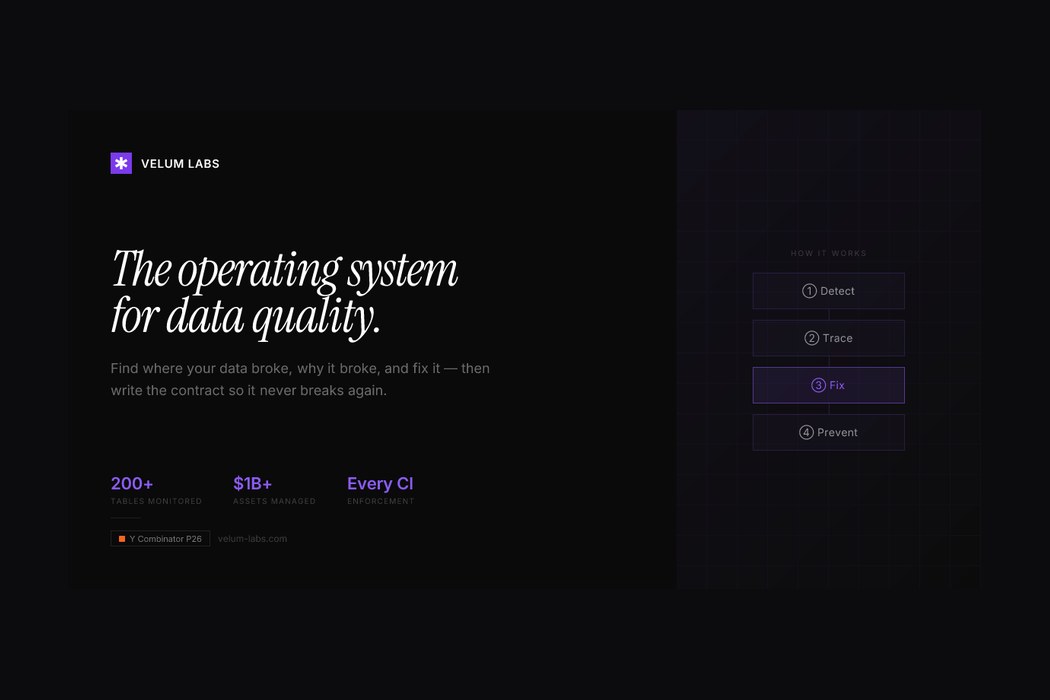
Velum Labs
Velum Labs is a Y Combinator-backed San Francisco startup building an operating system for data quality. Its platform continuously watches a company's data stack, catches when metrics and definitions diverge, traces the root cause through query lineage, proposes automated fixes, and then writes enforceable data contracts so the same break does not recur. Founded in 2025 by Chilean-born childhood friends Benjamin Munoz-Cerro (CEO) and Alen Rubilar-Munoz (CTO), the company is already in production at regulated fintechs monitoring 200+ tables tied to more than $1B in assets.

Tejas Manohar
Tejas Manohar is the cofounder and co-CEO of Hightouch, the San Francisco company that helped create the Composable CDP category by bringing customer data platform capabilities directly onto the data warehouse. He moved to San Francisco at 16 to become one of Segment's first ten engineers, then left in 2018 to start Hightouch with Kashish Gupta and Josh Curl. Under his leadership Hightouch has crossed $100M in annual recurring revenue and raised a $150M Series D in April 2026 at a $2.75B valuation, pivoting the company toward AI Decisioning and agentic marketing.
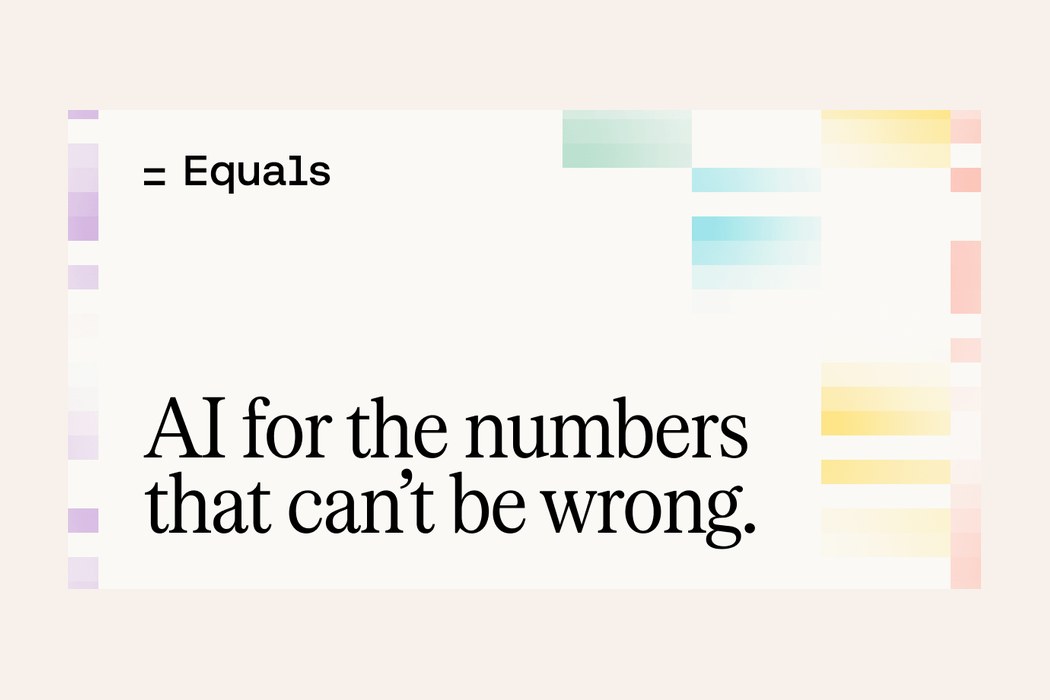
Equals
Equals is a next-generation spreadsheet built for business analytics. Founded by two Intercom veterans, it pairs the familiar spreadsheet grid with live connections to data warehouses and business tools, version control, real-time collaboration and, more recently, AI-assisted analysis. The company positions itself as 'AI for the numbers that can't be wrong,' aiming to give finance and go-to-market teams a single, trustworthy place to model ARR, pipeline, retention and other core metrics without exporting CSVs or standing up heavyweight BI stacks.