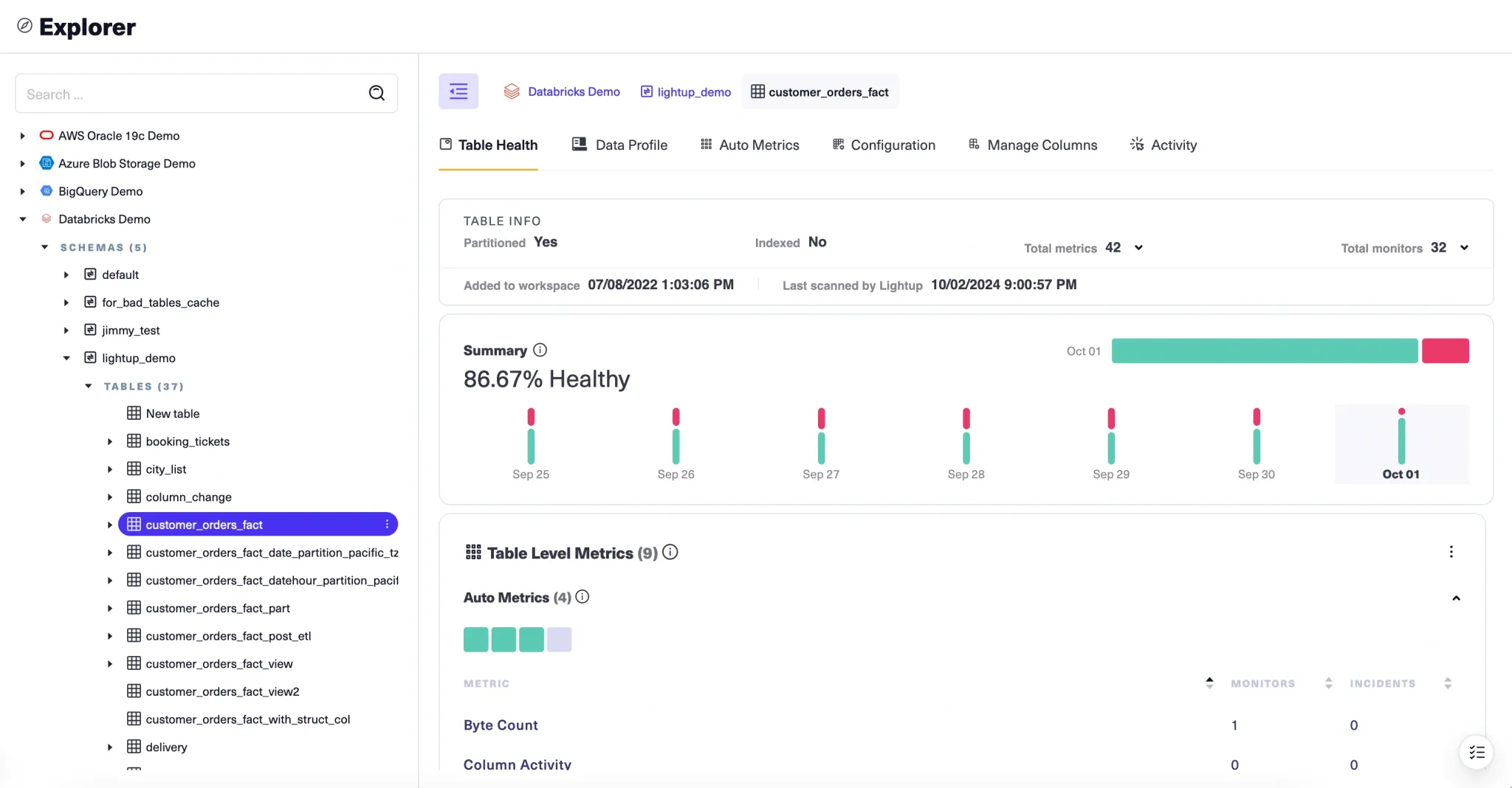
It is 9:14 on a Tuesday morning. Somewhere inside a Fortune 500 company, a dashboard quietly loads a number that is wrong. Last quarter, that number would have traveled all the way to a boardroom before anyone flinched. This morning, an alert fired first. Lightup saw it.
01 / WHO THEY ARE NOWThe quiet layer under good decisions
Lightup Data does an unglamorous job extremely well: it makes sure the data running a company is actually correct. Not the data in a demo. The data in production - the streams feeding the dashboards, the tables feeding the AI models, the numbers feeding the people who sign things. The platform sits on top of warehouses like Snowflake and lakehouses like Databricks and watches for the moment data goes sideways: a drift, an outage, a duplicated record, a column that suddenly went half-empty overnight.
The company is small - around nineteen people - and deliberately so. It is the kind of infrastructure startup that succeeds by being invisible. When Lightup is doing its best work, nothing dramatic happens. A bad number simply never gets the chance to become a bad decision.
"Data observability at the speed of light."
- Lightup's own tagline, and yes, the pun is intentional02 / THE PROBLEM THEY SAWEveryone trusts the data. Almost no one checks it.
Here is the uncomfortable truth the founders kept running into. Companies pour enormous effort into collecting, moving, and modeling data - and then assume it is right. Data quality, for most of the last decade, was somebody's side project: a few hand-written checks, a brittle script, a Slack message that said "is this report broken or is it just me?"
The traditional fix made things worse. To check data at scale, older tools copied it out into their own systems first - which is a bit like photocopying a library to find out if a book has a typo. It was slow, expensive, and the copy was already stale by the time you read it.
The old way of checking data quality meant moving the data first. Lightup's bet was simple: don't.
- The founding insight, paraphrased03 / THE FOUNDERS' BETSend the math to the data
In 2019, three founders made the bet. Manu Bansal had just sold his previous startup, Uhana - an AI analytics company - to VMware that same year. He teamed up with Rajiv Ramanathan and Vivek Joshi, both with deep systems and product backgrounds, and pointed all that experience at the least fashionable problem in the data stack.
Their wager: data quality is an infrastructure problem, not a spreadsheet problem. Instead of pulling data out to inspect it, Lightup pushes the computation down into the warehouse where the data already lives. It borrows the customer's own compute fabric - the very engines of Snowflake, Databricks, Dremio - to run checks in place. No copying. No staleness. No second bill for a second copy of your data.
"We leverage the compute fabric of those scalable data warehouses and data lakehouses instead of moving data."
- Manu Bansal, Co-Founder & CEOThe Lightup timeline
04 / THE PRODUCTNo code, no thresholds, no babysitting
The pitch to a data team is mercifully concrete. Point Lightup at your warehouse and it recommends metrics automatically - no configuration ritual required. Its AI models learn what "normal" looks like for each stream, so you are not hand-tuning thresholds at midnight. When something drifts, an alert fires, the offending records get surfaced, and lineage shows you exactly what downstream report is about to break.
Data Observability Platform
Monitors production pipelines at scale using pushdown checks inside your own warehouse.AI Anomaly Detection
Models learn normal behavior and flag drift and outliers - no manual thresholds.Zero-Config Auto Metrics
Recommends and generates quality metrics so you can start monitoring on day one.Data Lineage
Traceability and impact analysis to see how one bad value ripples downstream.Reconciliation & Remediation
Finds discrepancies between systems and automates the cleanup.Agent & Genie (Beta)
Agentic and GenAI copilots that work natively with Claude and Gemini.It works on batch and streaming, across multi-cloud, hybrid and on-prem. The data never has to leave home.
- The architecture, in one sentence05 / THE PROOFNames, numbers, and a16z
Skepticism is fair - data observability is a crowded room. So here is the evidence. Lightup's customers are not logos invented for a slide; they include AMD, Skechers, KFC, McDonald's and Gap. The $9M Series A was led by Andreessen Horowitz, whose Martin Casado called it an "exceptional ability to address the data quality problem, unlike any other company." Total raised stands at $20.7M.
By the numbers
Total funding raised to date.
Reported year-over-year ARR growth around 2023.
Named to the CB Insights AI 100 in 2024.
Type II and ISAE 3000 Type II certified.
The integrations read like the modern data stack's address book: Snowflake, Databricks, Dremio for compute; Alation and Collibra for governance; PagerDuty for the alert that wakes someone up.
06 / THE MISSIONMake data quality everyone's job
The word Lightup keeps using is "democratize." For years, checking data was the private burden of a few overworked data engineers. Lightup's mission is to hand that power to business users and managers too - through no-code checks that anyone can read and trust. The goal it states plainly: 100% data quality coverage across enterprise operations.
"This is validation that we are achieving our mission of ensuring accuracy, reliability, and quality."
- Manu Bansal, on the Series A07 / WHY IT MATTERS TOMORROWAI is only as honest as its data
There is a reason a data quality company spent 2025 shipping GenAI copilots and unstructured data monitoring. Every enterprise is now feeding its data into large language models, and an AI model trained on dirty data fails in ways that are harder to spot and more confident in tone. The cost of a wrong number used to be a bad quarter. The cost of a wrong dataset is now a hallucinating model that sounds completely sure of itself.
That is the world Lightup is built for - one where the question is no longer "do we have data?" but "can we trust the data we already have?" It is not a flashy problem. It is just the one that quietly decides whether everything built on top works.
Back to that Tuesday morning. The wrong number loaded, an alert fired, and a data engineer fixed it before coffee. No boardroom ever saw it. No decision was made on it. That is the whole point of Lightup - the most important thing it does is make sure nothing happens at all.