ccaas
(89)
The Call Center That Started Listening
Ozonetel began by moving business calls to the cloud. Its more interesting bet is that the conversations themselves can tell a company what to fix next.

Anand Janefalkar Put the Smartphone on Hold - Then Rebuilt the Call Center Around It
A misspelled surname, a car phone in a movie and years spent making smartphones taught Anand Janefalkar the same lesson: technology works best when it gets out of the conversation. UJET is his decade-long attempt to make customer service behave accordingly.

The Acquisition Hangover in Your Contact Center
CCaaS acquisitions buy breadth fast. They can also leave seams in data, workflows and support—making a platform’s family tree a surprisingly useful buying guide.

Elite Group sells the part of the cloud that still needs people
The Lancashire communications provider builds its case in the awkward details: overloaded inboxes, roaming SIMs and phone systems that cannot follow staff home. Its business is making somebody else’s technology work in the real world.

Your Contact Center Dashboard Is Grading the Wrong Test
Alvaria and UJET can both report the contact center basics. The meaningful choice is whether leaders need deeper workforce control or a clearer line from each conversation to customer and business outcomes.
The Contact Center Winner Depends on the Work
Six platforms promise a better customer conversation. The useful choice starts with the work your team actually does, the systems it already runs and the operational muscle it is ready to build.
The Contact Center Compliance Shortlist Is Smaller Than It Looks
Eight cloud contact center vendors promise control. The real divide appears in audit evidence, data architecture, accessibility and the fine print around recordings, payments and resilience.
Your Contact Center Is Quietly Asking to Be Replaced
The warning signs rarely arrive as one spectacular failure. They show up as extra tabs, stalled AI pilots, spreadsheet reporting and channels that still cannot carry a customer's context.

Your Contact Center Is Telling You to Leave
The loudest warning signs are not missing features. They are the daily workarounds that reveal a platform built for another era—and a bolt-on architecture that cannot keep up.
The Conversation Intelligence Buyout Map
Conversation intelligence did not disappear; it moved inside bigger platforms. This field guide tracks who bought whom, what survived, and why Spiral by UJET is a rare acquired product still standing on its own.

How to Leave Cisco or Avaya Without Dropping a Call
A contact center migration does not need a heart-stopping cutover. This four-phase playbook moves queues, channels and business units in controlled waves while service stays live.

The Contact Center Migration Checklist Nobody Can Skip
The dangerous parts of a contact center move are rarely hidden in the new platform. They are hiding in the old one—inside forgotten integrations, inherited routing rules and promises nobody thought to write down.

Why 200 Agents and 5,000 Agents Buy Different AI
The same AI pitch lands in two entirely different buying machines. Here is how to choose a contact center platform for the operation you actually run—not the logo you hope to resemble.

Which UJET Are You Looking For?
One UJET runs cloud contact centers; the other engineers electric scooters. The quickest way to tell them apart is the address bar.

Jay Lee Wants Marketing and Revenue to Speak the Same Language
The Five9 growth chief trained as an engineer, learned marketing inside payments giants, and now runs a job that most companies keep in two separate offices.

RingCentral
The company that dragged the office phone into the cloud is now betting the whole switchboard on AI agents that answer, route, and read the room.
Squaretalk
The cloud contact center platform trying to turn every outbound call into a smarter, faster, better-connected conversation - without the enterprise price tag.
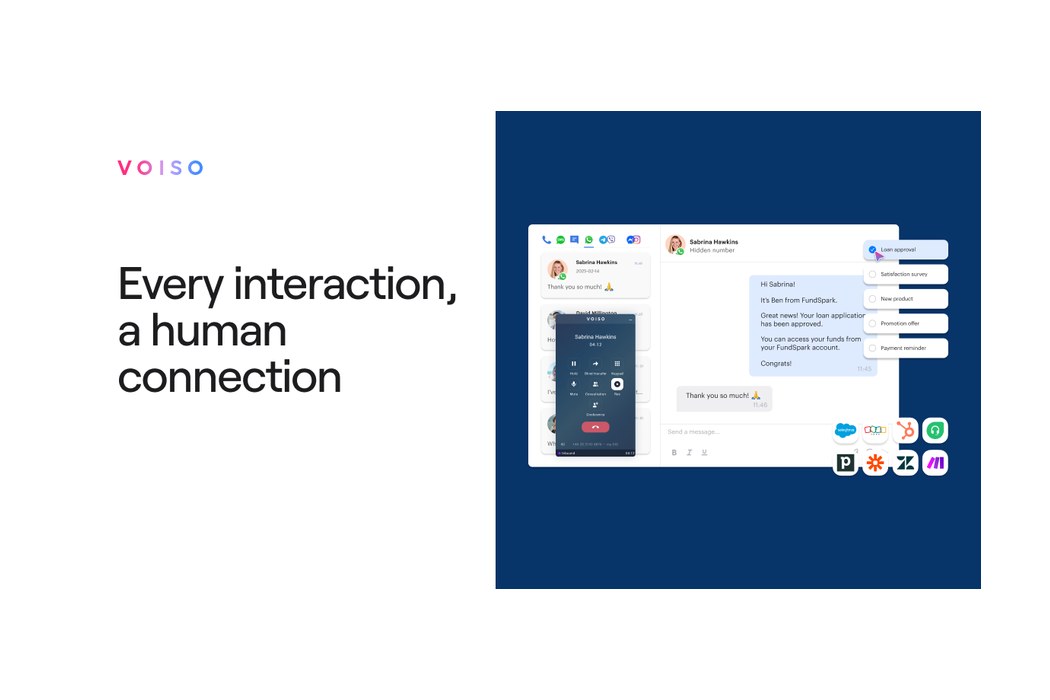
Voiso
Every interaction, a human connection.
Puzzel
The Oslo company that quietly runs the phones, chats and inboxes behind Scandic hotels, JYSK stores and a slice of European customer service - and is betting AI can make agents faster without making them robots.

8x8
One company built its whole pitch on erasing the line between the phone on your desk and the call center that answers your customers. Here is how 8x8 turned four decades of telephony into an AI-driven customer-experience platform.

TCN
For 25 years, a self-funded company in southern Utah has quietly wired the phone lines of collections agencies, hospitals and call centers - no contracts, no venture money, and a stubborn belief that AI should help agents, not fire them.

Vocalcom
For nearly three decades the French software maker has quietly wired the phones, chats and bots behind some of the world's busiest customer service desks. Now it is betting its future on an AI-ready cloud.

Regal
The founders spent six years running a contact center that customers hated calling. Now they sell software so other companies don't have to.

Sharpen
The Indianapolis contact-center company that bet on the phone call - and is now teaching it to answer itself.
Cyara
Cyara is a customer experience (CX) assurance software company whose automated platform tests and monitors contact center systems - IVRs, chatbots, voice, digital channels and, increasingly, AI agents - before and after they reach customers. Founded in Australia in 2006 and now headquartered in Texas, Cyara helps large enterprises catch defects in customer-facing systems early, cut manual testing, and keep voice and digital channels working across more than 100 countries.
Teneo.ai Wants Your Contact Center to Stop Guessing
The Stockholm company behind the Teneo platform is betting enterprises want AI agents that resolve calls at 99% accuracy - and that they would rather bolt that onto Genesys, Amazon and the rest than rip anything out.
Voice AI Is Quietly Winning the Customer Service War
Salesforce, Replicant, Rasa and Five9 are betting your next support agent won't be human. Here's who's ahead, what actually changed, and why the phone call became the last battleground.
Odigo
Centralize all your channels, automate your journeys with AI and offer your customers an omnichannel, memorable experience.

NiCE
How a company that started by recording phone calls in Israel became the operating system for the world's customer service - and why every conversation you have with a big brand probably runs through it.
Nextiva
A phone company that decided phone calls were only the beginning. How Nextiva turned a VoIP line for small businesses into an AI platform that runs a billion customer conversations a year.