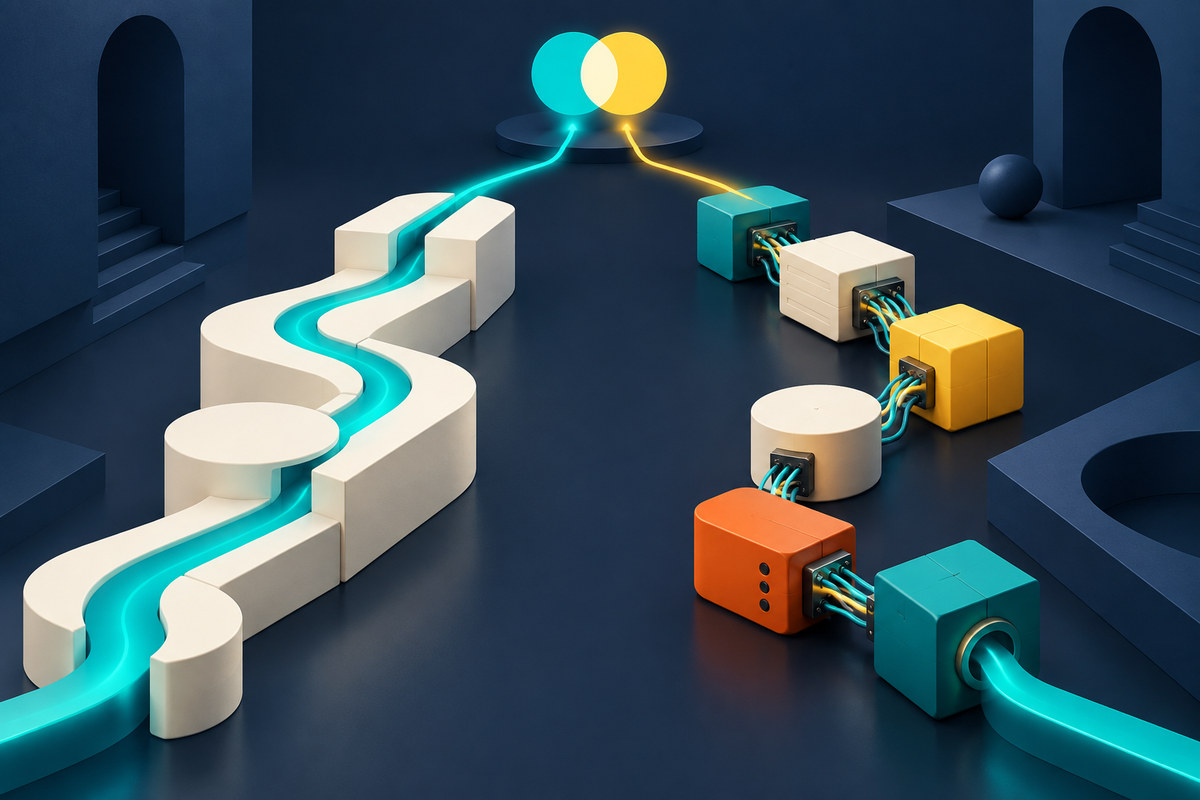
A contact-center demo is designed to feel like a single afternoon. A call arrives. An agent sees the customer. An AI assistant suggests an answer. A supervisor opens a dashboard. Everything appears to belong together. Then implementation begins, and the product’s history enters the room.
One feature has its own administrator. Another reports on a different clock. An integration carries context into voice but drops it when the customer moves to messaging. A support ticket crosses an invisible border and lands with a team that knows its module but not the whole journey.
Those moments are often treated as isolated annoyances. They may be something more useful: architectural evidence. Many major Contact Center as a Service platforms became broad through acquisition. Buying a proven company can add a mature capability, experienced people and customers far faster than building from zero. It is a legitimate—and often smart—strategy. But a portfolio can be sold as one before it behaves as one.
“The buyer is not purchasing a slide of colored boxes. The buyer is purchasing the handoffs between them.”Built vs. bought, in one sentence
That distinction matters because routing must meet workforce management. Conversation data must meet analytics. AI must receive the same context that the agent sees. Identity, permissions, reporting and support must survive every crossing. The seams are where deployment calendars stretch and operating work quietly accumulates.
Breadth has a backstory
The industry’s family trees are public. NiCE acquired cloud contact-center provider inContact in 2016, later adding digital-engagement specialist Brand Embassy, knowledge-management company MindTouch, proactive-outreach provider LiveVox and, in 2025, conversational and agentic AI company Cognigy. NiCE describes acquisitions alongside internal innovation as a route to a broader platform. The result is formidable reach: cloud routing, workforce capabilities, digital channels, analytics and AI under one roof.
Genesys provides another version of the story. Its $1.4 billion agreement to acquire Interactive Intelligence in 2016 joined two substantial customer-experience businesses. In fiscal 2022, Genesys said acquisitions of Bold360, Pointillist and Exceed.ai expanded its digital, journey-analytics and conversational-AI capabilities. Those deals gave it technologies and teams that would have taken years to recreate.
Five9 completed its acquisition of intelligent virtual-agent provider Inference Solutions in 2020 and acquired Acqueon in 2024 for approximately $173.8 million, extending proactive, omnichannel outreach. Five9 called Acqueon a step toward orchestrating interactions across marketing, commerce, sales and service. Again, the strategic logic is plain: buy specialized capability, then connect it to a larger distribution engine.
Selected family-tree moments
NiCE
2016 · inContact
2019 · Brand Embassy
2023 · LiveVox
2025 · Cognigy
Genesys
2016 · Interactive Intelligence
2021 · Bold360
2021 · Pointillist
2021 · Exceed.ai
Five9
2020 · Inference Solutions
2020 · Virtual Observer
2024 · Acqueon
None of those histories proves a bad experience. Nor does organic development guarantee elegance. A homegrown platform can still be confusing, unreliable or incomplete. Acquisition history is not a verdict; it is a map of where a buyer should look more closely.
Four places the seams tend to surface
The seam test
Don’t ask whether it integrates. Ask what survives the crossing.
Run one real journey and observe the handoffs, not just the endpoints.
Create a user, change a queue and grant reporting access. Count the logins and repeated settings.
Ask every module what counts as a handled interaction. Compare the answer and the timing.
Move from app to chat to voice. Track identity, consent, transcript, intent and attachments.
Simulate a failure across products. See whether one support team stays accountable.
“Single pane of glass” is a lovely phrase. A screen-share is better. Ask the vendor to make configuration changes live across the products in the proposal. If voice, chat, quality management and workforce tools produce different definitions or update at different speeds, managers will spend Monday reconciling Friday.
AI magnifies the issue. Models working with partial, delayed or differently defined records do not become more trustworthy because the interface looks polished. And the cost of a broken workflow is rarely the failed API call alone. It is the repeated question, the extra tab and the customer explaining the problem again. If operational ownership stops at module boundaries, the buyer becomes the integration layer.

What one codebase is supposed to buy
UJET’s counter-position is architectural: its platform was engineered as one system, with voice, digital and mobile journeys organized around a CRM-first model. Its public materials say customer context moves across channels without reconstruction, reporting follows end-to-end journeys and AI receives consistent inputs. Rather than making the contact-center database a second system of record, UJET says it reads and writes customer data through the CRM while minimizing personally identifiable information stored on its own platform.
The promised advantage is less translation. One data model reduces reconciliation. Shared controls reduce duplicated configuration. A common release process reduces the chance that improving one component breaks another. When those properties hold, deployment becomes configuration work instead of a prolonged integration program.
UJET points to that 2020 stress test: an existing e-commerce customer added more than 14,000 support agents in three weeks, taking a single-tenant cloud contact center beyond 22,000 agents. It was an expansion under extraordinary pandemic conditions, not a universal implementation timetable. Still, it demonstrates the kind of speed UJET means when it contrasts a unified platform with a stitched stack.
The company’s 2026 switching report adds customer-pattern evidence. Across organizations moving from more than 15 platforms, it groups the reasons into measurable AI, native CRM integration, built-in security and compliance, and speed and simplicity, with reliability as the baseline. The report is UJET’s own synthesis and many examples are anonymized, so buyers should use it as a set of hypotheses to test—not a substitute for a proof of concept.
The feature list is the wrong unit of analysis
Procurement naturally turns software into rows and checkmarks. Does the platform have outbound dialing? Quality management? A virtual agent? Sentiment? A checkmark proves availability. It says little about cohesion. Two vendors can check the same box while asking the customer to carry radically different operational burdens.
A better scorecard measures joins. How many identities govern the suite? How quickly does an interaction appear in every report? Can a supervisor move from a metric to the underlying conversation without changing products? Does a routing change propagate everywhere? Can the same context serve an agent, a bot and an analyst? What happens when an acquired product is renamed, repackaged or retired?
Six questions worth stealing for your next demo
- Which capabilities share one data model?
- Which products have separate administrators?
- How fresh is cross-module reporting?
- Who owns a ticket spanning two modules?
- Can we change a queue live?
- What context reaches the bot and agent?
Ask for the product roadmap at the seam level. “Integrated” might mean a shared navigation bar, a batch data transfer, a maintained connector or one underlying service. Each can be appropriate. The problem begins when those meanings are treated as interchangeable. Buyers should request the data-flow diagram, release dependencies and escalation model for the exact bundle they plan to run.
Then run the least glamorous test in enterprise software: make a small change. Add a field. Adjust a queue. Introduce a channel. Update a compliance rule. Time the work and count the teams. The everyday change request exposes architecture more reliably than the keynote demo because it reveals who owns the spaces between features.
“A platform’s origin story is not gossip. It is a clue to its daily behavior.”The practical takeaway
Buy the seams, not the story
Acquisition is how mature software markets grow up. Specialists invent useful things; larger companies give those things scale, distribution and a place in a broader suite. Customers can benefit enormously. The honest question is not whether a platform bought technology. It is how completely the acquired capability has become part of the operating system.
The reverse is true for a platform built largely as one thing. Unity is an architectural advantage only if the product also has the breadth, resilience, controls and ecosystem the operation requires. A clean foundation does not excuse a missing capability. It simply changes the type of risk—from integration drag to functional fit.
That gives buyers a sharper choice. If a broad assembled suite has the exact specialized tools required, price the seams into the decision: implementation, duplicate administration, data reconciliation, cross-product support and future upgrades. If a unified platform covers the requirements, value the speed and consistency that do not appear as separate line items.
Read the acquisition timeline, then test the borders it created. The best system is not necessarily the one with the longest feature list or the fewest corporate ancestors. It is the one whose history your agents, administrators and customers do not have to relive every day.
Reporting draws on official materials from UJET, NiCE, Genesys and Five9, plus the UJET 2026 Contact Center Switching Report.