Consider the final minutes of a restaurant meal. The conversation has found its rhythm. Nobody wants another course. Everybody wants to leave. Yet departure requires a small administrative project: attract a server, request a bill, negotiate the split, surrender the cards, wait. Cover built a company around that interval. The meal had ended; the machinery of paying for it had barely begun.
- A free diner app, earning its margin from restaurant payments.
- Stored cards, automatic tipping, and even bill splitting.
- More than 350 restaurants at the 2015 Velocity acquisition.
- Standalone app retired in 2016; functions folded into Velocity.
Founded in 2012 by Mark Egerman and Andrew Cove, Cover publicly launched in New York in October 2013. Its premise borrowed from the ease of leaving an Uber: enter payment details beforehand, enjoy the service, then go. At participating restaurants, diners created or joined a table in the app and told their server they were using Cover. The card on file settled the meal, including the chosen tip.
This was restaurant payment processing dressed as permission to leave. The customer received something unusually legible for a financial product: fewer minutes spent waiting. A wallet app asks you to admire a new way to transact. Cover offered a better ending to dinner.
The feature they learned to remove
The interesting decision concerned the split. During roughly a year of live testing, the founders tried allocating bills by dish, percentage, and dollar amount. Those options appeared helpful. They also demanded that people retrieve their phones and perform the very accounting exercise the app was supposed to abolish.
Cover settled on automatic, even splitting. The experiment had changed the founders’ minds about how much control belonged in the moment. There is a difference between giving someone every possible choice and letting someone finish dinner. Here, the latter won.
That choice has an obvious boundary. A person who ordered a salad may dislike subsidising everyone else’s wine. Equal shares suit groups willing to accept equal shares. A quiet interface cannot resolve an argument about fairness. The lesson for product builders is to watch what a feature does to the room, as well as what it does on the screen.
“meaning you weren’t better than the status quo”
Mark Egerman on the elaborate splitting options, 2013
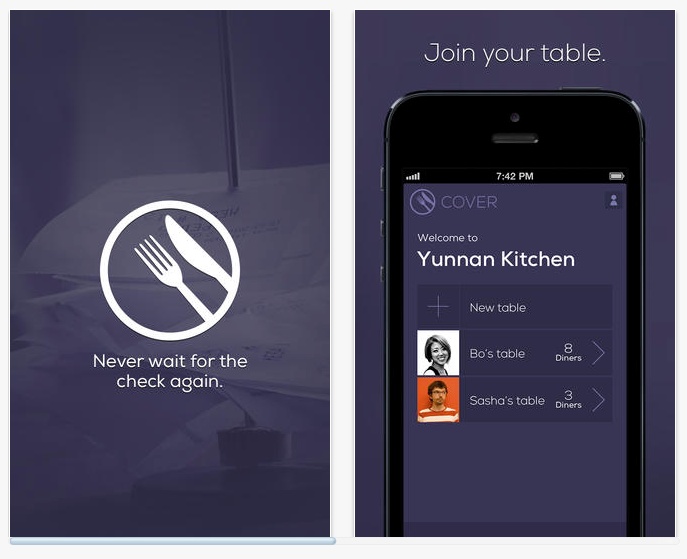
A fashionable address book was part of the product
Cover’s customers were two constituencies with different interests: diners seeking an easier exit and restaurants seeking cheaper, smoother payments. Its restaurant selection gave the app a personality. Early partners included Carbone, Parm, and Empellón Cocina; later coverage named Alder, Bar Primi, Coi, and Wayfare Tavern. These were places people had reasons to visit before anybody mentioned software.
In his 2014 Forbes test, Steven Bertoni described using Cover at Burger and Barrel and compared the experience to dining at a private club. His observation points to the positioning: the restaurant list was part of what customers were buying into, even though the app itself was free. A payment network with desirable places to eat gives people a reason to keep it installed.
Competitors approached the table from different directions. Square brought its own point-of-sale system. TabbedOut offered another route to mobile settlement. OpenTable approached payments through reservations; Cover also accommodated walk-ins. The distinction mattered at the time: a diner could use Cover without first passing through a booking funnel.
Free to download. Paid in the plumbing.
Free software still needs an income. Cover earned money from payment processing, retaining a margin between what restaurants paid and its underlying processing costs. The commercial promise was a lower restaurant fee without an app subscription for the diner. This placed its expertise in the unglamorous territory behind the pleasant exit: moving money, settling merchants, and handling exceptions.
In a contemporary Eater interview, Egerman described Cover covering a venue’s payment and gratuities when a card failed, then contacting the diner afterward. Removing the awkward encounter at the table transferred work and risk to the company. The payment had become less visible to the guest, not less real.
Investors supplied $1.5 million in seed funding in 2013, followed by a $5.5 million Series A led by Spark Capital in July 2014. That is $7 million of disclosed early funding. The restaurant rollout also required human effort. An elegant consumer flow depended on venues agreeing to use it and staff knowing how to close the tab. Downloads alone could not create that network.
350 restaurants, then a larger table
By March 2015, Cover had added Los Angeles to New York and San Francisco. In September, Velocity announced its acquisition, reporting acceptance at more than 350 restaurants across those three cities. The acquisition price was undisclosed. The number describes restaurant availability, not active diners or profitable locations.
Velocity offered a broader hospitality proposition, connecting venues and affluent guests through payments, loyalty, and access. Its announcement gave restaurants a choice: retain Cover’s standalone iPad solution or move to an integrated platform with a venue dashboard and customer relationship management tools. Egerman became executive vice president of payments; Cove joined the advisory board.
The strategic logic was consolidation. Restaurants were being asked to juggle booking, payment, loyalty, and customer-management products. Combining services could make the supplier relationship easier while giving Velocity an established American foothold. The deal changed the unit of competition: a pleasant checkout now belonged to a wider hospitality offering.
New York · San Francisco · Los Angeles
Reported at acquisition, September 2015
The app retired. The idea kept its seat.
In May 2016, Eater reported that Cover had been retired and its functionality and restaurant partners consolidated into Velocity. The standalone product ended before the broader ambition did. Later, Velocity Black developed into a digital concierge spanning travel, entertainment, shopping, and dining. Capital One announced its acquisition of that business in June 2023.
Cover belongs to that history as the restaurant-payments company. Treating it as today’s AI lifestyle concierge would collapse several businesses and years of change into a misleading present tense. Its useful contribution is specific: it showed how much a product could achieve by understanding one small, disagreeable ritual.
What can another founder copy? Pick a moment people already resent, test it in its actual setting, and make adoption worthwhile for the business that must deliver it. Then examine who absorbs the exceptions. Cover’s quiet exit required a participating restaurant, cooperative staff, an acceptable split, and reliable settlement. When those conditions hold, software can be gracious enough to let the evening continue without it.
Keep a table in the conversation
Explore Cover’s historical website, its LinkedIn, X profile, and Facebook. Follow the parent’s later business at Velocity Black.
Watch the founders’ Food+Tech meetup interview · Read about the app’s retirement · Read Capital One’s acquisition announcement.