For years, summer at Boscia & Boscia meant asking people to pay for work already finished. Tax season ended; collections season began. The accounting firm’s problem was almost comically familiar: it could calculate someone else’s obligations more efficiently than it could collect its own.
In an Anchor-published account, partner Nick Boscia describes a different calendar. The firm now collects roughly $700,000 before tax season starts. He reports that about 99% of clients pay through Anchor. Those are one firm’s results, but the sequence is worth examining. The important event moved from the end of an engagement to its beginning.
- Clients approve the agreement and connect their payment method together.
- Agreed billing terms drive invoices, collections and accounting sync.
- The platform costs $5 per successful payment; payment frequency matters.
- Firms still have to define services, handle exceptions and bring clients along.
An agreement with a job to do
A conventional engagement letter is a record of a promise. Anchor makes that promise operational. The service provider specifies the work, price and billing terms; the client approves and supplies a payment method. Scheduled invoices and collections follow the agreement. The document acquires a second occupation.
This is particularly useful in professional services, where the work rarely stays politely inside its original description. A bookkeeping client adds payroll. A consulting project picks up another deliverable. Anchor supports changing agreements and flexible billing arrangements, so the commercial record can keep pace. The alternative is often a person remembering to update several systems, preferably before everyone goes home.
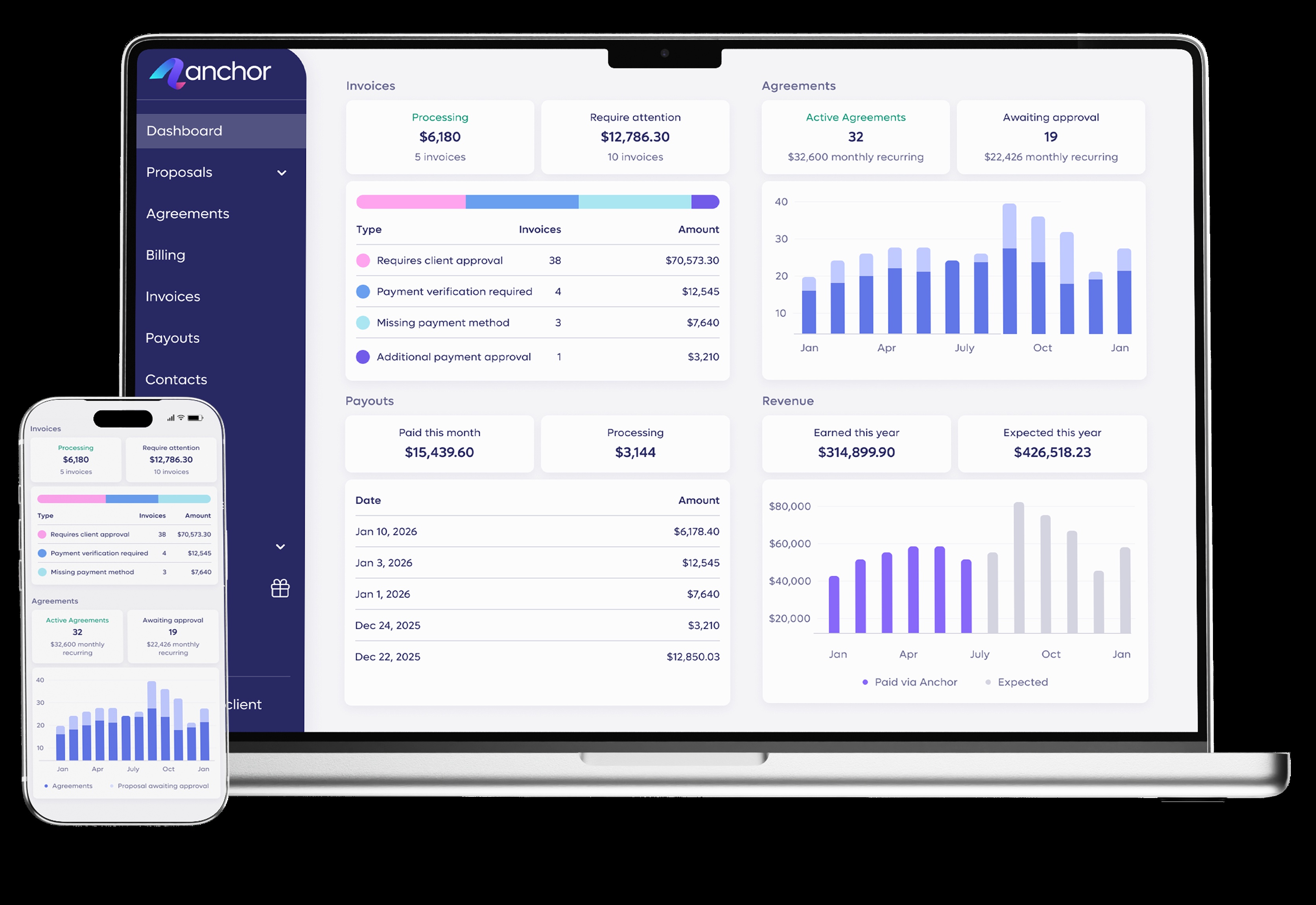
The agreement interface brings billing controls, invoices, payment methods and an activity log together. Clients have portal access to the same agreement history. That matters: automatic collection asks the customer to surrender a familiar ritual, and visibility helps make the replacement intelligible.
Five dollars, multiplied by habit
Anchor’s published pricing is unusually easy to put on a napkin. There is no monthly platform subscription. The company deducts $5 when a payment succeeds. Users, clients, proposals and invoices are unlimited under that model. ACH carries no additional processing charge; cards cost 2.9% plus 30 cents, a fee the firm can absorb or pass to the client according to its tax-firm page.
The arithmetic deserves more attention than the word “free.” A $5 platform fee equals 5% of a $100 payment and 0.5% of a $1,000 payment. Collect from 100 clients once a month and the platform charges $500 for those successful payments. Collect twice and it becomes $1,000. These are illustrations, excluding card charges, rather than estimates of any customer’s bill.
For a firm replacing subscriptions and repetitive administration, that may be attractive. For one collecting many tiny payments, the equation changes. Compare the whole workflow: software charges, processing charges, payment count and the staff time left behind.
The software cannot make the firm say no
Boscia’s firm tried Ignition before switching. The Anchor account says adoption had disappointed; a demonstration and the option to pass card fees to clients helped change his mind. Migration was gradual. The firm moved willing clients first, later made Anchor the required method, then changed bookkeeping billing from quarterly to monthly. The lesson is sequencing: avoid asking clients to learn every new habit at once.
“Our summers were doing collection work. Now we do none of that.”Nick Boscia, partner, Boscia & Boscia PC
GWCPA’s account offers a different route. Previous piecemeal payment arrangements had created complexity, so the practice chose one process for the firm. Its six-figure receivables balance fell to near zero over roughly a year. Automation helped, but outstanding balances also required conversations, payment plans and a firmer stance about providing future services.
That qualification is the story. Some clients left without paying. Software did not rescue every dollar. It made an agreed process easier to execute; management supplied the resolve. A practice that keeps doing unbilled work, accepts endless exceptions or leaves its service descriptions vague can reproduce its old problems inside a handsome new interface.
There are product limits, too. Anchor’s on-demand services require manual billing. Its staged-billing guide allows up to six stages and says changing an existing staged service requires removing and recreating it. Automation is a set of explicit rules, with someone still responsible for the unruly bits.
A narrow wedge into a crowded market
Founded in 2021, Anchor’s leadership comprises CEO Rom Lakritz, CRO Omry Man and CTO Leeor Aharon. The company describes backgrounds spanning finance, cybersecurity and software architecture. Its stated mission is to remove the time, uncertainty and cash-flow anxiety created by old billing processes.

The market already contains engagement software such as Ignition and GoProposal, broader client-management tools, and accounting packages with invoicing features. Anchor’s argument is the continuity between agreement and collection, plus transaction-based platform pricing. It also connects to the books: QuickBooks Online and Xero integrations synchronize invoices, payments and refunds. Zapier and Make extend the workflow to other tools.

Distribution matters in a profession that runs on trust. A 2022 CalCPA partnership offered member discounts and support through an association with more than 40,000 members. That is access to an audience, not 40,000 customers. In January 2025, Anchor announced $20 million in Series A funding, led by Mosaic General Partnership and Oren Zeev, following its $15 million seed round.
The next interface is a conversation
Anchor’s May 2026 Claude Connector documentation describes querying invoices and creating or editing proposals through natural language. Its directory still labels that connector “coming soon,” so availability merits checking. The guide draws a useful boundary: charging clients and adding credit remain outside connector actions. It also advises reviewing consequential changes.
The practical idea survives without AI. Define the service. Agree the terms. Obtain payment authorization before the work creates a debt. Keep changes visible. Anchor packages those decisions into software, but the decisions remain the firm’s. The reward, when the arrangement holds, is wonderfully ordinary: summer becomes summer again.