Worldwide
Rate (2024)
Share
Active Users
The Company That Runs Your Child's Preschool
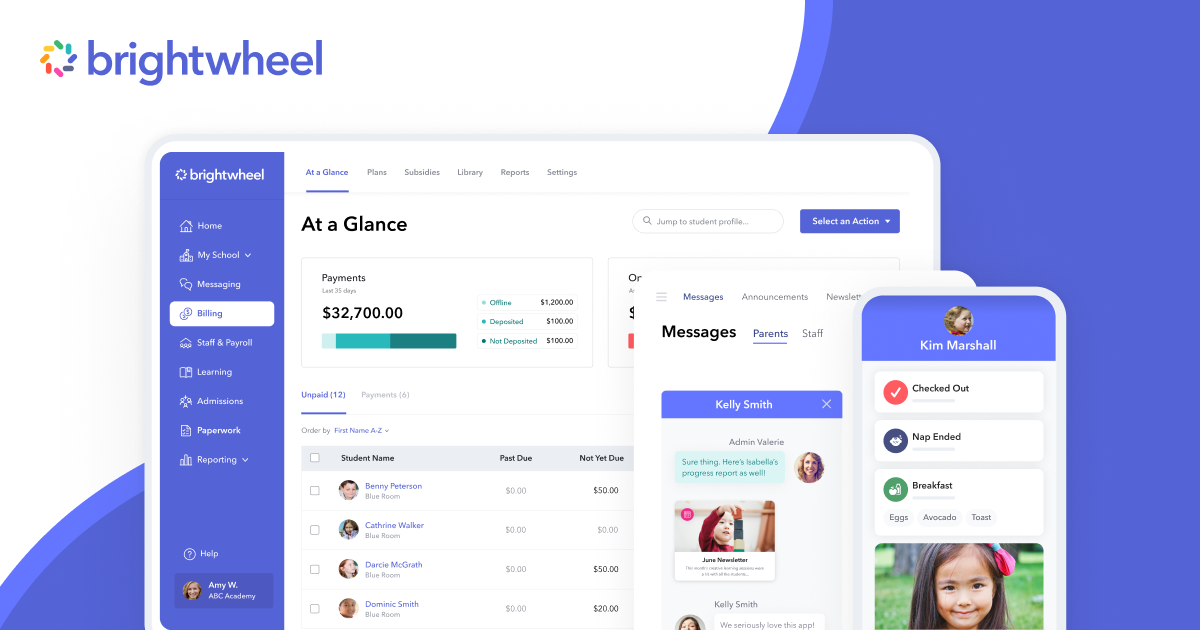
Walk into almost any childcare center in America and you'll find brightwheel somewhere - on the tablet at the front desk, in the teacher's pocket, on the parent's phone. The app tracks who arrived, who's been fed, what milestone a two-year-old hit during circle time, and whether last month's tuition cleared. It sends a photo to a parent at 11am, confirms a subsidy payment from the state at noon, and generates a compliance report for a licensing audit before pickup.
This is not a niche product. With 150,000 programs served and 53% of the childcare management software market, brightwheel is the category. Its closest competitors share the remaining half among themselves. It processes more childcare billing than any other platform on earth. And it got there not by disrupting a glamorous industry, but by solving a problem everyone else found too small, too messy, or too unglamorous to touch.
"150,000 programs, 2.2 million monthly users, 50+ countries - and the market problem they exist to solve is still, in large part, the clipboard."
brightwheel profile - YesPressAmerica's Childcare Infrastructure Was Running on Paper
Before brightwheel, the administrative reality of a preschool director's day was genuinely grim. Enrollment meant paper packets, wet signatures, and file cabinets. Billing meant spreadsheets, post-it reminders, and uncomfortable conversations about late payments. Attendance was a literal clipboard by the front door. And parent communication - the daily updates, the incident reports, the developmental milestones - happened via printed newsletters and phone tag.
There was nothing charming about this. It wasted teacher time that should have been spent with children. It created compliance risks for centers navigating state licensing requirements. It made billing inefficient, collection unreliable, and cash flow unpredictable. For a sector where the average operator runs on thin margins and one bad month can close a program, none of this was abstract.
The numbers tell it plainly: Early education centers spend an estimated 20+ hours per week on administrative tasks that software can automate. For a director managing 80 enrolled children, that's half a workweek - every week - not spent on curriculum, teacher development, or the actual education part of early education.
Dave Vasen Went to Preschool. At 30-Something.
Dave Vasen had credentials that made no obvious sense for childcare software. Stanford BA (honors). Wharton MBA (distinction). Product lead at Amazon on the Kindle team. VP of Product at AltSchool. He'd built licensing programs for hardware manufacturers and managed a K-12 education vertical for one of the world's largest companies.
But before he wrote a line of code for brightwheel, he spent weeks inside a preschool - not observing from a boardroom, but actually working there. Washing snack cups. Filing attendance sheets. Watching teachers split their attention between children and clipboards. The inefficiency wasn't theoretical. It was physical - the stuck file drawer, the missing signature on a health form, the billing spreadsheet someone hadn't updated in three weeks.
His daughter Serena had just been born. The problem of childcare quality - and the visibility that parents lack when their child is in someone else's care - had become personal. Brightwheel launched in 2014 out of that collision: operational empathy, technical fluency, and the particular stubbornness of someone who knows what good software feels like and refuses to accept what bad administration costs.
"He tested early prototypes directly with real teachers. Not focus groups. Not surveys. Real classrooms, real problems, real snack-cup logistics."
brightwheel - OriginOne App Where Seven Apps Used to Live
Brightwheel's pitch is deceptively simple: replace the stack. Before brightwheel, a typical childcare center used separate tools for billing, attendance, parent communication, enrollment, lesson planning, and compliance reporting - often held together by spreadsheets, email threads, and institutional memory. Brightwheel collapses all of it into a single platform that runs on any device, syncs in real time, and doesn't require an IT department to maintain.
QR-code and app-based contactless check-in with live room ratio monitoring and licensing compliance tools.
Automated invoicing, autopay, late fee automation, subsidy tracking, and year-end tax statements for families.
Real-time daily updates, photos, videos, and direct messaging. Parents see what's happening in the classroom as it happens.
Custom online enrollment packets, digital signatures, waitlist management, and family application portals.
Lesson planning, Experience Early Learning curriculum integration (acquired 2023), and HighScope-aligned assessments.
Time tracking, scheduling, time-off management, and one-click Gusto payroll integration for seamless processing.
Expense tracking, P&L reporting, general ledger, and CACFP management for federal nutrition program compliance.
Centralized dashboards for enterprise operators running multiple locations with consolidated reporting across sites.
* ARR figure represents annualized run rate as of mid-2024. Revenue figures from public sources.
Ten Years, One Clear Direction
Numbers That Don't Require a Glossy Pitch Deck
The strongest argument for brightwheel isn't the funding story or the valuation - it's the retention. In a market where most SaaS companies celebrate 90% retention as a win, childcare software has historically been sticky because switching costs are high and operator time is scarce. Brightwheel has turned that stickiness into something more deliberate: a 97% customer satisfaction rating, new features shipped monthly at no additional cost, and what the company calls the largest support team in early education technology.
The Gusto payroll integration is a useful case study. Instead of building a competing payroll product, brightwheel connected directly to an existing best-in-class tool - reducing the number of logins a center director needs, and making the entire ecosystem more defensible. The 2023 acquisition of Experience Early Learning follows the same logic: if a competitor could offer a curriculum tool that brightwheel didn't have, eliminate that gap entirely by bringing it in-house.
"97% customer satisfaction in childcare software. In 2024. That isn't luck - that's a team that reads its own support tickets."
brightwheel profile - YesPressThe partnership with Learning Care Group - one of the largest multi-site childcare operators in the country - shows the enterprise path is real. The platform's multi-site management tools, centralized reporting, and consolidated dashboards are designed for organizations running dozens or hundreds of locations. At that scale, the billing automation and compliance reporting alone can justify the contract.
$88.8M and a Who's Who of EdTech Credibility
| Round | Amount | Date | Lead Investors |
|---|---|---|---|
| Seed | Undisclosed | Jun 2015 | Eniac Ventures, Lowercase Capital, Mark Cuban |
| Series A | $10M | Oct 2018 | GGV Capital, Chan Zuckerberg Initiative, ICONIQ |
| Series B | $21M | 2020 | Bessemer Venture Partners, Omidyar Network |
| Series C | $55M | Feb 2021 | Addition, Bessemer, Emerson Collective, GGV |
Total: $88.8M across 30 investors including 22 institutional. Valuation: $700M+ (2024)
The Administrative Burden Is the Educational Problem
Brightwheel's stated mission is to give every child a high-quality early education - by empowering the teachers and administrators who provide it. The logic is specific, not vague: if a preschool director spends 20+ hours a week on paperwork, she spends 20+ hours a week not improving curriculum, not coaching teachers, not building the family relationships that make programs sticky.
The software is the lever. Automate billing, and a director recovers time for classroom observation. Digitize enrollment, and a family gets a smooth first impression instead of a confusing paper packet. Give parents real-time updates, and trust in the program increases - which drives referrals, which fills waitlists, which makes the business viable enough to raise teacher pay and reduce turnover.
It's a coherent theory of change. And unlike a lot of edtech mission statements, this one is backed by a product that actually does what it claims.
The Details Worth Knowing
Dave Vasen personally worked in a preschool for weeks - using actual clipboards and juggling multiple apps - before writing a single line of code for brightwheel.
Brightwheel was the first childcare app to introduce two-factor authentication - proving that security in early ed wasn't someone else's problem.
Mark Cuban and Chris Sacca invested $600K on Shark Tank Season 7 (April 2016) for 6.67% equity. The bet aged rather well.
A new staff member can be fully onboarded and comfortable on the platform in under 15 minutes. That's a UX achievement in any software category.
The Chan Zuckerberg Initiative invested in both the Series A and Series B - a rare double-down that reflects brightwheel's alignment with early childhood education outcomes research.
Despite fewer than 500 employees, brightwheel maintains the largest engineering team and the largest customer support team dedicated exclusively to early education technology.
Early Education Tech Is a Decade Behind Every Other Sector
Healthcare, finance, real estate, logistics - all of these have been transformed by software. Early education is catching up, but the gap is still significant. Most of the 50,000+ licensed childcare operations in the US are small businesses - owner-operated, under-resourced, and historically underserved by technology companies who preferred to chase larger enterprise contracts.
Brightwheel's bet is that the bottom of that market is now addressable at scale - and that solving it well creates a compounding advantage. Every new program onboarded increases the network effects of the platform. Every new feature added (financial reporting, curriculum tools, multi-site management) increases the switching cost. Every parent who experiences real-time updates and digital billing becomes an implicit demand-generator at the next childcare center they consider.
The 2026 product roadmap points toward a full-stack education operating system: one that connects back-office compliance with frontline classroom experiences, and that grows with programs as they scale from a single room to a multi-location enterprise. The company isn't finished building. The market isn't finished adopting. And the clipboard problem - for all the progress - isn't fully solved yet.
brightwheel in Action
All the Links You Need
Back to the Classroom
That preschool director from the opening - the one juggling the clipboard, the billing spreadsheet, the unanswered parent texts, and the licensing audit that's coming up next Tuesday - she still exists. There are tens of thousands of her, running programs in church basements and strip malls and purpose-built early learning centers across America.
What's changed is that the clipboard is optional now. Check-in is digital. Billing runs itself. The parent who texted at 9am got a photo update at 10:30. The compliance report is three clicks away. And the director, instead of staying two hours late reconciling payments, went home at 5.
That's the mundane, specific, genuinely useful version of what brightwheel does. No grand disruption narrative required. Just a company that identified a real problem, built a real product, and kept improving it until it became indispensable. 150,000 programs and a $700M valuation later, the original thesis holds: operational software is educational infrastructure.