An insurance premium is an unusually obedient expense. It leaves the company, appears in the accounts, and returns next year asking for more. Luzern Risk begins with an awkward question: if a business understands its own losses, why must it always rent someone else’s balance sheet to finance them?
The answer might be a captive: a licensed insurance company owned by the business it insures. Premiums go into that company. Claims come out. Surplus can remain with the owner. The charming part is ownership. The less charming part is that you have acquired an insurance company, with all the accounting, capital, and regulatory obligations the phrase implies.
- Own the risk: Luzern helps businesses assess, form, and run captive insurers.
- Bring the machinery: specialist services and a digital platform come in one flat-rate engagement.
- Check the economics: retained profits are possible; claims and capital commitments remain yours.
The bill becomes a balance sheet
Consider a fleet manager. Luzern describes one with more than 40,000 vehicles and roughly $55 million in annual premium moving into a captive. That is enough insurance spending to make ownership a boardroom question. If the fleet can manage its risks well, why should all the underwriting margin belong elsewhere?
A smaller example makes the same point. A real-estate technology firm plans five coverage lines in one captive, with a projected $400,000 first-year reduction in commercial premium. That number is a forecast, not a cheque already deposited. The distinction matters: a captive rearranges who finances losses; it does not make the losses vanish.
Projected first-year reduction in commercial premium
Vehicles in a client’s fleet; approximately $55M annual premium moving into its captive
Luzern’s audience includes CFOs, risk professionals, legal teams, and brokers. Its clients range from smaller businesses with substantial insurance needs to publicly traded companies. Real estate, transportation, healthcare, and program insurance feature in its public material. These are customers for whom insurance can be a meaningful piece of the financial architecture.
Nine trades walk into one dashboard
Running a captive involves specialists who ordinarily have excellent reasons to occupy separate inboxes. Luzern groups the work into nine disciplines: accounting, actuarial, legal and tax, fronting and reinsurance, captive management, claims, investments, advisory, and regulatory compliance. Its product is the coordination of those disciplines as much as the software itself.
The platform holds financial statements, claims activity, policies, documents, and filing status. It adds scenario modeling, electronic signing, compliance workflows, role-based access, and API integration. Owners can look at the insurer they own without first commissioning a report about it. A dashboard has rather more appeal when the underlying money is yours.
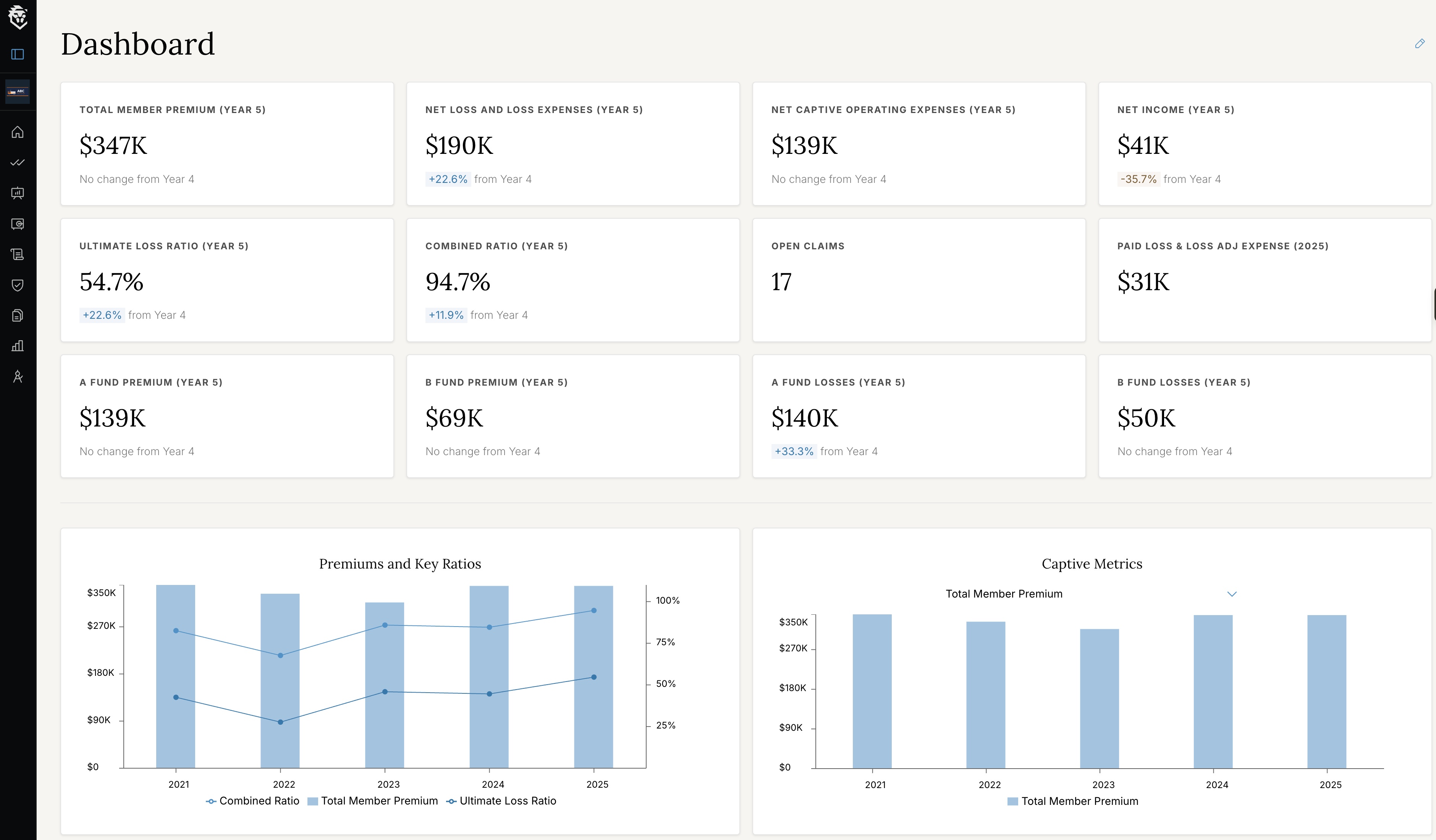
Luzern calls its platform AI-native and says automation handles repetitive work so specialists can spend more time on analysis and advice. The useful question is what becomes easier to operate. Live information, fewer handoffs, and a shared record are tangible features. They still need competent people interpreting reserves, negotiating capacity, and answering regulators.
New captives begin with program review and actuarial feasibility, followed by structure and domicile selection, approval, and licensing. Existing owners can change manager. Brokers can bring clients while remaining broker of record. Luzern supplies the captive machinery behind the relationship, an arrangement with considerably less social drama than replacing the broker.
A Ranger, a physicist, and the paperwork
CEO and co-founder Gabriel Weiss previously co-founded Safekeep, acquired by CCC Intelligent Solutions, and served as an Army captain and Airborne Ranger. CTO and co-founder Jonathan York is an Oxford-trained physicist with technology leadership experience at Bridgewater Associates and Standard & Poor’s. CMO and co-founder Sam Espinosa founded Next Caller, later acquired by Pindrop.


The biographies suggest a company comfortable with financial systems. Insurance expertise supplies the other half: the team includes actuarial, captive accounting, risk, and management specialists. Its advertised service model gives customers a dedicated advisor and a response within two business hours. That commitment describes responsiveness, rather than promising that every complex problem can be solved before lunch.
Founded in 2023, the business was formerly XN Captive. Its 2025 rebrand accompanied a $12 million Series A from Caffeinated Capital. In June 2026, former Marsh Captive Solutions president Ellen Charnley became the founding member of its advisory board. September brought a $45 million Series B led by Insight Partners, with Trust Ventures and Caffeinated Capital participating.
The new capital has three stated jobs: develop the platform and its AI capabilities, systemize operations, and broaden clients’ alternative-risk options. Weiss describes the aim as “deliver better outcomes for our clients, at a much greater scale.” The operational challenge is making specialized work repeatable without flattening each customer’s peculiar risks.
Ownership has an entry price
Luzern advertises one all-inclusive flat management rate. Premiums and starting capital are separate commitments, held within the captive to support its obligations. Formation and operation also carry expenses. Comparing a manager’s fee with last year’s insurance bill would therefore miss much of the calculation.
Its published guidance says some structures may be viable around $100,000 in premium; others need well over $1 million. Structure, coverage, and loss history determine the answer. The free modeling tool asks seven questions and shows six years of estimated performance. It is a useful opening conversation, followed by formal feasibility work.
Marsh and Aon already offer captive expertise; Marsh also has a digital Captive Companion platform. Luzern’s competitive proposition combines brokerage independence, bundled pricing, and a shared operating system. For a buyer, the sensible comparison is the complete service, provider arrangements, reporting, and economics of the proposed program.
The practice readers can borrow is simple: assemble loss history, policies, premium, exposure data, and financials before deciding how much risk to retain. A business short of committed capital, facing unfavorable loss economics, or needing guaranteed immediate savings may find ownership unappealing. Luzern’s interesting idea is to make that decision legible. The insurer becomes a company you can examine, rather than an annual bill you endure.