At Social Tap, across from San Diego’s Petco Park, a drink could take twenty minutes to reach a table. That is a substantial portion of an evening to spend contemplating an empty glass. The venue’s problem, as Union’s case study tells it, was painfully ordinary: a server took an order on paper, then entered it into a point-of-sale system. When baseball crowds arrived, the sequence became a queue.
- Union puts ordering and payment on guests’ phones and staff iPhones.
- Its specialty is the busy bar, where open tabs and sudden crowds complicate service.
- The same transactions feed a second business: beverage-brand engagement and purchase intelligence.
The intriguing question was whether the bar needed more people or fewer steps. Social Tap had tried other approaches without getting the service it wanted. Three weeks before opening day, it chose Union. Installation finished four days before the season began. Union’s published account reports drink waits falling to two minutes. Treat that as a customer case study, rather than a forecast for every establishment. Still, it identifies a problem worth examining before another recruitment advertisement goes up.
The missing minutes
Union sells a venue operating system: cloud-based POS software, payments, guest ordering and tools for managing the work around them. Its chosen habitat is high-volume hospitality. A quiet shop and a crowded nightclub may both accept cards, but their evenings bear little resemblance. Union’s POS page advertises support for more than a thousand tabs, offline funds capture and a button for closing all tabs at night’s end. These are details written for people who have actually had to close a bar.
Guest-led ordering changes the route. A customer scans or taps, browses a menu and sends an order from a phone. A ticket reaches the printer or kitchen display. Staff prepare it and deliver it; guests can pay and tip when ready. No app download is required for the current QR ordering flow. Staff retain the ability to add items and adjust the tab. The phone takes over some clerical work while people continue doing hospitality.
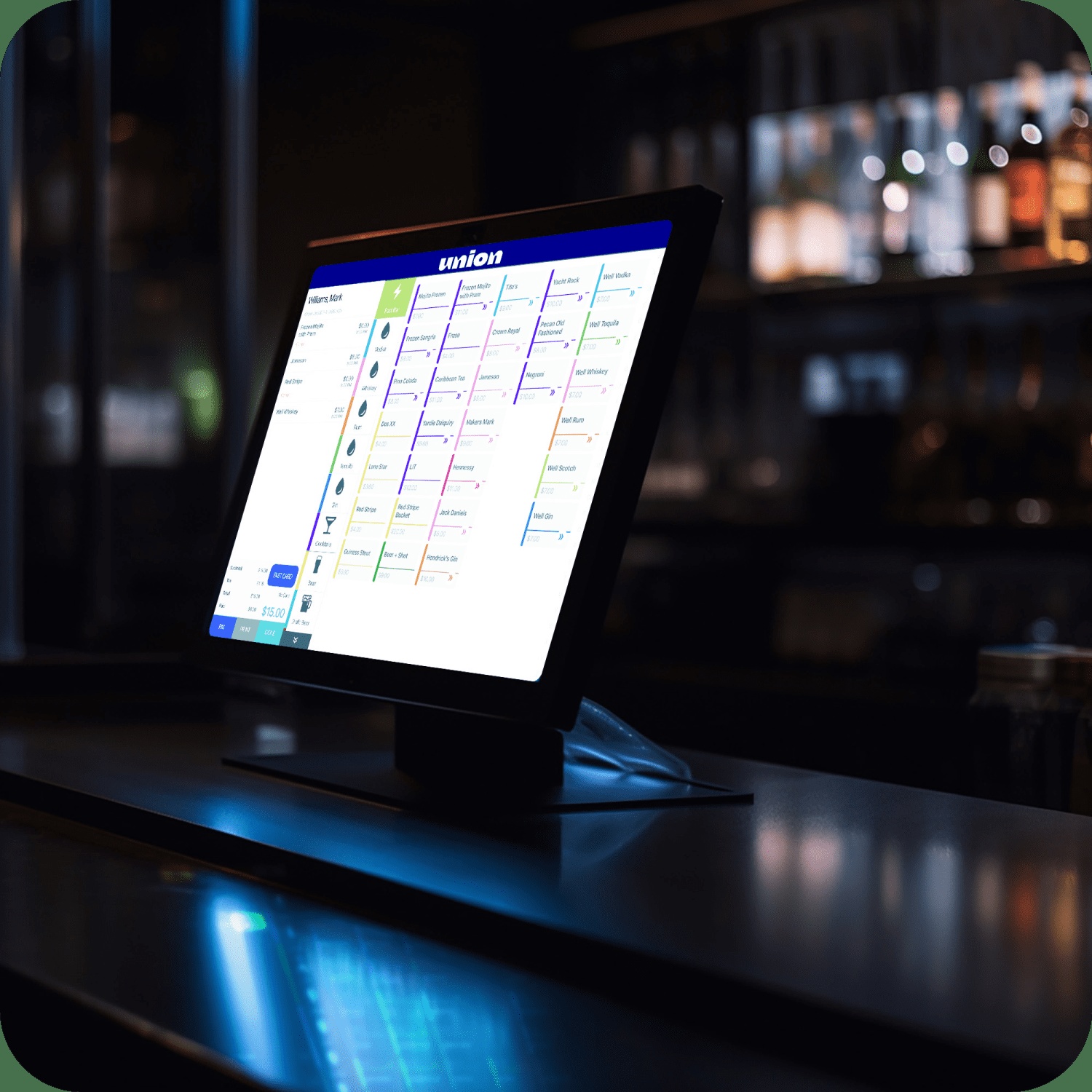
Union Pocket extends that idea to servers. The iPhone POS can take an order at the table, split a check and accept Tap to Pay. The first iPhone solution was announced in September 2023; the current product supports compatible iPhone 12 and later devices. A walk back to a terminal may look trivial on a floor plan. Repeat it throughout a crowded shift and it becomes a job of its own.
A loyalty scheme with a memory
At Austin’s Bouldin Acres, guests spread across an outdoor venue with televisions, a concert stage and pickleball courts. The distance between wanting a drink and finding someone to order it from was part of the service problem. Union’s case study describes the move to guest-led ordering and an operator who incorporated rewards into his sales strategy after seeing how rewarded cocktail purchases performed.
There are two distinct reward arrangements. Union Rewards funds credits in the mobile experience while the venue receives the item’s full price. Status, by contrast, is the venue’s own loyalty program: a phone number identifies the guest, spending earns points and rewards apply automatically. Status is included in the subscription, but the venue funds its discounts. The distinction matters. A complimentary feature and a complimentary drink are different entries in the accounts.
Then the tab changes employers
A transaction is useful to the bar because it records a sale. It is useful to a beverage brand because it records a choice. Union’s OnPrem Impact Network offers brands product-trial opportunities and consumption insights. A distributor’s shipment can tell a supplier what arrived; a tab can show what somebody ordered. Those observations answer different questions.
In July 2026, Union announced a partnership with Seek to put its purchase data into Insight Cloud. The offering includes analysis of market performance, brand switching, consumer loyalty and pricing. The announcement describes a network across more than forty states. That gives the company a place in both hospitality software and beverage intelligence. It also creates a reason to scrutinize the sample: independent, high-volume bars do not represent every place Americans drink.
Union’s terms explicitly describe advertising and data licensing among its commercial activities. Its model therefore includes venue software and payments alongside brand engagement and intelligence. Captured spending is transaction volume, however, and should never be mistaken for company revenue. A large tab total does not tell you what Union keeps.
The price of trying it
The expansion was backed by a $22 million Series B announced in December 2021, led by Clerisy with investors including Fiserv, NEA and Aquila Capital Partners. Broeker, Union’s founder and CEO, described customers comfortable with digital ordering but impatient with the rituals surrounding it.
“What they are not comfortable with is waiting to be seated, waiting to order, and waiting for their check.”Alex Broeker · December 2021
For an operator considering a smaller experiment, GameOn keeps the existing POS and adds mobile ordering during busy periods. Its public offer lists a $299 setup fee and a limited-time rate as low as three percent of GameOn sales, including processing. At that advertised rate, $10,000 of sales would mean $300 in sales-based charges, plus setup. That is illustrative arithmetic, not a merchant quote. KitchenHub, which brings third-party orders into Union and synchronizes menus, is advertised separately at $49 a month.
Copy the question before the software
Union competes for operating decisions also served by Toast, NCR Aloha and TouchBistro. Its argument centers on beverage-heavy venues, guest control and the commercial value of purchase data. Partnerships extend its reach: OpenTable connects reservation and POS information, while integrations cover scheduling, inventory, accounting and tips. Its public support promise includes human help around the clock, a sensible accommodation to customers whose trouble rarely respects office hours.
The useful thing to copy is the diagnosis. Measure where orders stall, test a different route, and compare service times before declaring victory. If preparation is already the bottleneck, faster ordering can simply move the queue. Partner guidance also excludes straightforward retail and quick-service businesses without substantial alcohol sales. Union’s proposition works best where its particular questions matter: who is waiting, what they want, and what another round would require.