The Booking That Was Never There
There is a particular kind of loss that hotel accounting is not built to see. A guest finds the property, likes the room, clicks through to pay - and then the card declines, or the funds are short, or the checkout page simply times out on a hotel Wi-Fi connection somewhere over the Indian Ocean. The guest shrugs and books elsewhere. Nothing appears in the property management system. There is no cancellation to log, no no-show to flag, no line item anywhere. The booking never existed, so nobody mourns it.
Fikäfi calls these shadow guests, and the company's claim about their number is the most provocative thing it says in public. When it examined the payment layer across its client properties, it found two to three of them hiding behind every completed booking.
That figure deserves scrutiny - it is a vendor's number, drawn from a vendor's client base, and any hotel's ratio will depend heavily on its markets, its card mix and how long it holds an authorisation. But the underlying observation is not really in dispute. Payment failure in travel is common, and the failure happens in a gap between the booking engine and the acquirer where no single department owns the reporting. Revenue managers watch conversion. Finance watches settlement. Nobody watches the seam.
We opened up the payment wall and found two to three shadow guests hiding behind every completed booking. Hotels spend heavily to drive guests to their door. Payment failure isn't their fault. But being blind to it is.Andre Privateer, Co-Founder and CEO, Fikäfi
That framing - not a new feature, a renamed problem - is what Fikäfi is really selling. The software follows from it.
What the Company Actually Does
Strip away the framing and Fikäfi is a payments layer that sits between a hotel's reservation systems and its bank. It supports credit cards, debit cards and digital wallets, and says it will add local payment methods where a market demands them - a practical concession in regions where a domestic scheme, not Visa, is how people actually pay.
The entry product is Paylinks. These are secure, time-bound payment requests sent by email, SMS or WhatsApp, used for deposits, balances, advance payments and card capture. The WhatsApp channel is not decoration. In the Maldives, Sri Lanka, Egypt and much of the Gulf - Fikäfi's earliest markets - WhatsApp is where the reservations desk and the guest already talk. Putting the payment request in that thread removes a step rather than adding one.
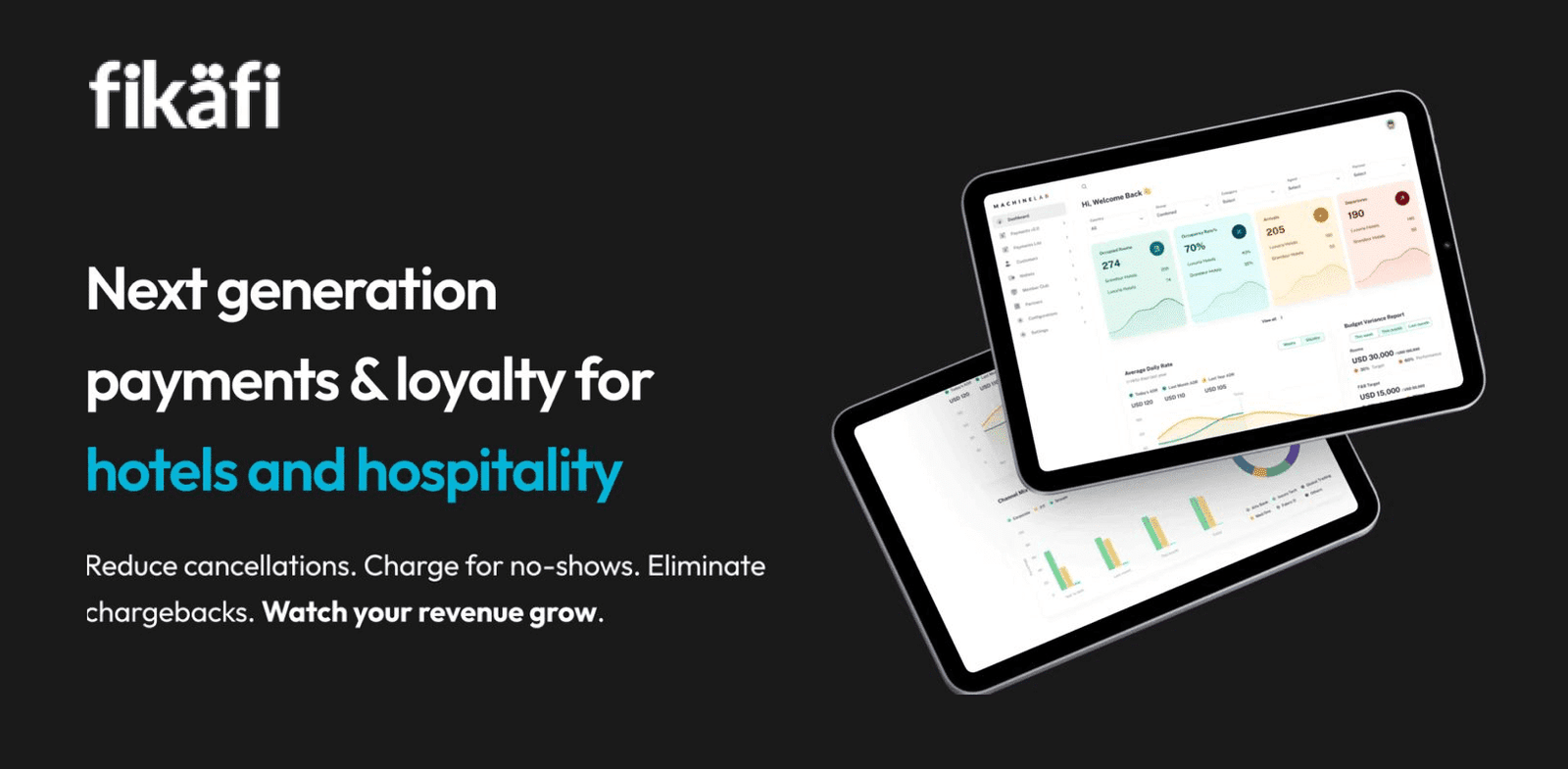
From there the platform extends in two directions. Backwards into revenue assurance: verify a payment method at booking, charge the full stay ahead of arrival, automate the reminder sequence in between, and expose pending, expired and failed payments on a dashboard where somebody has to look at them. Forwards into loyalty: a guest-facing digital wallet holding redeemable credit, a member club for properties with no chain programme behind them, a CRM for pre-stay and post-stay messaging, and a mobile app tying booking and rewards together.
A quieter module handles partner payment automation - calculating and transferring commissions to agents and intermediaries. It is unglamorous, and it is the sort of thing that consumes a finance team's month in spreadsheets at a 200-room independent.
Paylinks
Time-bound payment links by email, SMS or WhatsApp, with automated reminders. Used for deposits, balances and card capture.
Pre-Arrival Charging
Confirms a valid payment method at booking and charges the full stay ahead of check-in, targeting no-shows and chargebacks.
Orchestration Layer
A single rail across domestic and international guests, local compliance and automated settlement - built to be embedded inside a PMS.
Digital Wallet
Guest-held credit and rewards, redeemable only on direct bookings. The counter-move against OTA commission.
Member Club & CRM
Membership tiers and personalised guest messaging for independents that have no chain loyalty scheme to lean on.
Partner Automation & Dashboards
Commission calculation and transfer, plus real-time visibility over pending, completed, expired and failed payments.
The Customers, and the Maths They Are Doing
Fikäfi's direct customer base is independent hotels, resorts and small-to-mid groups - properties with real rate complexity but no in-house payments team. Its site lists more than seventeen properties, among them Abbey Hotel, Ayala Hotels, Bandos Maldives and Jetwing Hotels, with a geographic centre of gravity across the Indian Ocean, the Middle East, Egypt and the UK.
These are exactly the operators squeezed hardest by online travel agency economics. Commission on an OTA booking commonly runs 15 to 30 percent. A chain can absorb that because it has a points programme, an app and a brand that pulls guests back direct. An independent resort in the North Malé Atoll has none of those things, so it rents the customer relationship in perpetuity.
Fikäfi's answer is deliberately unsubtle. Rather than issue points - cheap to grant, hard to redeem, and the reason most independent loyalty schemes are theatre - it issues wallet credit. Real money, spendable on the next direct stay. The proposition to the operator is a straight arbitrage: pay the guest something in advance to come back direct, or pay the OTA more after the fact.
The company's headline client result comes from a 15-property group in Saudi Arabia, which it says recorded a 58 percent lift in direct revenue within two weeks of deployment. Two weeks is fast enough to be worth interrogating - a change of that speed reflects timing and collection mechanics rather than demand creation. Which is consistent with what the product does. It does not find new guests. It collects from the ones already there.
Where the money goes on a direct-booking strategy
Business Model: Two Revenue Doors
The visible model is transactional. Fikäfi earns on card processing, quoted from 1.95 percent, with no setup fee and no monthly minimum. Collected funds settle to the hotel's chosen bank account by SWIFT - monthly, bi-monthly, or whenever the property asks. That last detail is a small but genuine concession: most processors settle on their own cycle, and a seasonal resort's cash flow does not follow a processor's calendar.
The software - paylinks, wallet, member club, CRM, dashboards, partner automation - is bundled around that rail rather than licensed separately. It is a familiar fintech shape: give away the application layer, monetise the flow.
The second door is more interesting, and it opened in March 2026.
Elektraweb, a cloud hospitality platform combining a PMS, booking engine and channel manager, embedded Fikäfi's payment orchestration layer across its product. Elektraweb's reported footprint runs to thousands of hotels across more than 40 countries and four continents. In one integration, Fikäfi's addressable base went from a direct sales list to a platform's installed base.
We have always believed that the hotels we serve deserve the same advantages as the largest international brands. With Fikäfi's payment orchestration layer embedded across our platform, we are excited to finally give them that - complete visibility over every guest interaction from the moment they decide to book, and the tools to act on it.Kemal Oral, Founder and CEO, Elektraweb
Elektraweb's decision is the part worth noting. Payments look, from a platform team's whiteboard, like an adjacent feature - an API and some paperwork. They stop looking that way once you meet local acquiring rules in 42 countries. Choosing to embed rather than build is a scope judgement, and it is the judgement that gives a company incorporated in September 2025 a route to thousands of properties by the following spring.
Where It Sits Against Everyone Else
Hotel payments is not an empty room. The closest functional comparison is Sertifi, now part of Flywire, which pairs payment capture with e-signature for reservation contracts and group agreements and is well established in pre-stay collection. Selfbook attacks a narrower slice - checkout conversion on the hotel's own website. Mews, Cloudbeds and Oracle OPERA all offer payment modules inside their own property management systems. Underneath all of them sit the processors: Adyen, Stripe, Shift4, FreedomPay, and regional acquirers such as Red Dot Payment.
Fikäfi's position is defined by three choices rather than a technical claim.
First, packaging. It sells the recovery of failed and pending payments as its own revenue line, not as a feature buried in a payments tab. The shadow guest framing is a marketing device, but it is a marketing device that reorganises how an operator reads their own numbers - and that is a real thing to sell.
Second, price transparency. Publishing 1.95 percent with no setup fee and no monthly minimum is unusual in a category where rates are typically quoted only after a discovery call. It also anchors the conversation on cost, which favours a challenger.
Third, distribution posture. By building an orchestration layer designed to be embedded, Fikäfi positions itself as infrastructure for PMS vendors rather than a competitor to them. That is a smaller headline than owning the guest relationship, and a much shorter path to scale.
| Player | Primary angle | Where Fikäfi differs |
|---|---|---|
| Sertifi (Flywire) | Payment capture plus e-signature for contracts and group business | Fikäfi leads with failed-payment recovery and messaging-app delivery, not document workflow |
| Selfbook | Checkout conversion on the hotel's own booking page | Fikäfi covers the whole payment lifecycle through to settlement and post-stay loyalty |
| Mews / Cloudbeds / Oracle | Payments bundled inside the vendor's own PMS | Fikäfi embeds into third-party PMS platforms instead of competing with them |
| Adyen / Stripe / Shift4 | Underlying processing and acquiring at scale | Fikäfi abstracts the processing layer and adds hospitality-specific workflow above it |
| Regional acquirers | Local rates and domestic scheme coverage | Fikäfi offers a single cross-border rail with published pricing and SWIFT settlement |
The People and the Coffee Break
Fikäfi was co-founded by Andre Privateer, who serves as chief executive, alongside co-founder Imran Saeed. Privateer's background is in hotel distribution rather than payments - more than fifteen years across digital transformation, commercial strategy and development work with owners and hospitality groups in Europe, Asia and the Caribbean. He also holds a role as venture partner for travel technology at Machinelab Ventures, which gives him an unusual double perspective on the sector: the operator's problem and the investor's pattern library at the same time.
That distribution background shows in the product. Fikäfi's entire thesis is a distribution person's complaint - you spent the money to get the guest, so why did nobody check whether the guest paid?
Then there is the name. Fika is the Swedish institution of stopping work for coffee, deliberately and without apology. It is a peculiar flag to plant in fintech, where the vocabulary tends toward velocity. But the company treats it as a product specification rather than a mood board. Its stated values are blunt to the point of being unfashionable: no sales pressure, value-driven solutions, adaptable technology, security first.
The argument behind them is that hotel software accumulated complexity nobody asked for. Walk into a back office and count the systems required to answer one question - did we get paid? PMS, channel manager, booking engine, terminal, acquirer portal, reconciliation spreadsheet. Six places for one number. Selling less, in that context, is a harder promise than selling more.
Andre Privateer
Fifteen-plus years in hospitality distribution and commercial strategy across Europe, Asia and the Caribbean. Also a venture partner for travel technology at Machinelab Ventures.
Imran Saeed
Co-founder of Fikäfi, working alongside Privateer on the company's build-out from Singapore.
Timeline
The brand and platform take shape
The fikafi.com platform and product identity are established, built around paylink and guest wallet concepts and the fika argument for simpler hotel software.
Core payment and loyalty suite ships
Paylinks, the guest mobile app, digital wallet, member club and CRM reach market for independent hotels and resorts.
Fikafi Pte. Ltd. incorporated in Singapore
Registered on 10 September 2025 under UEN 202540504R at 160 Robinson Road, Singapore Business Federation Center, with partner payment automation and advanced dashboards added to the suite.
Elektraweb embeds the orchestration layer
In March the PMS platform integrates Fikäfi across its booking engine, channel manager and property management system, extending the rails to thousands of hotels in more than 40 countries.
The Market It Is Betting On
Most of the noise in hospitality technology is currently about guest experience - AI concierges, dynamic personalisation, contactless everything. Fikäfi is working in a duller register. Whether the card on file still works. Whether the deposit arrived. Whether the commission split was calculated without somebody rebuilding it in Excel.
None of that demos well at a conference. All of it appears in a bank account, which is a useful property for a vendor to have when hotel technology budgets tighten.
The company's exposure is equally clear-eyed. It is young, it is small, its published client numbers are its own, and its scale case currently rests heavily on a single platform partnership. Payment orchestration is a category with well-funded incumbents who can match a price. And the shadow guest framing, powerful as it is, is a claim the industry has not yet independently tested at scale.
What Fikäfi has done is pick an unattended seam and name it. In a market where most vendors promise to bring more guests through the door, a company insisting you first collect from the ones already standing there is at least asking a different question.
What is working
Transparent pricing in an opaque category; distribution through PMS partners rather than against them; a genuinely differentiated problem framing; delivery channels matched to its actual markets.
What to watch
No disclosed funding, revenue or headcount. Scale case concentrated in one platform partnership. Client results self-reported. Incumbents can match 1.95% if pressed.
Fact File
Fikäfi at a glance
- Legal name
- Fikafi Pte. Ltd.
- Registration
- UEN 202540504R, incorporated in Singapore 10 September 2025
- Registered office
- 160 Robinson Road #14-04, Singapore Business Federation Center, Singapore 068914
- Founders
- Andre Privateer (Co-Founder & CEO); Imran Saeed (Co-Founder)
- Category
- Hospitality payments · payment orchestration · guest loyalty
- Card rate
- From 1.95%, no setup fee, no monthly minimum
- Settlement
- SWIFT to the hotel's chosen account — monthly, bi-monthly or on request
- Channels
- Email, SMS, WhatsApp
- Named clients
- Abbey Hotel, Ayala Hotels, Bandos Maldives, Jetwing Hotels, plus properties in Egypt and the Maldives (17+ listed)
- Key partner
- Elektraweb (PMS, booking engine, channel manager) — integration announced March 2026
- Contact
- WhatsApp +44 7356 069127
- Funding
- Not publicly disclosed
Questions People Ask
What does Fikäfi actually do for a hotel?
It collects money. Fikäfi sends secure, time-bound payment links by email, SMS or WhatsApp, captures and verifies cards before arrival, charges the full stay ahead of check-in, chases pending payments automatically, and settles funds to the hotel's bank by SWIFT. Around that rail it adds a guest wallet, member club, CRM, partner commission automation and real-time payment dashboards.
How much does Fikäfi cost?
The company publishes card processing from 1.95% per transaction, with no setup fee and no monthly minimum. It supports credit cards, debit cards and digital wallets, and says it will add local payment methods for specific markets.
What is a "shadow guest"?
Fikäfi's term for a booking that fails at the payment stage - an abandoned checkout, a declined card, insufficient funds - and therefore never appears in the hotel's reporting as a cancellation or a no-show. The company says it found two to three of these behind every completed booking when it examined the payment layer.
Who founded Fikäfi and where is it based?
Andre Privateer is Co-Founder and CEO, alongside Co-Founder Imran Saeed. The legal entity, Fikafi Pte. Ltd., was incorporated in Singapore on 10 September 2025 with a registered office at 160 Robinson Road, Singapore Business Federation Center. Privateer also serves as a venture partner for travel technology at Machinelab Ventures.
How is Fikäfi different from Sertifi, Selfbook or a PMS payment module?
Sertifi and Selfbook focus on signature-plus-payment workflows and checkout conversion respectively, while Mews, Cloudbeds and Oracle bundle payments inside their own PMS. Fikäfi sells recovery of failed and pending payments as a distinct revenue line, prices transparently with no minimum, and distributes by embedding inside PMS platforms rather than competing with them - the Elektraweb integration being the clearest example.