Consider a hotel kitchen between meal rushes. The equipment is there. So is the space. The expensive question is whether enough people will order dinner to justify keeping it all running. Butler Hospitality looked at that question and widened the circle. Why should a kitchen’s customers stop at the building’s front door? A guest three blocks away might be just as hungry. The trick was to deliver dinner as room service, with the hotel doing what hotels already knew how to do: sell a place to sleep.
- Butler pooled food orders across neighbouring hotels.
- Guests ordered meals and amenities through hotel-linked channels.
- Funding passed $50 million; national expansion followed.
- Operations ended in May 2022. Bankruptcy administration continued.
The burger was a geography problem
Founder Premtim Gjonbalic, usually called Tim in early coverage, came from a family restaurant background. Running restaurants inside Manhattan hotels exposed him to the mismatch between an essential amenity and a difficult business. In his 2020 founder interview, the proposed remedy was kitchen utilization: take over an existing hotel restaurant, then prepare food for guests at surrounding properties. A quiet dining room could acquire a much larger address book.
That distinction matters. Butler occupied a space between restaurant management and delivery technology. Its customers included owners who wanted relief from food-and-beverage operations, and guests who wanted something more convenient than locating a takeaway in an unfamiliar city. The company had to satisfy both. The hotel bought an operating arrangement; the guest bought dinner.
One kitchen, several hotel lobbies
The New York numbers gave the idea its appeal. In April 2020, Travel Weekly described a network of 22,000 rooms served from four kitchens, three in Manhattan and one near JFK. Pooling nearby demand was the mechanism. A property with few orders could borrow the scale of its neighbours instead of carrying a whole kitchen alone.
KITCHEN
Guest ordersHOTEL B
Guest ordersHOTEL C
Guest orders
Geography became part of the product. Nearby hotels helped a shared kitchen offer more meals without making every delivery an expedition. This is the practical inference from the model: density matters more than a collection of distant pins on a map. Spare cooking capacity is useful only when enough customers are within a workable journey.
The pandemic briefly changed who those customers were. Butler served essential personnel staying in hotels and committed to additional donated meals for frontline workers. Existing kitchens and hotel relationships could be redirected when ordinary travel disappeared. That was a concrete adaptation, with people to feed rather than a new slogan to print.
A bag, a bill, a remembered breakfast
Butler also understood the small irritations of ordering. Its guest-service approach included phone and text channels, digital breakfast vouchers and preference tracking. A guest could arrange breakfast in advance. Calls went to Butler’s service team. The intended result was less negotiation between a hungry traveller, a busy front desk and an outside delivery driver.
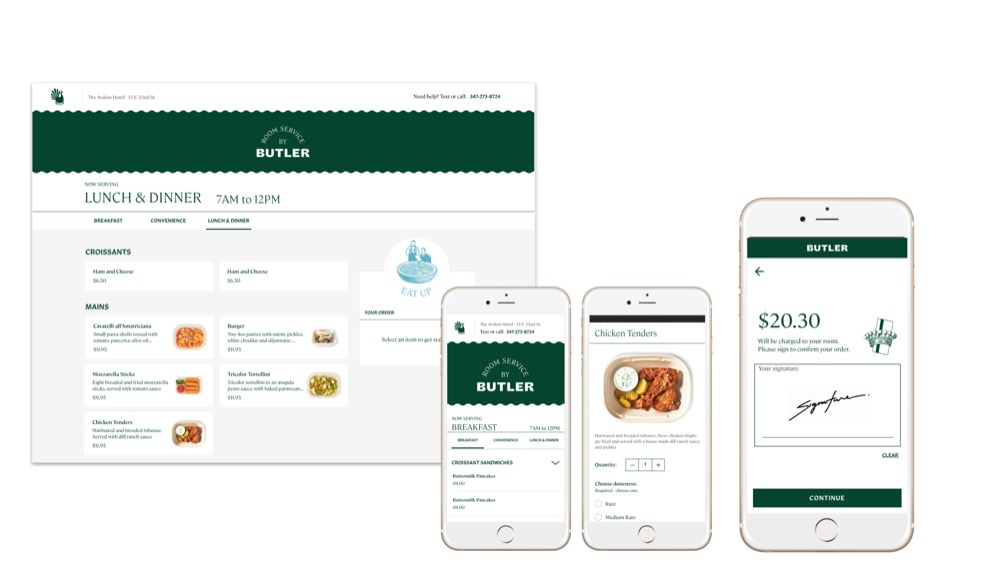
Food could be charged to the hotel bill. The menu extended beyond meals to practical items: a charging cable or deodorant. Travel Weekly listed a $15 burger and a $12 wedge salad in 2020, with no service fees or mandatory gratuities at that time. These were historical menu prices, not a claim about the cost of today’s room service.
Execution extended well beyond checkout. Food On Demand reported Butler’s attention to menus, packaging, kitchen leases, cooks and delivery. Ordinary delivery apps were alternatives, but Butler’s pitch depended on controlling the journey to the guest’s room. Each extra responsibility also brought work that an attractive ordering screen could not perform.
“Hotels look at room service as a loss leader, whereas I see it as an underutilized asset.”Tim Gjonbalic · PYMNTS · July 2020
The map grew faster than the certainty
Capital made expansion possible. The $15 million Series A in July 2020 brought cumulative funding to $20.2 million. In October 2021, Butler announced another $30 million-plus investment, taking the total above $50 million. Its funding announcement described ambitions for nearly 250,000 rooms and named relationships with Hilton, Hyatt, IHG and Marriott.
October 2021
March 2022
Those room targets were ambitions. In March 2022, the company reported serving more than 60,000 keys across eight markets while announcing western expansion. A key meant a room in its coverage; it did not mean a meal ordered. The difference is small in a presentation and enormous in a kitchen.
The business had physical commitments, too. In July 2021, Butler signed a three-year Manhattan office sublease for 27,040 square feet. The office is evidence of the scale it planned to occupy, not proof of what caused the collapse. Expansion announcements describe intention. Cash needs arrive on a schedule of their own.

May arrived without dinner
Operations ceased around May 13, 2022. Restaurant Dive’s reporting confirmed the shutdown through former employees and hotel staff. Its March website count had found 408 hotels in at least ten cities. One Washington hotel manager said Butler had delivered ten to twenty orders daily. Guests generally liked it; the deliveries nevertheless stopped.
TechCrunch reported that financing commitments fell through; Gjonbalic said the board chose shutdown. That explains the decision as he described it. It does not establish which kitchen, contract or cost first became untenable. The defensible lesson is narrower: a useful service and a large potential audience do not guarantee enough cash to keep operating.
For another operator, the copyable idea is to pool nearby demand and remove friction from billing. The conditions deserve equal attention: concentrated hotels, usable kitchens, dependable delivery and sufficient orders. As an operating inference, scattered properties or thin demand weaken the economics. Adding cities does not automatically repair a poorly utilized kitchen.
The business stopped. The docket continued.
B Hospitality Corp., doing business as Butler Hospitality, entered a Delaware Chapter 7 case in September 2022. The public docket records distribution and fee orders in June 2026 and an unclaimed-check order that August. Those entries concern liquidation, not returning room service. Butler leaves an unusually legible business puzzle: the spare kitchen was real, the guest convenience was real, and the operating company still ran out of road.
Historical company links: Website · LinkedIn · X · Facebook
More reading: The early startup profile · The founder on kitchen utilization · The hotel shutdown report