A restaurant can become famous far beyond its delivery radius. This is a pleasant problem until somebody on the other side of town wants its fried chicken at seven o'clock. An app can take the order, a courier can carry the bag, and neither can make a distant kitchen any closer. All Day Kitchens was founded to attack that inconvenient middle: the miles between the place that earned a diner's affection and the place where dinner is eaten.
- All Day ran small satellite kitchens for established restaurant brands, with pickup and delivery from locations nearer new customers.
- Its staff helped select and finish a short menu, then handled the final steps of fulfillment.
- In October 2021 it reported more than 15 sites and a $65 million financing round. A 2024 report said many sites had since closed.
Ken Chong and Matt Sawchuk had worked on Uber Eats. Their insight was that demand had become digital faster than restaurant kitchens had become distributed. A popular local operator could buy ads, join every delivery app, and still be confined by geography. In 2018 the pair started Virtual Kitchen Co., the company that would become All Day Kitchens. The proposal to a restaurant was simple enough to fit across a counter: give us dishes worth traveling for, and we will put them in more neighborhoods.
The dish has to survive the trip
The machinery behind that sentence was less simple. Restaurant partners supplied food and recipes. All Day's teams used small satellite sites to finish dishes, package orders and hand them off for delivery or pickup. Its culinary specialists helped decide which menu items could stand the journey. The company also offered a consumer menu that could combine dishes from several local brands in one order. This was restaurant expansion broken into parts: the original kitchen retained the brand and cooking identity; All Day took on new locations and the final stretch of service.
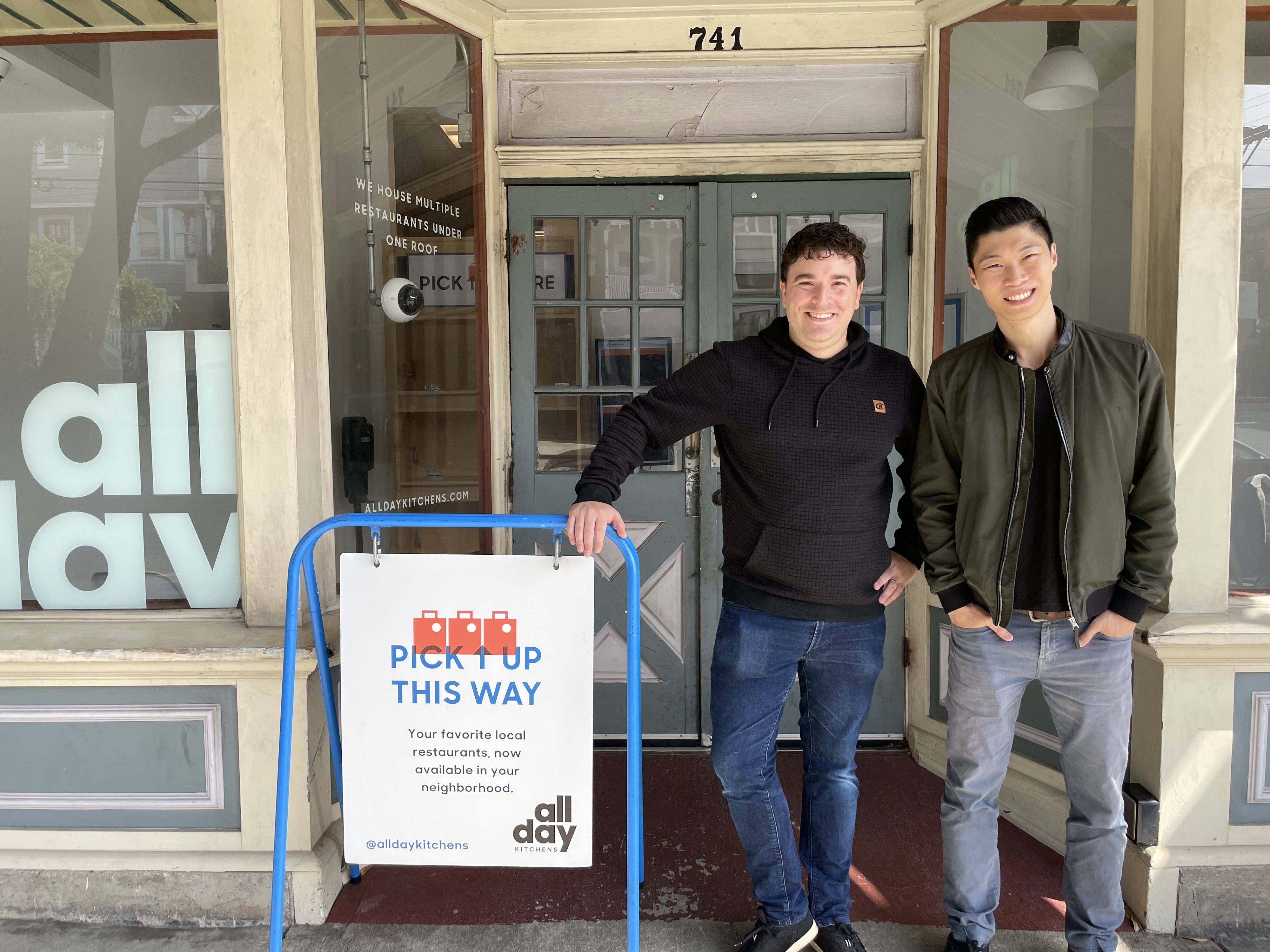
All Day's public partner list read like an unusually good food crawl: Honey Butter Fried Chicken, Mott St and HaiSous in Chicago; China Live and Dosa in the Bay Area. Its release also named Home of Chicken & Waffles, whose owner, Darnell Johnson, said the arrangement drew guests who had discovered the brand at an All Day location. That kind of discovery was the sale. The restaurant could test a neighborhood before committing to a lease, buildout, full crew and the daily anxiety of another storefront.
Yet the menu could not simply be photocopied. Molly McGrath, All Day's culinary and operations director, argued for choosing restaurant best sellers that traveled well and editing the delivery selection down to roughly six items. The kitchen team could then learn the finishing sequence and repeat it under pressure. A dish that needs a chef's last-second judgment, a fragile crust or immediate service may delight at the original restaurant and disappoint in a paper bag. The last few minutes belong to whoever packs the order.
“What matters to us the most is being close to customers.”Ken Chong, 2021
A network, not a spare room
The standard ghost kitchen comparison can obscure All Day's wager. A warehouse operator rents cooking space to restaurant tenants. All Day sold access to an operating network: locations selected for proximity to diners, shared kitchen crews, menu adaptation, technology and a route from order to handoff. Chong emphasized that distinction when the company changed its name. “Virtual Kitchen Co.” had confused some partners and described a narrower thing than the founders wanted to build. “All Day” sounded like the language of an actual kitchen and could face consumers, too.
The business model relied on restaurant partnerships and shared production. Public accounts do not reveal the partner fee, revenue split or cost per order. That matters because the apparent saving for a restaurant is only half the ledger. All Day still needed sites, equipment, kitchen workers, food transport and consistent service. Its promise was to spread those costs over enough brands and orders at each location. A quiet Tuesday, a narrow delivery radius or a menu that bogged down the crew could make the arithmetic turn rude.
It is easier to understand the company's expertise by watching what it chose to count. In October 2021, All Day reported more than 15 locations across the Bay Area and Chicago, a fourfold increase in restaurant partners over the prior year, and doubled satellite kitchen count that year. The network was still small next to a national restaurant chain, but large enough to test a difficult idea across two distinct food cities. Chicago's cravings would not necessarily match San Francisco's; each new market required its own partner roster and its own map.
When the map grows faster than the kitchen
Lightspeed led the October 2021 Series C, with GIC participating and existing backers including Andreessen Horowitz, Founders Fund, Khosla Ventures and Base10. The $65 million round brought the company's announced total to $102.5 million. The plan was to open in more US markets, invest in research and development, and hire. This was the moment when a business built around saving restaurants the expense of new locations had to prove that it could afford locations of its own.

The wider ghost kitchen sector soon received a harsh examination. Several operators closed units or shifted toward software after ambitious physical expansion. All Day's own later picture is narrower than its 2021 announcements: in July 2024, the San Francisco Chronicle reported that many of its locations had closed and said the company had not responded to its request for comment. The current company website displays a brand mark over video but little operating detail. It would be irresponsible to treat the 2021 location count as a current one, or to read the 2024 closures as proof that every part of the company ended.
What failed first, in the evidence available, was the expansive map. The public record does not give a cause for individual closures. The economics suggest an obvious pressure point, though: a distributed kitchen network incurs fixed costs at every node, while demand arrives unevenly and food quality must hold across each shift. This is an inference, not a disclosed postmortem. All Day's experiment is most interesting precisely because the consumer's wish was easy to understand and the operator's burden was easy to underestimate.
The useful part fits on a small menu
There is a practical lesson here for any restaurant tempted by a new delivery territory. Start with the dishes customers already want, then test whether they taste right after transport. Cut the remote menu until a second team can execute it reliably. Study where demand originates before paying for a new point on the map. Measure orders, labor, waste, complaints and repeat business by site, not just gross sales across the network. The first question is whether a meal can travel. The second is whether the margin can.
All Day Kitchens' cleverest move was to separate a restaurant's reputation from the room that created it. Its hardest task was preserving that reputation in another room, with other hands, at a cost low enough for everyone to win. The future of any such network rests there, in the unromantic interval between a cook's final touch and a customer's first bite.