The most revealing number in Pizza Pizza’s history is not 967-11-11, the telephone jingle lodged in generations of Canadian heads. It is one in three. That was the share of digital-delivery customers who reported a problem with an online order when the Toronto chain studied its ecommerce experience. A company built to remove friction from dinner had put friction back on the menu.
The finding was specific enough to hurt. Complex web orders - several toppings, several items, one hungry group negotiating through a screen - failed more often than similarly complex phone orders. Customers could not always see what they had built. Payment demanded too many steps. Some abandoned the cart. Pizza Pizza did not need another campaign promising convenience; it needed a better checkout.
A pizza chain disguised as an interface problem
Pizza Pizza Limited is the private operating company behind the Pizza Pizza and Pizza 73 restaurant systems. It franchises and operates quick-service stores, supports owners, coordinates ordering and delivery, and sells an unusually configurable collection of pizza, wings, panzerottis, crusts, sides, desserts and drinks. The customer is anyone who wants dinner to be predictable without being identical: students, families, office groups, arena crowds and solo slice buyers.
Founder Michael Overs opened the first shop on New Year’s Eve in 1967, in roughly 300 square feet at Toronto’s Wellesley and Parliament. The early advantage was not culinary theatre. It was availability plus memory. Centralized telephone ordering and a repeating 11-11 number made the act of buying pizza easier to recall. The jingle was primitive user-interface design: a shortcut stored in the customer’s brain.
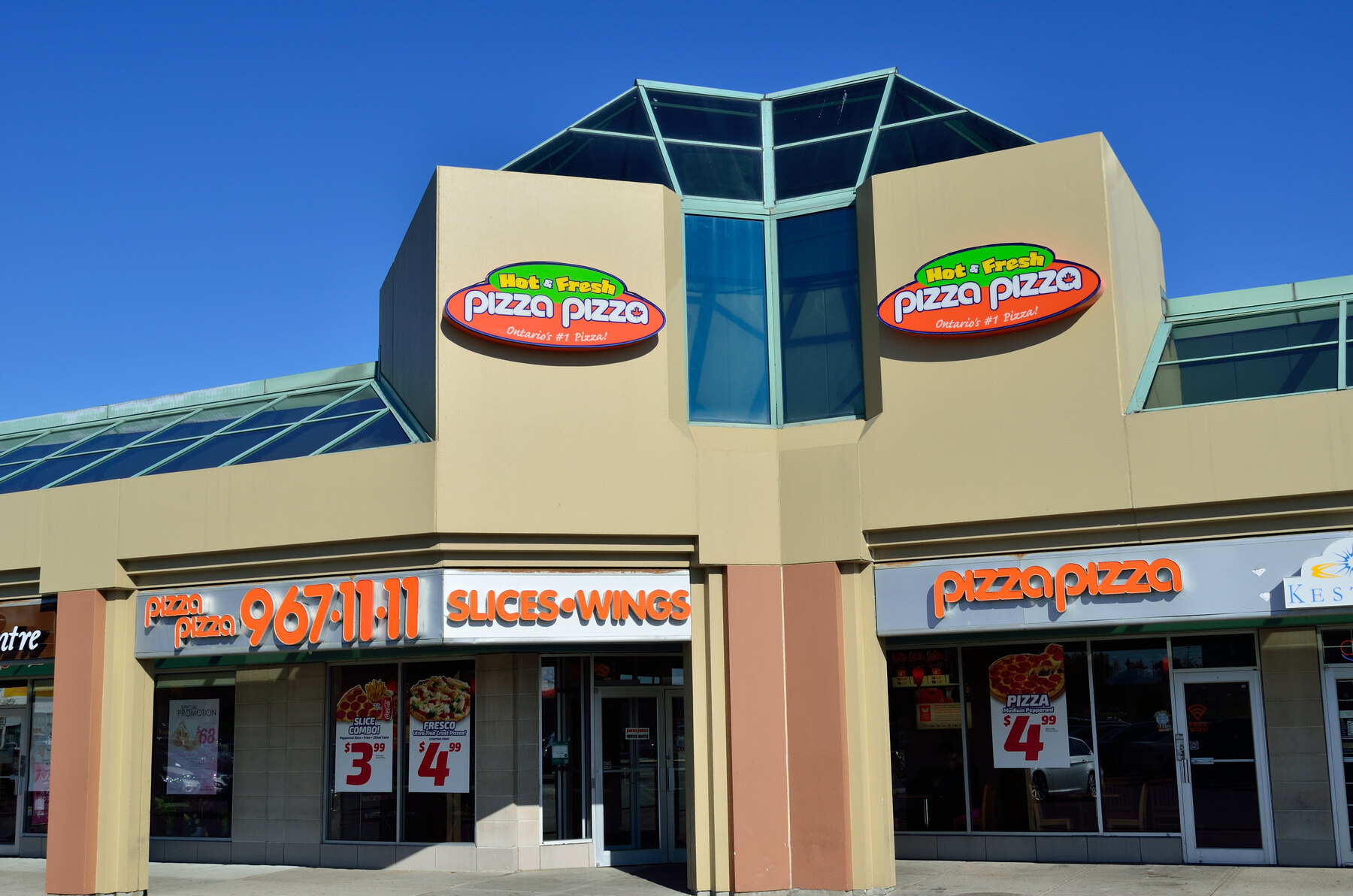
Today the network stretches coast to coast with more than 750 restaurants. The operating company remains private, but the economic plumbing is unusually visible. A separate public entity, Pizza Pizza Royalty Corp, indirectly owns the Pizza Pizza and Pizza 73 marks. Its partnership licenses them to Pizza Pizza Limited and receives royalties of 6 percent on Pizza Pizza system sales and 9 percent on Pizza 73 system sales from restaurants in the royalty pool.
In 2025, that 794-restaurant pool recorded C$635.5 million in system sales, up 2.4 percent. Royalty income reached C$40.8 million. These are not Pizza Pizza Limited’s revenues, and the distinction matters. System sales measure what participating restaurants sold; the royalty company skims the contracted percentage. The structure turns consumer appetite into a relatively clean stream of trademark income while the operator and franchisees handle the messy work of ovens, labour and late-night delivery.
What failed first
Success made the digital failure more dangerous. Pizza Pizza had won a Webby for its iPhone ordering app in 2011, then expanded to iPad and web experiences. But an award does not freeze software in amber. As digital volume climbed, menu complexity met an aging journey. The company and customer-insight partner SMG linked transaction data to individual feedback and found the break: web customers struggled most when their orders became complicated.
The response was almost aggressively practical. Step-by-step wizards guided complex orders. Product imagery changed dynamically to mirror toppings. The payment path lost steps. Reported outcomes included a 12 percent year-over-year rise in digital sales, a two-point decline in dissatisfaction with ease of ordering and a five-point decline in dissatisfaction with payment.
The complaint was not a reputation problem. It was a product requirement.
A broader rebuild followed with digital partner Plastic Havas. The team started with the front-end experience, tested formally and informally, and then replaced a monolithic ecommerce backend with a cloud system described as using more than 800 microservices. Personalization drew on data tools; a conversational Pizza Assistant helped with ordering. The project reported that ordering became 15 percent faster. Pizza Assistant users doubled basket size and cut bounce rate in half.
Test quietly. Launch with a crane.
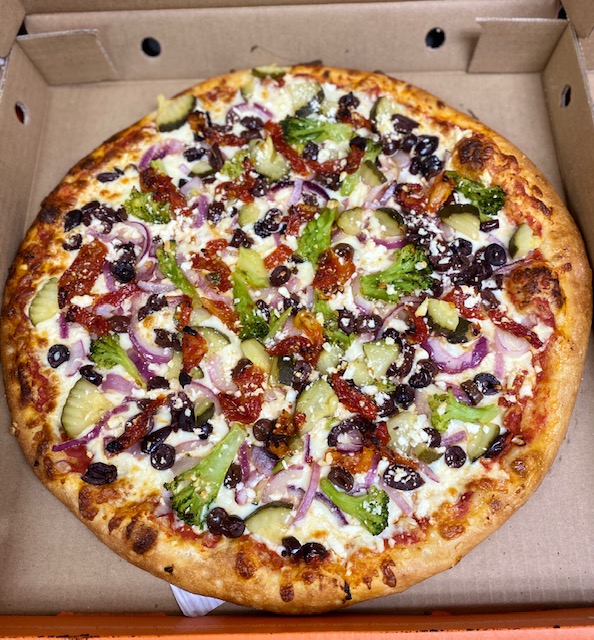
Pizza Pizza applies the same logic to food. Customers said they wanted a bigger pizza at a useful price. Instead of forcing the idea through the whole network, the company tested an 18-inch XXL pie through Pizza 73, its western Canadian sister brand. The result was strong enough to change management’s mind about a broader release. Pizza Pizza rolled it out nationally in 2025.
Then restraint ended. To explain that the pizza was big, agency Zulu Alpha Kilo built a 20-by-20-foot, 5,000-pound Pizza Pizza box and suspended it 200 feet above downtown Toronto. The stunt travelled because it made one claim visible at a glance. It did not ask viewers to learn a new brand philosophy. It showed a gigantic box.
That plain-spoken physical humour separates the brand from competitors without pretending pizza is rare. Domino’s leads with delivery technology and scale. Pizza Hut brings global recognition. Little Caesars owns speed and a sharp value proposition. Regional chains and independents can win on local taste. Pizza Pizza’s mix is Canadian ubiquity, menu breadth, direct ordering, delivery control and an advertising voice fluent in hockey, inflation, transit delays and dipping sauce.
Its partnerships turn that national footprint back into local relevance. Pizza Pizza has attached itself to the Professional Women’s Hockey League’s Canadian operations, the Winnipeg Blue Bombers, BC Place, the BC Lions and Vancouver Whitecaps FC. The Slices for Smiles program has supported children’s hospitals, while individual announcements record smaller gifts to community health needs. These deals do two jobs. They put food where crowds already gather, and they give franchisees a regional story larger than a coupon. The approach is not charity as decoration; it is distribution meeting identity. A sports partnership will not rescue weak unit economics, but it can make the orange box feel native in a market where the brand is still expanding. That matters in British Columbia and Manitoba, where a Toronto institution cannot rely on Ontario nostalgia alone.
What it costs - and what you actually buy
For would-be franchisees, the company publishes unusually concrete gates. The current franchise fee is C$35,000. A candidate needs at least C$150,000 in unencumbered cash, representing at least 30 percent of total investment, plus a credit score of 730 or better and no prior bankruptcies. Total investment is estimated at C$380,000 to C$550,000 depending on the opportunity.
The buyer gets training, location and lease help, operating systems, marketing, supply-chain support and a familiar national sign. The company asks for full-time involvement and describes its strongest franchisees as owner-operators. This is not a C$550,000 vending machine. It is a local operations job wrapped in a national demand engine.
The system also faces ordinary restaurant gravity. In 2025, same-store sales grew only 0.9 percent, and chief executive Paul Goddard said customers had become more deliberate with spending. New stores can lift a royalty pool while mature-store demand stays soft. Delivery marketplaces compete for the customer relationship. A huge menu creates choice, but also procurement, training and interface complexity. The same customization that attracts a family can punish the kitchen or checkout when the system is poorly designed.
The part worth stealing
Borrow the loop, not the orange paint.
- Collect feedback at the transaction level, not as a quarterly mood board.
- Find the exact moment a complex purchase breaks.
- Make the customer’s choices visible before adding persuasion.
- Test a risky product in a contained market with real buyers.
- When it works, explain the benefit in one physical, shareable idea.
The subtle lesson is ownership. Pizza Pizza’s telephone system, website, app, loyalty program and live tracking all try to keep the order inside a channel the company can observe. Third-party marketplaces may add reach, but direct channels turn each transaction into product intelligence. That intelligence can improve checkout, promotions, menu design and delivery. The loop compounds only when the business can connect behaviour to feedback.
It works when…
Orders repeat, customer behaviour is measurable, regional tests resemble the eventual market and operations can absorb the winning idea.
It breaks when…
Feedback is anonymous, the product is rarely repurchased, the test market is misleading or a campaign creates demand the kitchen cannot serve.
Pizza Pizza’s advantage is therefore less romantic than a secret sauce and more durable than a clever ad. It is a system for shortening the distance between appetite and order, then learning from whatever still gets in the way. The chain’s most amusing moves - bipartisan wings, fixed-rate pizza, a tool that rolls dipping sauce onto crust - sit on top of a serious operating habit: listen, test, measure, scale.
The first shop needed only 300 square feet. The modern company needs restaurants, franchise contracts, brand rights, data systems, delivery logistics and cultural timing. Yet the governing idea remains close to the old phone jingle. Make the next action obvious. Make it easy to remember. And if one in three customers says the button is broken, fix the button before buying another billboard.