The oddest item on KFC Canada’s summer menu is not chicken. It is a pink lemonade carrying hibiscus boba pearls, made to order under a new brand called Kwench. There are iced lattes, sparkling lemonades and shakes, too - nine drinks in all, beginning at C$3.50. By the end of this summer, the company expects Kwench in more than 170 restaurants. In 2027, it wants 600. KFC Canada and its franchisees have attached a C$30 million price tag to the expansion.
For a chain built around an old Kentucky recipe, this is a conspicuous detour. It is also an unusually clear view of how KFC Canada operates. The business protects a few fixed objects - the Colonel, the bucket, the 11 herbs and spices - while treating almost everything around them as material for adaptation. In Canada that has meant poutine, a separate PFK identity in Quebec, plant-based chicken made with a Canadian supplier, app ordering, food rescue and collaborations with brands ranging from Kraft Dinner to Mike’s Hot Honey.
The result is a company that sells familiar fried chicken but grows by creating new reasons to remember it. Its customer might be a family picking up a bucket, a student ordering a sandwich, a rewards member hunting a deal or, if Kwench works, someone who did not intend to buy chicken at all.
A global machine with a Canadian accent
KFC Canada is the Canadian restaurant business inside Yum! Brands, alongside a worldwide KFC network. But the local operation is not simply a row of company-run branches taking instructions from Kentucky. More than 650 restaurants are owned and operated by Canadian franchisees. About 12,000 people work in those restaurants. The company says its chicken is 100 percent Canadian farm-raised and its fries are made from Canadian potatoes.
That structure explains both the reach and the constraint. Franchisees provide capital, local knowledge and day-to-day operating muscle. The brand supplies the name, recipes, product development, marketing, technology and standards. Revenue at the restaurant level comes from food and beverage sales across counters, drive-thrus, pickup and delivery; the broader franchise system is supported by fees and royalties. A national idea matters only when hundreds of independent operators can serve it quickly, consistently and profitably.
KFC’s place in the Canadian market is crowded. McDonald’s and A&W own broad everyday habits. Popeyes, Mary Brown’s, Chick-fil-A and local shops compete more directly for chicken orders. KFC’s distinction is its combination of scale, family-bucket heritage and cultural flexibility. The brand is old enough to be nostalgic, large enough to be convenient and cheeky enough to put boxed macaroni on a chicken sandwich.
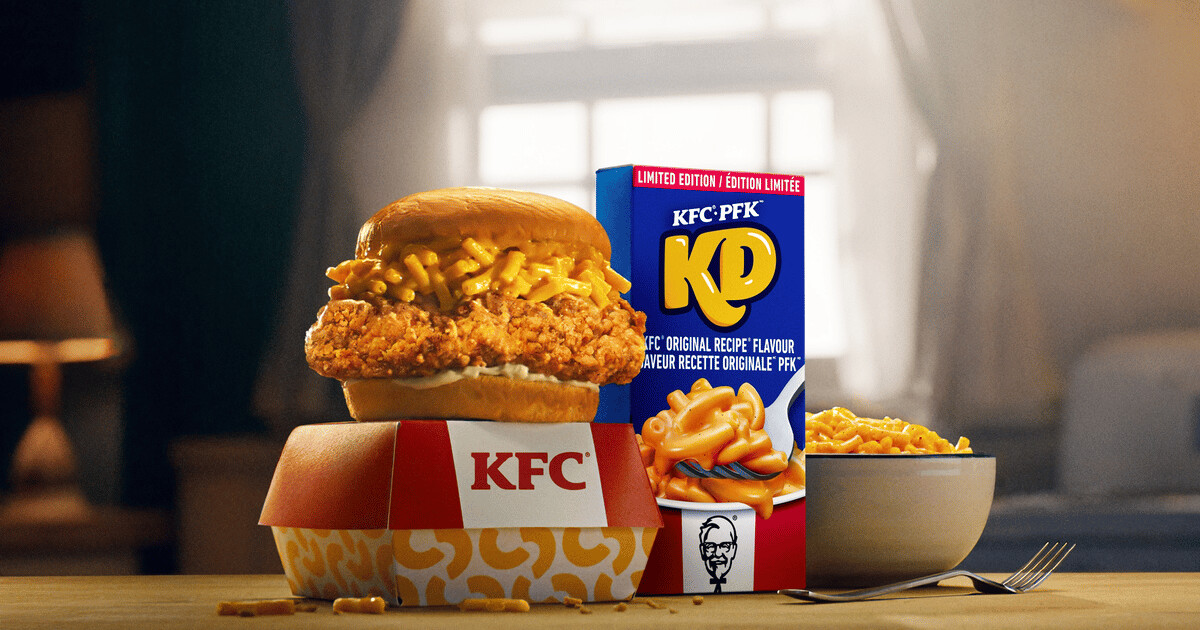
The joke had inventory
The 2024 KFC x KD launch is the cleanest demonstration of the strategy. Plenty of brand collaborations amount to two logos sharing a hoodie. This one changed products on both sides. KFC sold a chicken sandwich and snack wrap topped with KD. Kraft Heinz put the Colonel’s Original Recipe flavour into boxes of macaroni and cheese in grocery stores. The restaurant aisle and retail aisle carried the same gag.
The launch played out in public. Colonel Sanders appeared at Toronto’s Canadian National Exhibition, wandered through grocery stores and borrowed KD’s yellow visual codes. But the useful part was not the costume. Consumers could see the stunt, buy it in two channels and explain it in one sentence. That clarity helped produce 278 million earned-media impressions. On Meta, ad recall ran 110 percent above benchmark; on TikTok, the stop rate was 300 percent above benchmark. KFC recorded its highest brand consideration in five years, while Kraft Heinz sold six months of retail inventory in two.
“Our partnership with KD is KFC Canada’s largest brand partnership to date.”Katherine Bond-Debicki, KFC Canada CMO
The disclosed campaign cost is not public. That omission matters. Earned impressions are not cash in a till, and brand consideration is not restaurant profit. Still, the case provides a better scoreboard than most collaboration announcements: a defined inventory result for Kraft Heinz and a five-year brand measure for KFC.
The localization loop
What failed first changed the size of the bet
A smaller experiment had already taught KFC Canada to listen when demand ruins the plan. In November 2019, it tested a plant-based chicken sandwich made with Lightlife at a single restaurant near Toronto. The first failure was inventory planning: more than a month’s supply disappeared in six hours. The constraint produced better evidence than a survey ever could. People had travelled, queued and paid.
That sellout changed the company’s mind about scale. In August 2020, Plant-Based KFC became a permanent menu item nationwide, with plant-based popcorn chicken offered for a limited period. The logic is worth copying: make a pilot small enough to read, choose a success signal tied to behaviour and prepare the organization to respond when the result is much larger than forecast. A viral queue is wasted if sourcing, training and franchise economics cannot survive the follow-up.
KFC Canada applied a related move in basketball. Rather than spend millions on a conventional league or celebrity sponsorship, it noticed that players already lick their fingers during games. The “Finger Lickin’ Open Endorsement” invited anyone to shoot a bucket, perform the celebration and post it for a chance to be paid in KFC. More than 1,000 people were endorsed. The campaign reported C$17.485 million in earned-media value and briefly pushed KFC past McDonald’s as the number-two brand associated with basketball.
The cleverness was not avoiding all cost. It was swapping an expensive gatekeeper for a behaviour the brand could plausibly own. KFC did not rent a player’s fame; it gave fans a role in the ad.
The bucket becomes a platform
Behind the stunts is a conventional operating ambition: more visits, larger orders and stronger loyalty. The website and app handle pickup and delivery. KFC Rewards and the VIP program add member offers. Good Cluckin’ Deals, launched in July 2026, creates a long-term value platform beside the everyday menu. Limited-time flavours such as Mike’s Hot Honey or the Matty Matheson collaboration give existing customers another reason to open the app.
Kwench pushes further because it changes the occasion. Fried chicken tends to imply lunch, dinner or a group meal. Iced coffee and fruit-coloured refreshers can mean morning, after school, mid-afternoon or a social-media post. KFC says Kwench is its first Canadian expansion outside the core food category and its largest Canadian adaptation to date. Canada is the third KFC market to take it national after the United Kingdom and Ireland, and Australia, which lowers the invention risk. The Canadian risk is execution at scale.
Kwench is aiming for a 3.5x restaurant expansion
Planned Canadian locations. C$30 million disclosed investment from KFC Canada and franchisees.
Made-to-order drinks add equipment, ingredients, training and speed-of-service pressure. Boba pearls are less forgiving than pouring fountain pop. The 170-store first stage is therefore not timid; it is a live operating filter before the network approaches 600. The chain is borrowing a concept proven elsewhere while letting Canadian franchisees absorb it in steps.
The quieter system underneath
Localization also appears where it generates less social chatter. Since 2016, KFC Canada says its restaurants have donated 333,000 pounds of food, equivalent to more than 264,000 meals, while working with 254 charities. The national program, relaunched with Second Harvest in 2025, matches a recurring restaurant surplus with a recurring shortage: charities often struggle to secure protein. In early 2026, the company also contributed C$53,500 raised with restaurant guests in late 2025.
Packaging has followed the same trial-and-scale pattern. KFC Canada removed plastic straws and bags, moved poutine and chicken bowls into bamboo containers and tested fibre cutlery. It announced a goal of home-compostable consumer packaging by 2025. The public sustainability page details material changes, though it does not publish a complete audited scorecard against that original deadline. For operators, this is the less photogenic side of innovation: a package still has to hold hot gravy, travel through delivery and fit restaurant economics.
What another operator can steal
- Start with an observed behaviour. Finger licking in basketball and customization in KD already existed. KFC did not have to teach either habit.
- Make the campaign purchasable. A sandwich, grocery box, rewards offer or drink gives attention somewhere to land.
- Let the test threaten the plan. The plant-based pilot was useful because a six-hour sellout was allowed to trigger national action.
- Translate operations, not just copy. Canadian chicken, potatoes, poutine, PFK and franchise ownership make the local claim tangible.
- Expand by occasion. Kwench is designed to create beverage visits, not merely add another flavour to dinner.
When this playbook breaks
It does not work when the connection needs a paragraph to explain, when the product exists only for a photograph, or when operators cannot make it quickly at peak time. It also weakens without distinctive brand assets. A younger chain cannot casually borrow KFC’s decades of recognition, and a small network cannot justify national supply changes from one noisy store. Finally, earned attention is a poor substitute for repeat demand. Kwench must sell after the novelty fades.
The Colonel remains useful because KFC Canada refuses to place him behind glass. He can turn up in a grocery aisle, narrate an Alexa skill, sit courtside or stand beside a boba drink without losing the central promise. The brand’s advantage is not that every side quest succeeds. It is that the organization has built a method for deciding which joke deserves inventory, which pilot deserves scale and which Canadian habit can support another trip to the bucket.