Katherine Bond-Debicki inherited a familiar problem in an unusually literal package. Canadians knew KFC’s red-and-white bucket. They knew Colonel Sanders. They knew the promise involving fingers and good taste. Recognition was everywhere, yet the chain’s place in the broader quick-service market lagged behind its standing in other countries. The symbols worked. The business needed them to work harder.
That gap became the organizing question of her leadership at KFC Canada: how does a large, famous company behave with a challenger’s urgency? Her answer has been less about inventing a new identity than giving the old one new assignments. The Colonel can sell value by protesting that prices are too low. The bucket can become a record player. A fork can become the rejected character in a love story. Heritage, in this system, is not protected from mischief. It is the raw material for it.
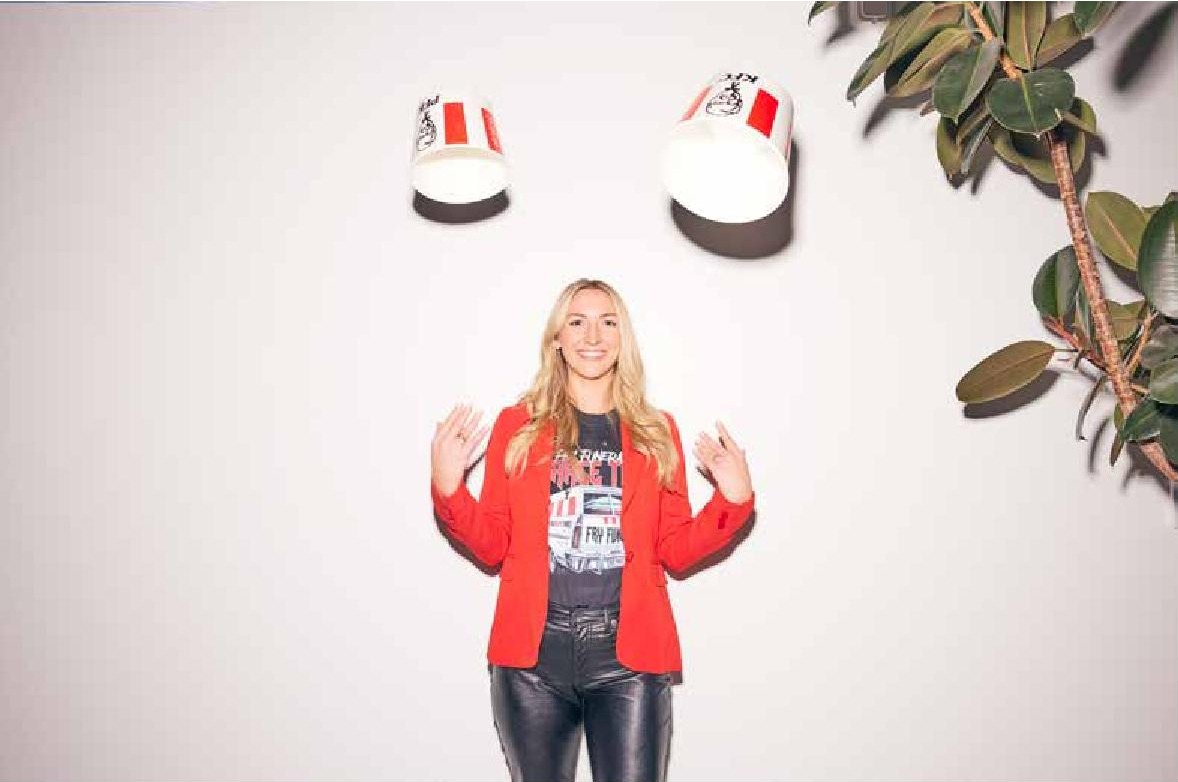
The brand manager crosses an ocean
Bond-Debicki’s route to Toronto ran through Ireland. She began at Procter & Gamble, working across baby, fabric and home-care portfolios. It was a classical consumer-goods education: understand a category, protect a promise, respect the accumulation of small decisions. In 2014 she moved to KFC’s UK and Ireland operation as a brand manager. Three years later she transferred to Canada as a senior brand manager.
By 2021, she was leading KFC Canada’s marketing portfolio. The remit was broad - brand and retail communications, omnichannel marketing and food research and development. Her public title later added Chief Digital Officer, reflecting a truth that restaurant marketing had already made obvious. The customer does not separate the advertisement from the app, the menu from the pickup counter or the promise from the food in the box.
The timing sharpened the challenge. Family dinner had helped KFC through the early pandemic years, but habits were moving again. Delivery and digital ordering had accelerated. Younger customers had more chicken options and fewer reasons to inherit their parents’ loyalties. KFC Canada was the leading fried-chicken chain, yet competed in a North American market thick with scaled specialists and dominant burger companies.
“Retail is always urgent and important.”Katherine Bond-Debicki
Protecting the important from the urgent
The sentence sounds ordinary until you see the budget calendar hiding inside it. Retail communication arrives with dates, prices and an immediate sales target. Brand building arrives with a longer horizon. When both compete for the same people and money, Tuesday’s offer usually beats next year’s meaning. Bond-Debicki concluded that KFC Canada had allowed that dynamic to run for too long.
She reorganized the 20-person marketing team. Retail and brand communications, previously one pillar, became two. Dedicated brand-building roles were created. Budgets moved. The remaining pillars - retail, omnichannel and research and development - had to become more focused with fewer resources. This was strategy expressed as an org chart before it appeared as an ad.
The shift began to show in 2022 with “Love at First Bite,” a platform imported from KFC’s UK office and centered on the moment just before someone eats the chicken. A year later came a made-in-Canada platform. “Sorry, Utensils” gave abandoned forks and knives the emotional weight of a breakup, scored by the soft-rock ache of “All Out of Love.” The campaign ran across television, print, radio, outdoor and digital. Its cast was young and diverse; its behavior was unmistakably KFC.
The joke carried a serious function. Finger licking connected the oldest language in the brand to a current audience without writing a lecture about legacy. The platform supported chicken nuggets and stayed in market beyond its initial run. Brand work and retail work had separate owners, but the public experience could still be one thing.
The Bond-Debicki operating loop
heritage
tension
value action
restaurant use
The discipline beneath the stunts
KFC Canada’s work can look like a cabinet of oddities. There was the time Colonel Sanders entered Street Fighter 6. There was a basketball court tucked under a highway to speak to Raptors fans. When customers had little affection for the old fries, a Colonel-branded hearse drove through Toronto and a livestreamed funeral invited people to pay their last respects. New seasoned fries followed.
The most useful reading is not that brands should stage more funerals. It is that a complaint, a product decision and a distinctive character were aligned. The event acknowledged what customers already said, made change tangible and ensured KFC owned the story. The humor did not cover the product problem. It announced that the company had acted on it.
Value received the same treatment. KFC had long been associated with family-sized sharing meals, which could make the brand appear expensive to someone eating alone. The “Not Everybody’s Happy, But You Will Be” platform made the Colonel furious about a Tuesday deal. He complained on social media, vandalized his own billboards and placed a full-page newspaper rant. The campaign doubled value consideration and lifted quality perception by double digits. A price message also refreshed a brand character.
Brand codes meet grocery aisles
The 2024 collaboration with KD made the operating model especially clear. Two Canadian comfort-food habits met in both restaurants and supermarkets: KD KFC Original Recipe mac and cheese on grocery shelves, plus a mac-and-cheese chicken sandwich and wrap at KFC. Bond-Debicki called it KFC Canada’s largest brand partnership to that point and its first to join an exclusive menu launch with a grocery product.
The results made the partnership more than a collision of logos. KFC reached its highest brand consideration in five years. Kraft Heinz gained market share and moved six months of retail inventory in two. Familiarity supplied the invitation; product and distribution supplied the proof. The work later received Strategy Awards recognition.
Other local moments worked on a smaller scale. On Quebec’s Moving Day, a mock claims program offered chicken for finger-licking “injuries.” Nearly three quarters of redeemed offers traveled through the app, and Quebec app adoption rose 28 percent month over month. The execution was culturally specific, digitally useful and tied to a meal. It is a compact example of how an amusing idea can do operational work.
“I think we have a menu modernization job to do.”Katherine Bond-Debicki
Pride in fried, with room to move
Bond-Debicki has not framed modernization as an escape from fried chicken. She has called it “pride in fried,” while arguing that confidence in the core still leaves room for choice. Under her marketing leadership, KFC Canada expanded attention to wraps, sandwiches, nuggets, seasonal combinations and new sides. In early 2025, the chain partnered with Mike’s Hot Honey around the sweet-and-spicy flavor trend. Novelty sat beside Original Recipe rather than replacing it.
That balance also describes her use of culture. The work does not chase every conversation. It looks for a bridge between a current behavior and an asset KFC can credibly own. Hockey language, a gaming character, a holiday record made from a bucket lid - each one begins with an existing piece of the brand and asks it to behave differently.
In 2025, the “Kyle F*cking Connor” hockey campaign earned one Gold and three Silver Cannes Lions, according to Bond-Debicki’s public celebration of the work. Her message emphasized the team behind the idea. That instinct echoes the way she discussed being named one of Strategy’s 2023 Marketers of the Year: the recognition, she wrote, belonged to internal talent, agency partners, franchisees and restaurant teams as much as to one executive.
The experience is the product
On a 2025 podcast, Bond-Debicki described three broad disruptions in quick-service restaurants: the drive-thru, digital ordering and the move toward experience-led marketing. Her point widens the competitive set. The threat is not merely the restaurant across the street. It is every easier, more personal or more interesting way a customer can answer hunger.
This explains why the Chief Marketing Officer role grew to include digital. A campaign can create a craving; the ordering system must convert it without friction. A local activation can earn attention; the app must give that attention somewhere to go. A menu can promise variety; the restaurant must deliver it. Modern brand management is partly the craft of keeping those surfaces in agreement.
Outside the office, Bond-Debicki’s official speaker biography sketches a person well matched to the assignment: an avid traveler, a culinary enthusiast who jokes that she has mastered eating more than cooking, and a mother of two. It also describes her as a believer in foresight and in marketing’s ability to influence organizational change. The campaigns get noticed because they are visible. The organizational choices are the quieter work making them possible.
KFC Canada’s transformation remains an ongoing business project, touching restaurants, menus, digital systems and communications. Bond-Debicki’s most concise public line about it is also the least decorated: “We’re only getting started.” For a heritage brand, that may be the healthiest relationship with history. Keep the parts people recognize in a second. Build the organization that can make them useful tomorrow.