The joke arrived wearing a banker's suit. In the summer of 2022, while Canadians watched interest rates and grocery bills climb, Pizza Pizza offered an extra-large four-topping pizza for $16.99. Customers could get “pre-approved.” The rate could be locked in for a year. The questions were friendly - “Do you like pizza?” - and naturally everyone qualified. A national restaurant chain had converted the language of financial anxiety into dinner.
Fixed-Rate Pizza was funny because it was timely. It worked because the value proposition survived the laugh. Units sold per restaurant ran 67 percent above the norm for a new special. Within six months, the offer had produced more than $8 million in sales; later, the total passed $15 million. Earned media exceeded 91 million impressions. Against a total production, media and public-relations budget of $284,672, the campaign became a neat demonstration of Adrian Fuoco's preferred equation: a bold idea, a useful offer and enough evidence to defend the next experiment.
Fuoco, Pizza Pizza Limited's chief marketing officer, has been refining that equation across more than two decades of Canadian brands. His remit now includes brand strategy, omnichannel planning, communications, food innovation and menu strategy for Pizza Pizza and Pizza 73 in Canada and PZA Pizzeria in Mexico. It is a wide portfolio, but the work tends to compress into ideas that can be explained before an elevator closes.
“Great brands lead with creativity and bold ideas, backed by strategy and the courage to fail (sometimes).”Adrian Fuoco
A long apprenticeship in familiar things
Familiarity is both an advantage and a trap. A legacy brand begins with recognition, but recognition can become wallpaper. Fuoco learned this problem at institutions Canadians already knew. He spent 12 years at Canadian Tire, helping lead category marketing plans, launch the Jumpstart brand and later shape the “Canada's Store” campaign. The work demanded a feel for national scale without sanding away local meaning.
Then came five years at Boston Pizza. There, Fuoco helped refocus the brand on the nouns sitting in plain sight: pizza, family dining and sports. One memorable execution shrank patio furniture to the size of a pizza saver. The small plastic table in the middle of a delivery pie acquired tiny chairs, turning takeout packaging into a miniature Boston Pizza patio. A conventional touchpoint became the joke, and the joke carried the positioning.
His fundraising work at Boston Pizza exposed the other half of his method. The Kids Card program had a compelling offer, but the cause needed to feel concrete. The campaign translated every $5 donation into one hour a child could spend with a role model. A small media buy in the previous year had lifted sales enough to justify a larger push. The pattern is recognizable now: simplify what the customer receives, make the effect legible, then look at the result.
Category marketing, Jumpstart and “Canada's Store.”
Pizza, family dining, sports and very small patio chairs.
Brand, channels, communications, food innovation and menu strategy.
The platform under the toppings
Fuoco joined Pizza Pizza in 2019. In 2022, the company introduced “Everyone Deserves Pizza,” a platform built around pizza as a common presence in good days, bad days, victories and failures. The sentence is deliberately roomy. It gives the brand permission to talk about price, dietary choice, geography, sports and whatever Canadians happen to be discussing that week.
Pizza Pie Charts made that breadth visible. More than 60 outdoor headlines split pizzas according to local arguments and observations: people who say “Toronto” against people who say “Turronno,” carpoolers against people with pools in their cars. Each execution changed with its city, while the final claim stayed the same. The national chain could sound local without pretending to be small.
The work also restored a degree of surprise to a company founded in 1967. A Dip Roller applied creamy garlic sauce across a slice like paint. Buzz Off Pizza used garlic, tomatoes, hot peppers and onions in a mosquito-repelling Canada Day stunt. Growflation offered more food for the same price and generated more than $1.5 million in digitally attributed sales from over 20,000 orders. The form changed, but each campaign attached the comedy to a product fact or a customer concern.
The giant box and the tiny brief
In 2025, consumer feedback pointed Pizza Pizza toward a larger pie. Pizza 73 tested the 18-inch XXL pizza in Alberta, and the response gave the company confidence to take it national. The launch brief was uncomplicated: the pizza was very big. Its announcement should be, too.
So a crane hoisted a 20-by-20-foot pizza box 200 feet over a busy Toronto neighbourhood. The structure weighed 5,000 pounds. People below reached for their phones, turning the physical stunt into its own distribution system. The resulting commercial needed little explanation. Product and spectacle were the same size joke.
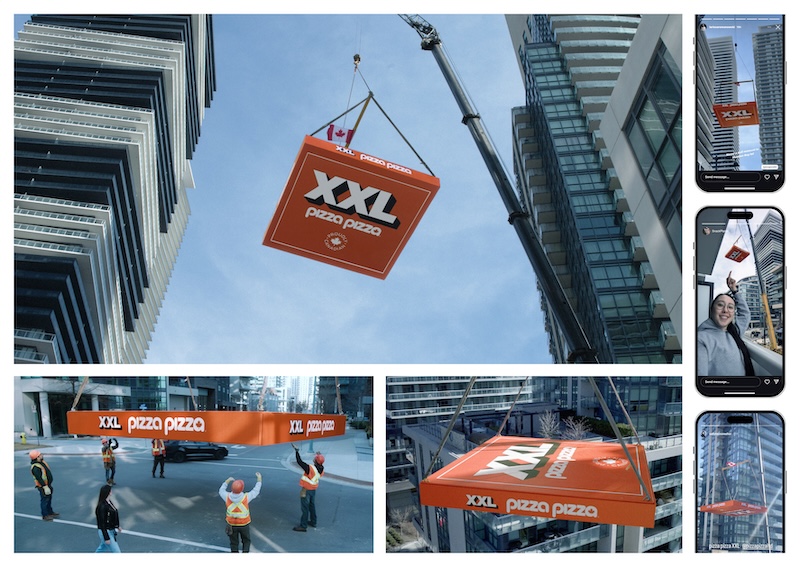
The restraint inside the spectacle is easy to miss. Plenty of large activations require a paragraph to decode. This one fit in a sentence: a big pizza got a big box. Fuoco has repeatedly backed ideas with this retellable quality. Fixed-Rate Pizza. Bipartisan Wings. Reverse Tariff. Volcano Dipper. Their names carry most of the briefing document.
Speed matters to that work. When trade tensions became part of the Canadian conversation in early 2025, Fuoco's team launched a Reverse Tariff discount in time for the Four Nations hockey final. He credited the marketing team, franchisees and agency partners for the creativity and hustle required to land the short ad in the moment. The promotion returned for Canada Day. Timeliness became an operational ability, not merely a tone of voice.
Let the result finish the sentence
Bipartisan Wings is perhaps the cleanest illustration of how this system handles risk. During the 2024 U.S. election season, Pizza Pizza ran opposing attack ads for left wings and right wings. Both accused the other side of culinary misconduct before resolving the tension with the promise of harmony in a bucket. Creative testing helped the team calibrate the joke while emotions were high.
The campaign spent in places where people were already following politics, including news media and social feeds. By week five, wing sales were 40 percent above the average of the prior four weeks. For three months afterward, the category remained 25 percent higher year over year. Forty-two percent of people exposed to the ads said the work made them want to try the wings. On Meta, attributable sales returned more than $32 for each advertising dollar.
Those figures do more than prove a joke worked. They explain how a team earns room for another one. “Courage to fail” sounds romantic until a national franchise system, a menu calendar and a media budget enter the room. Fuoco's version includes the parenthetical “sometimes,” an understated acknowledgment that risk needs boundaries and feedback. The unusual idea gets a fair test. The numbers get the final word.
His title now says CMO, but the career reads like an operator's education in attention. Product innovation changes what can be promised. Technology changes how quickly it can arrive. Franchisees determine what can be executed across hundreds of restaurants. Agency partners sharpen the story. Marketing connects those parts, then gives the customer one clean reason to care.
Whatever the kids are having
For someone associated with an expanding catalogue of headline-friendly pizzas, Fuoco's own topping order is almost aggressively unbranded. Asked what he would put on his Fixed-Rate Pizza, he said he would jump on whatever his children were ordering. “It's easier that way.” He lives in Toronto with his wife, two daughters and a cat. The domestic answer punctures the mythology of the taste-making executive. Sometimes the customer at the table has already made the decision.
It also lands close to his public philosophy. Relevance begins with paying attention to what people want, even when the concept is straightforward and the execution is not. Fuoco has said companies must keep up as needs evolve, and he places convenience alongside product and value. The wit works because it serves that practical hierarchy. A pizza still has to be easy to order, arrive quickly and make the people eating it happy.
In 2026, the Volcano Dipper continued the pattern. A volcano-shaped pizza filled with creamy garlic dip met a science-fair setting familiar to parents and children. Fuoco described playfulness as central to Pizza Pizza's brand personality. Shared memory supplied the story; a new menu item supplied the reason for it.
That is the durable lesson in Fuoco's work. A familiar brand does not need to disguise its age or chase every conversation. It needs to recognize the moment that fits, bring something useful to it and speak clearly enough to be repeated. The spreadsheet is not the enemy of the joke. In the right hands, it is how the joke gets another chance.