The most revealing thing in a Papa Johns pizza box may be the thing nobody ordered: a lone pepperoncini beside a sealed cup of buttery garlic sauce. The pair is part garnish, part ritual and part quality-control device. You can change the crust, swap the toppings and send the pie across town, but those two small cues tell the customer that the system has arrived intact. They also explain the company better than its menu does. Papa Johns is in the business of making thousands of locally assembled dinners feel predictably familiar.
That familiarity now spans 5,978 restaurants in 51 countries and territories. Only 469 of those restaurants were company-owned at the end of June 2026. The other 5,509 belonged to franchise operators who rent the name, follow the playbook, buy into the supply system and serve customers who usually have several cheaper or faster alternatives within a few taps. The company owns the choreography more than it owns the stage.
Four businesses hiding in one pizza box
To a diner, Papa Johns sells pizza, wings, sides, desserts, drinks and, depending on the market, folded Papadias or crustless Papa Bowls. Orders move through restaurants, the website, mobile apps and third-party marketplaces. Papa Rewards adds a simple loop: spend, earn points, convert them into Papa Dough and apply the credit to another order.
The corporate ledger tells a more interesting story. Papa Johns books sales from company-owned restaurants, royalties and franchise fees, commissary sales, technology services and advertising-fund contributions. In 2025, company-owned restaurant sales were about $676 million. Commissary revenue was nearly $930 million. The warehouse-and-truck side of the company was larger by revenue than its own restaurant tills.
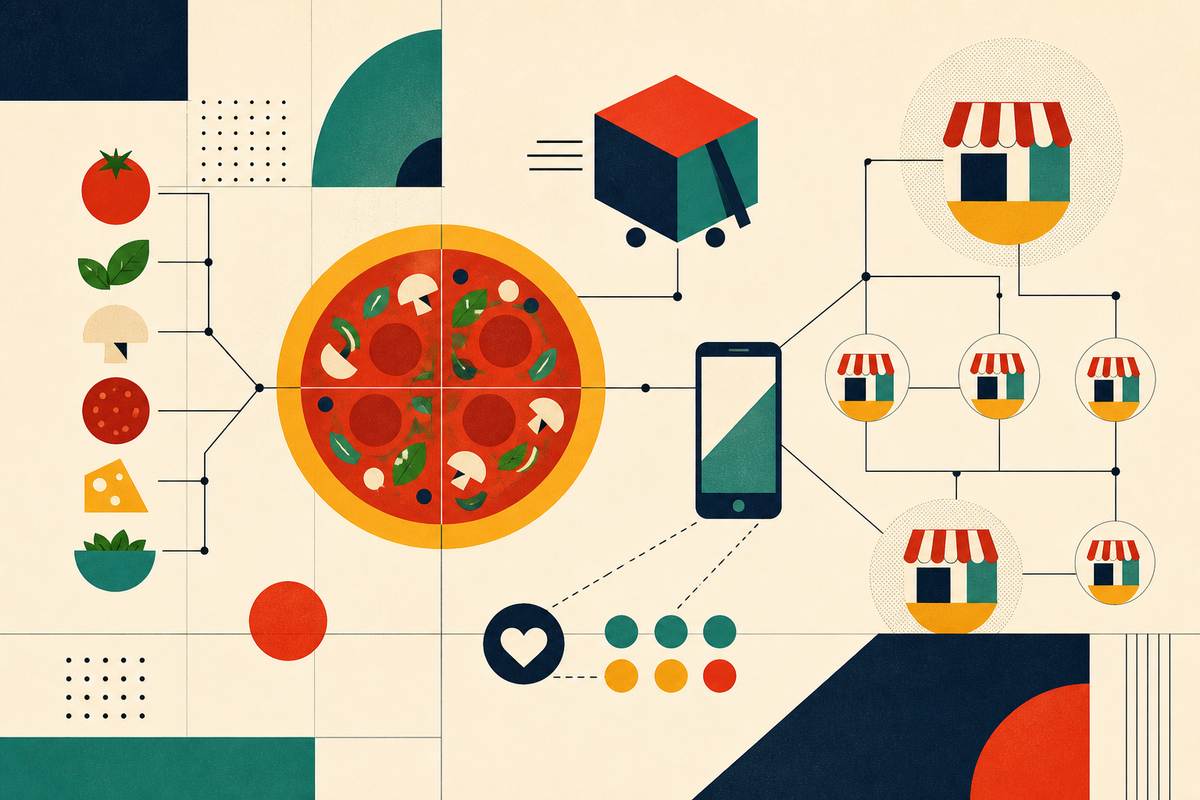
The Papa Johns operating system
Company stores sell meals directly. Franchised stores extend the footprint with local capital and operators.
Royalties and development fees monetize the brand, playbook, training and territory.
Fresh dough, sauce, food and paper products turn ingredient consistency into recurring supply revenue.
Ordering, loyalty, point of sale and national campaigns keep a fragmented network facing the customer as one brand.
That mixture solves two problems at once. Diners get an easy, customizable meal that can feed one person, a family or an office without a committee meeting. Franchisees get a recognizable brand, recipes, procurement, marketing, training and technology they would struggle to assemble independently. Papa Johns sits between the two, trying to keep quality high enough for the customer and restaurant economics healthy enough for the operator.
“Better ingredients” is a distribution claim
Papa Johns' most persistent point of difference is its original dough. It is made with six ingredients and delivered fresh rather than frozen. The pizza sauce uses vine-ripened tomatoes; the cheese is made from mozzarella. Every pizza comes with that garlic sauce and pepperoncini. Competitors can copy a promotion by Friday. Reproducing a fresh-dough network at national scale takes facilities, routes, standards and years.
Eleven U.S. Quality Control Centers produce and distribute dough and other supplies to traditional North American restaurants twice a week. A Canadian center also produces and distributes fresh dough. Domestic franchisees must buy dough and sauce through that network, and purchase other supplies from those centers or approved vendors. This sounds restrictive until one imagines 3,000 independent stores making their own calls on flour, fermentation and tomato sauce.
The ingredient promise lives or dies somewhere between a dough mixer, a route schedule and a Friday-night oven.The operational lesson
The arrangement is Papa Johns' quiet expertise: food production, cold-chain logistics, restaurant training and quality assurance packaged as a consumer brand. It makes the experience harder to improvise, but easier to repeat. That is useful to franchisees, and it creates a second stream of revenue for the parent company each time a restaurant prepares to sell another pie.
03 / The customer interfacePizza night became a software problem
Delivery pizza was digital commerce before many retailers learned the phrase. A customer chooses a location, configures a product, pays remotely and watches a physical object move through a local fulfillment network. The order is perishable, highly customized and expected quickly. A bad button can lose the sale; a bad dispatch decision can lose the customer.
Papa Johns released a new Android and iOS app in 2025 and modernized its mobile website. It expects to finish retiring legacy omnichannel systems by the end of 2026, while a point-of-sale replacement will take longer. Through a multi-year Google Cloud partnership and a joint innovation group called PJX, the company is working on predictive ordering, personalized offers, an AI customer-service assistant, voice ordering, dispatch and route optimization.
The ambition is to recognize the shape of a customer's habits: the usual Friday order, a birthday, a game night, a preference for stuffed crust. That can remove taps and make promotions less random. It can also lower service costs and give franchisees a cleaner operating picture. The risk is familiar to every retailer with a large loyalty database: personalization must feel useful, not watchful, and the new plumbing must work during the dinner rush.
04 / The marketQuality positioning in a coupon category
Papa Johns competes most visibly with Domino's, Pizza Hut and Little Caesars, then with regional chains, neighborhood pizzerias and every quick-service restaurant willing to deliver. Grocery stores compete for the same low-effort dinner occasion. Delivery marketplaces compete for the first tap, even when a Papa Johns restaurant eventually cooks the food.
The brand occupies a tricky lane. It asks customers to notice ingredient quality in a category trained to notice bundles, fees and delivery times. Fresh dough and distinctive extras support that pitch. So do menu formats like stuffed crust. But operational novelty can be expensive. A product that interrupts the makeline may win social attention while slowing the kitchen. Current management has emphasized core pizza execution, value and restaurant-level profitability over endless complication.
The 2025 “Meet the Makers” campaign made this practical idea visible by putting restaurant workers and their craft in the advertising. It was less about inventing a new reason to eat pizza than showing the hands behind an existing one. The useful brand lesson is modest: when every competitor can photograph melted cheese, show the process only your system is built to repeat.
05 / The pressure testInternational momentum, American indigestion
Papa Johns enters the second half of 2026 with an uneven map. Second-quarter global system-wide restaurant sales fell 4.8 percent from a year earlier. North American comparable sales dropped 8.3 percent as consumers ordered less in a heavily promotional market. International comparable sales rose 1.5 percent, the seventh straight positive quarter outside North America.
Management lowered its 2026 outlook and the board suspended the quarterly dividend beginning in the third quarter. The cash is being redirected toward franchise incentives, restaurant image improvements, customer acquisition, menu work, technology, supply-chain savings and international growth. In plain language, Papa Johns chose to fund the machine before paying shareholders to wait.
The company is also pruning. Its store count fell by 42 during the second quarter as 50 restaurants opened and 92 closed. Refranchising has reduced the number of company-operated stores, including 85 domestic restaurants in late 2025. Fewer corporate stores can make revenue comparisons look worse even when the franchise model becomes more concentrated. Still, refranchising cannot disguise weak order volume. Franchisees need customers, not merely a cleaner corporate structure.
06 / Growth around the edgesGarlic sauce leaves the box
Two recent moves show how Papa Johns can extend itself without opening another conventional restaurant. In summer 2026, a bottled garlic-flavored sauce inspired by the dipping cup reached select Walmart, Kroger, Albertsons, Safeway and H-E-B stores. The product converts a familiar free extra into a grocery item that can live beside fries, sandwiches or a home-cooked meal. It is brand extension by taste memory.
The company also partnered with Disney and Pixar around Toy Story 5, creating Pizza Planet pop-ups in Los Angeles, London, Seoul and Madrid, limited menus across 43 markets and its first in-app game. The campaign connected family movie night, pizza night and nostalgia without requiring customers to learn an unfamiliar behavior. DoorDash and Uber Eats relationships work from the other direction, bringing Papa Johns into places where customers already browse dinner.
These partnerships reveal where the company fits in the market. Papa Johns is large enough to coordinate a global entertainment launch, yet dependent on local franchisees to execute it. It is a consumer brand with a logistics backbone, an e-commerce funnel with hot ovens attached, and a franchisor whose reputation is remade one delivery at a time.
Papa Johns does not need to predict the future of food. It needs to become the easiest familiar answer to “What should we eat tonight?”The strategic job07 / What others can borrow
Standardize the substrate, personalize the surface
There is a portable business idea inside the box. Papa Johns centralizes the parts customers rarely want to think about: dough production, approved suppliers, safety standards, ordering infrastructure and national marketing. It leaves visible choice at the edge: crust, toppings, sides, timing, channel and reward. The customer experiences customization; the company manages controlled variation.
That model works only when the center earns trust. Franchisees must believe mandated supplies and technology help their economics. Customers must believe the quality claim survives a discount. Employees must be able to execute the menu during peak hours. Papa Johns' stated culture - People First, Everyone Belongs, Do the Right Thing, Innovate to Win and Have Fun - is not separate from the operating system. A franchise manual cannot rescue a rushed or unhappy kitchen.
The next chapter will be judged less by another clever crust than by ordinary repetitions: faster ordering, dependable delivery, restaurants that look cared for and pizza that arrives as expected. The pepperoncini will still be there, quietly taking attendance.