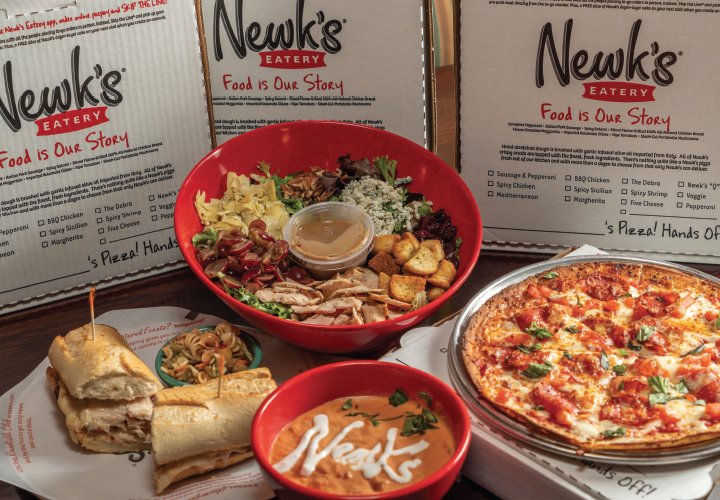
Newk's Eatery is the restaurant equivalent of a person who brings three homemade sides to a picnic and insists it was no trouble. Its open kitchens turn out toasted sandwiches, entrée salads, kettle-batch soups, pizzas, seafood, macaroni and cheese and twelve-layer cake. There are no fryers or microwaves. Dressings are made in-house. Meats are sliced and flame-grilled. The lunch crowd sees abundance; the operator sees prep lists, labor minutes and a small parliament of ingredients waiting in the walk-in.
That tension explains both the appeal and the difficulty of Newk's. Founded in Oxford, Mississippi in 2004 by Chris and Don Newcomb and Debra Bryson, the company was built from family recipes and the founders' earlier experience creating McAlister's Deli. The first franchise followed in 2005. Fourteen stores opened in 2011, another 14 in 2013, and the chain crossed 100 locations in 2016. Its customer was easy to picture: a person who wanted lunch quickly but did not want lunch to feel industrial.
The propositionFast food for people who dislike the bargain
Newk's occupies the busy lane between Panera Bread, Jason's Deli, McAlister's and Chicken Salad Chick. It sells to families, office workers, salad loyalists and event planners. A guest can eat in, collect a mobile order, send a boxed lunch to a meeting or have a third-party courier deliver it. That breadth solves two problems at once: it gives a group enough variety to avoid a veto, and it gives a host a predictable catering order without dropping to pizza-only diplomacy.
The difference is visible. The kitchen is open. Salads lean into proteins that many sandwich chains avoid, including shrimp and salmon. Southern chicken salad can share a menu with Italian-influenced pizza. The Roundtable, the chain's social condiment and iced-tea station, makes pickles and croutons feel almost ceremonial. Newk's charges for a premium fast-casual meal and supports it with preparation the customer can see and flavors the customer can recognize.
The commercial engine has several cylinders. Company-owned stores keep restaurant sales. Franchisees pay fees and royalties while investing their own capital in development. Catering added just under 11 percent of sales in 2024; delivery accounted for 13 percent. Rewards members earn 10 points for each dollar and can redeem them across the app, web and store. Newk's gets more occasions from the same kitchen, and customers get the same food whether the table is in the dining room or a conference room.
What failed firstThe room vanished before the appetite did
In March 2020, dining rooms closed and 75 percent of Newk's business disappeared within days. Before the pandemic, about 55 percent of sales were dine-in and digital represented roughly 14 percent. The company's first failure was not its food. It was a channel concentration that suddenly became unusable. Catering, about 12 percent of sales before COVID-19, also collapsed when offices and gatherings stopped.
“The smartest cut was the complexity a guest could not taste.”The operating lesson inside Newk's reset
The response was inelegant and effective. A cross-functional task force stood up curbside service systemwide in four days. Delivery fees came down. Newk's moved onto the front page of DoorDash and used Flybuy to alert employees when a curbside customer was approaching. Digital sales rose by roughly 37 percentage points to around half of the business. One Arkansas pickup window generated about $10,000 a week through app orders.
Newk's Pantry sold groceries, paper goods and meal kits while grocery stores remained an accepted reason to leave home. Restaurants rotated crews so an exposure did not disable the whole staff. The company waived franchise royalties in March and April, later charged half, and reduced advertising contributions. The cost was immediate cash and support from the franchisor. The alternative was asking already stressed operators to fund a system they could barely use.
Average unit volume recovered
*2022 franchised-unit figure. Other years are system-level figures reported by the company and trade press; comparisons are directional.
The change of mindVariety was valuable. Sprawl was not.
Before the shutdown, Newk's carried about 39 core items and roughly 400 stock-keeping units. Staffing pressure forced an experiment the company might otherwise have debated for months. Reopening restaurants could begin with 16 items; operating stores moved to 27. The total SKU count fell to 250. Food cost dropped four percentage points, then six after broader contract and sourcing work. Some labor-heavy ingredients were replaced with products that required less slicing and chopping.
This was the change in conviction: scratch-made did not require every task to remain sacred. Later, pre-sliced cheese replaced cheese cut by hand. That sounds painfully ordinary because it is. Customers came for a good chicken salad, a sturdy sandwich and hospitality, not a view of someone portioning cheddar. Newk's preserved the parts that carried flavor and deleted motions that carried only cost.
The store count still contracted. Newk's began 2020 with 122 locations, shed 12 during the first pandemic year and ended 2022 at 100. A 2025 disclosure listed 95 outlets at the end of 2024: 29 company-owned and 66 franchised. The stores most likely to remain closed were often the ones struggling before the crisis. COVID-19 did not invent weak sites; it removed their camouflage.
The second resetA quiet sale changes the math
Sentinel Capital Partners had bought a majority stake in 2014 for an undisclosed sum. In late 2023 it quietly sold Newk's, again at an undisclosed price, to FSC Franchise Co., the CapitalSpring-backed parent of Beef 'O' Brady's and The Brass Tap. The purchase did not arrive with a confetti cannon. It arrived with shared purchasing, construction, real estate and franchise-sales resources.
CEO Frank Paci described Newk's as a roughly $220 million system joining an FSC platform with about $500 million in purchasing power. The brands sell different experiences, but they all buy gloves, furniture, shrimp and real estate services. Shared volume can improve terms without asking a Newk's customer to care who negotiated the glove contract. Average unit volume rose from about $2.2 million to $2.4 million in 2024, and several restaurants exceeded $3 million.
Real estate became more flexible too. Newk's developed inline, end-cap and drive-thru options, worked with smaller boxes and learned to convert second-generation restaurant sites. A former IHOP in Pascagoula, Mississippi became a Newk's in under eight weeks. On another front, self-service kiosks processed as much as 12 percent of sales at some test stores, an answer to higher labor costs that also gave guests another ordering path.
The copyable bitKeep the promise. Redesign the machinery.
Restaurant operators do not need a private-equity owner or a twelve-layer cake to borrow the method. The transferable move is to map every task against the customer promise. Newk's promise lives in flavor, visible preparation, menu breadth and friendly service. Hand-slicing every cheese portion did not carry enough of that promise. Curbside, by contrast, preserved access to the whole proposition when the room was unavailable.
List every SKU, prep motion and vendor contract. Mark what a guest can taste, see or value.
Ring-fence signature recipes and service rituals before making cost cuts.
Test a smaller menu or footprint in one operating context, then measure speed, waste and mix.
Use common purchasing, technology and real-estate expertise across stores without blending the brands.
Newk's added portable wraps in 2024, then introduced Pick Three in July 2025, a mix-and-match offer that turned its wide menu into a value feature. It also moved some marketing dollars from digital-only channels back to broadcast, Amazon and connected television. In 2025, the company opened five locations, entered four new markets, signed 10 franchise deals and installed a cloud-based point-of-sale system plus a customer feedback platform. Delivery grew more than 2 percent and catering about 1 percent.
The franchise proposition remains capital intensive. A published profile has put total investment around $792,000 to $1.151 million, while the current inquiry asks candidates to confirm at least $1.5 million in net worth and $750,000 in liquid assets. This is not a cheap template for a novice who loves the salad. Newk's favors experienced multi-unit operators because a broad scratch kitchen rewards systems, training and purchasing discipline.
When this playbook will not work
- If the “invisible” task you cut is actually carrying flavor, food safety or consistency.
- If off-premise orders overwhelm a kitchen designed only for dining-room pacing.
- If smaller boxes save rent but erase hospitality, seating capacity or catering throughput.
- If a shared platform forces generic purchasing that weakens a differentiated menu.
- If franchise growth outruns operator quality, training or local demand.
Where it landsA regional chain with a more credible next act
Entering 2026, Newk's reported 97 restaurants, five openings from the prior year and 10 signed franchise deals. A University of Georgia location introduced a campus format. New markets included Pascagoula, Statesboro, Mandeville and Wichita. The company set a target of at least 15 signed development commitments, while the Newk's Cares program passed $2.3 million raised for ovarian-cancer research and awareness.
The chain is smaller than it was at its pre-pandemic peak, but its operating story is clearer. It sells a premium lunch with enough choice for a group, then extends that kitchen into catering, delivery and loyalty. Its expertise is not a secret sauce so much as the coordination of scratch preparation at franchise scale. The open question is whether it can add units without re-adding the complexity it spent years removing.
That is the useful ending for operators. Newk's did not discover a magic menu item. It learned which parts of abundance customers loved and which parts merely made the kitchen tired. The business that emerged still looks like Newk's. It simply asks fewer ingredients and fewer square feet to prove it.