Before Slim Chickens had franchise agreements, mobile ordering or a development map crowded with pins, it had a garage in Fayetteville, Arkansas. Tom Gordon and Greg Smart gathered friends there to taste chicken and dipping sauces, then changed the recipes according to what disappeared first. The exercise was informal, but the product logic survived: give people excellent tenders, then give them enough ways to make the meal feel like theirs.
The first restaurant opened in 2003. Today, Slim Chickens is a fast-casual chain with more than 300 restaurants worldwide and roughly 1,000 additional units covered by development agreements entering 2026. Its footprint reaches 32 U.S. states and international markets including the United Kingdom, Ireland, Germany, Turkey and the Philippines. The business is now 96 percent franchised, a very different organism from the neighborhood shop that Gordon and Smart once ran themselves.
Yet the plate is still recognizable. Hand-breaded chicken tenders and cooked-to-order wings anchor the menu. Around them sit sandwiches, wraps, salads, mac bowls, chicken and waffles, Delta sides, shakes and desserts layered into clear jars. Fourteen signature sauces turn the core product into a small decision tree. Customers can dine in, drive through, carry out, order in the app, summon delivery or feed a room with catering trays.
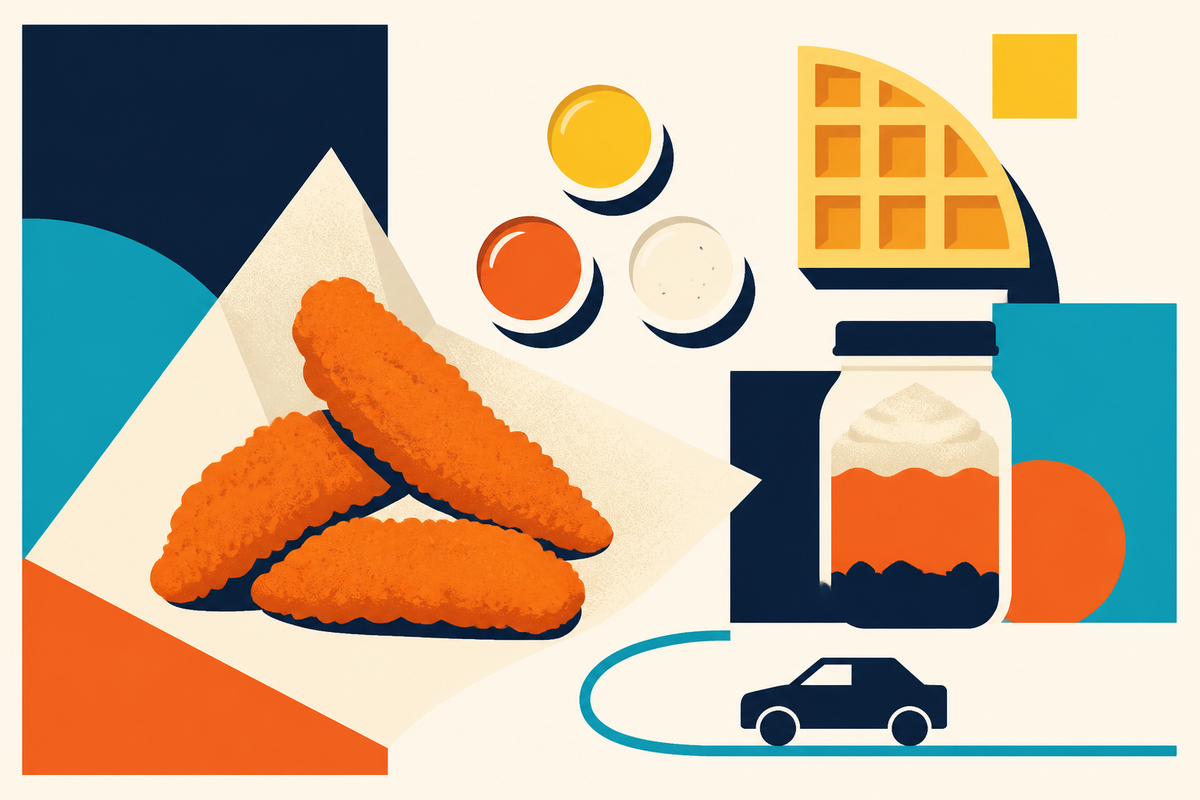
The menu is broad. The kitchen logic is tight.
Restaurant strategy often rewards ruthless simplicity. Raising Cane's built a formidable business around a famously narrow menu. Chick-fil-A made one sandwich into an institution. Slim Chickens takes the other side of the bet. It promises variety, but not by stocking a separate pantry for every idea. Chicken, sauces, bread, tortillas, fries, slaw and a few supporting ingredients reappear in different arrangements. A tender becomes a meal, a wrap filling, a salad topping or part of a mac bowl. Spicy breading can move through the same formats.
Fourteen reasons the same tender can feel different
One core order, many low-friction experiments. Sauce choice makes novelty cheap for the kitchen and personal for the guest.
That modularity matters because its customers are not one tribe. There are families splitting a picnic pack, office managers arranging catering, teenagers chasing app rewards, parents looking for a kids meal, delivery customers and sauce loyalists who already know their order. A broad menu lets a group agree on one restaurant without everyone eating the same thing. It also makes repeat visits less repetitive.
The 2025 launch of Spicy Tenders shows the system at work. Slim Chickens developed a seasoning cooked into the breading so the heat would be even and the kitchen would not acquire a new bottleneck. Consumer panels helped tune it. Chief Marketing Officer Patrick Noone wanted most guests to call the heat right and a smaller group to call it too hot - evidence that the seasoning still had conviction. When sales held up after the promotion stopped, the limited-time offer earned a permanent menu place.
“We're not just blowing your head off with heat.”Patrick Noone, chief marketing officer, on building flavor before spectacle
Hospitality is the expensive ingredient
Slim Chickens describes its mission as making fresh, hand-breaded tenders in a friendly atmosphere where people can relax and feel at home. The most concrete expression is easy to miss: dine-in food is brought to the table. That small act changes the social contract. A quick-service transaction becomes a lightly hosted meal. Staff are expected to greet customers, check the room and behave less like order expediters.
This is where the chain tries to separate itself from the crowded “better chicken” field. The food is cooked to order. The sauces invite preference. Chicken and waffles and jar desserts add a Southern accent. Service supplies the emotional shorthand. Competitors can copy a sandwich quickly; reproducing a service habit across hundreds of kitchens is slower.
It is also the hardest promise to scale. A fryer has a specification; warmth does not. Franchise growth adds distance between founders and front counter. Drive-thru-only formats remove the table entirely. Digital orders arrive without eye contact. Slim Chickens' current challenge is to translate hospitality into accuracy, packaging, pickup flow, app design and the few seconds available at a window.
The company is testing that translation in the place where it began. Its original Fayetteville restaurant was rebuilt as a drive-thru-only location, a practical response to convenience demand and tighter restaurant economics. The symbolism is almost too neat: the birthplace of the dine-in brand became a laboratory for service without a dining room.
The customer sees lunch. The franchisee sees a system.
Slim Chickens' economic engine is no longer simply selling chicken. Franchisees provide most of the capital for new restaurants. In return, the company licenses its name and operating system, supports site selection, construction, training, marketing and operations, and collects fees and continuing royalties. Published franchise materials list a 5 percent royalty, plus brand and local marketing contributions. The disclosed investment range is wide because a conversion, an endcap and a freestanding drive-thru are different real-estate projects.
The attraction for an operator is a recognizable brand that is still young enough to have open territory. Slim Chickens reported an average franchise unit volume of about $2.44 million in its 2025 disclosure, with total systemwide sales above $569 million. Those figures describe sales through restaurants, not the franchisor's own revenue, and averages do not erase the considerable range between locations. Still, nearly 80 percent of multi-unit operators were reported to be developing more stores - a useful sign of confidence from people who can see their own ledgers.
Flexible formats expand the addressable map. A traditional freestanding restaurant suits a suburban trade area. Conversions and endcaps can lower time and construction friction. In-line shops fit dense markets. Drive-thru-only units follow convenience. Nontraditional venues such as airports, universities and military bases borrow existing traffic. The menu stays familiar while the box around it changes.
A restaurant company with a software habit
The app and Slimthusiast Rewards program solve a different problem: a restaurant cannot build a relationship with an anonymous cash-register transaction. With PAR Engagement's Punchh platform, Slim Chickens has run segmented recall offers, double-point promotions and “Golden Ticket” campaigns across more than 200 locations. Olo supports digital ordering, while delivery marketplaces such as DoorDash extend reach beyond the drive-thru.
This is not glamorous technology. It is frequency technology. The useful questions are ordinary: Which guest has not returned? Did an offer lift visits at one store? Can a new opening begin with loyalty enrollment rather than build a customer file later? Better data also gives the franchisor a view across a system owned by many different operators.
Community work supplies another connection. Restaurants host fundraisers, donate food and participate in local events. A national No Kid Hungry partnership began in 2025 with a dollar donated for each heart-shaped waffle meal sold at participating restaurants, then continued with an app-download promotion. The waffle was product, fundraising device and marketing object at once - a tidy example of the chain's habit of making one ingredient do several jobs.
The flock enters its discipline era
Fast growth makes exuberant headlines, but Slim Chickens' 2026 language became noticeably more sober. President and Chief Operating Officer Christina Vaughan has emphasized labor, food costs, training, benchmarks, consistent execution and franchisee profitability. The company entered the year with 110 agreement deals signed in 2025 and new commitments spanning New York, Connecticut, New Jersey, Florida and California. Opening is no longer the only score that matters.
“At the end of the day, if franchisees are profitable and performing, we all benefit and the brand grows.”Christina Vaughan, president and chief operating officer
That discipline is necessary because chicken has become one of the busiest parts of quick service. Slim Chickens competes with national giants, tender specialists, wing chains, hot-chicken concepts and strong regional brands. Its defensible position is not a secret recipe alone. It is a bundle: cooked-to-order food, unusual menu breadth, sauces that make choice tangible, a hospitable service model, flexible real estate and experienced franchise partners.
The founders remain involved as CEO and chief brand officer, which gives the company continuity that many investment-backed restaurant chains lose. But founder presence does not guarantee founder feeling. That has to be rebuilt during every shift, in every new kitchen, by people who were not in the garage.
Slim Chickens fits between fast food's convenience and fast casual's promise of care. Customers can use it for a quick tender meal, a family pack, a catered office lunch, a rewards-driven pickup or a dessert that arrives with its own glass silhouette. Franchisees can use it as a multi-format platform for regional development. The problem it solves is modest but persistent: groups want speed without surrendering choice, and convenience without feeling processed.
The chain's next thousand signed restaurants will not be won by novelty alone. The winning work is repetitive: bread the chicken properly, keep the sauces distinct, make the app easy, hand over the right bag and treat the customer like a guest. Slim Chickens began by watching what friends reached for in a garage. At scale, the observation becomes a system. The trick is to keep it from becoming merely a procedure.