At 7:12 on a weekday morning, the product is not fried chicken. It is certainty. A commuter can turn off a Carolina road, order a Cajun chicken filet tucked inside a warm biscuit, add rounds of fried potato and be moving again before the day fully begins. Bojangles has spent nearly five decades making that small sequence feel local, familiar and repeatable. Now it is trying to perform the harder restaurant trick: carry the ritual into places where nobody grew up with it.
The chain began in Charlotte in 1977, when restaurant operators Jack Fulk and Richard Thomas opened a walk-in shop with no seating on West Boulevard. Their premise was precise: chicken with more seasoning than the prevailing fast-food norm, food prepared from scratch and service with a little theater. The biscuit became the hinge. Bojangles says a properly made one requires 49 individual steps, a wonderfully unreasonable number for an industry built around reducing motion.
That number explains the company better than its menu board does. Bojangles is a quick-service operator and franchisor, but its identity depends on making speed coexist with visible handwork. There are no microwaves in its restaurants, the company says. Certified biscuit makers mix, fold, cut and bake through the day. The food arrives quickly; the brand wants customers to sense that it was not assembled anonymously.
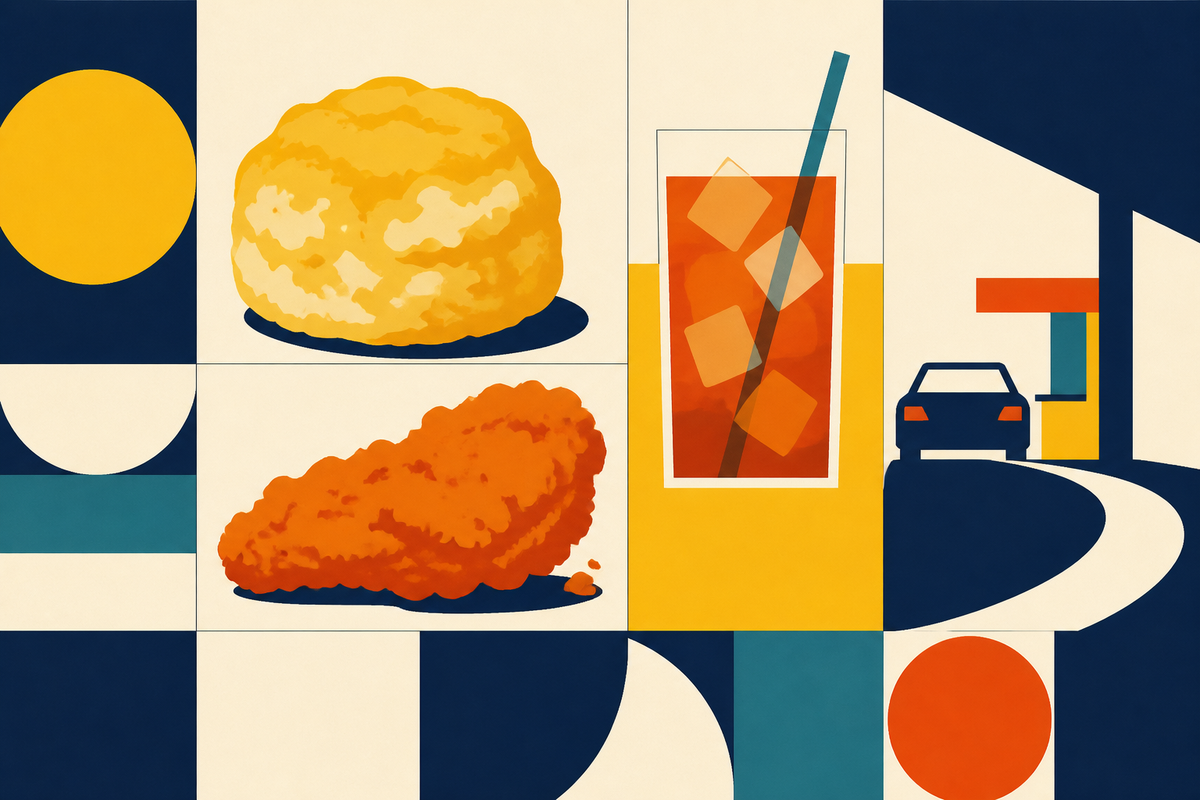
The breakfast advantage
Chicken is a crowded American category. Popeyes owns Louisiana swagger. KFC has global familiarity. Chick-fil-A pairs a chicken sandwich with famously controlled service. Raising Cane's narrowed its menu until tenders became a system. Bojangles enters the same contest through a side door at breakfast, when a biscuit can be the meal rather than its accompaniment.
That matters economically. A restaurant already paying rent, managers and kitchen equipment gains another productive rush before lunch. The chain can serve biscuit sandwiches to commuters in the morning, chicken sandwiches and tenders at midday, then family boxes and bone-in meals at dinner. Tea, seasoned fries, Dirty Rice, Bo-Tato Rounds and the fruit-streaked Bo-Berry Biscuit give the menu a vocabulary that feels more specific than “chicken place.” Catering extends the same kitchen into offices, school events, parties and football tailgates.
One kitchen, three occasions
Conceptual view of menu coverage, not reported sales share. Breakfast creates the extra lane; chicken and family meals carry the rest of the day.
Customers are not buying only calories. In the Carolinas, Bojangles can function as a road-trip marker, a game-day routine or the first meal after returning home. The chain's customers include families feeding a group, tradespeople and office workers passing through the drive-through, travelers, students, digital deal seekers and employers ordering breakfast for a room. Each occasion solves a mundane problem - a hot meal, quickly, with enough variety to satisfy several people - while the seasoning and regional menu keep the solution from feeling interchangeable.
Regional loyalty is difficult to manufacture. Bojangles already owns it. The task is learning how to transport it.
Scaling the handmade
Bojangles does not have to finance every new dining room itself. More than 500 of its restaurants are franchised, and the company says 93 percent of those franchised locations belong to multi-unit operators. That concentration is intentional. Its recruiting materials seek experienced restaurant groups with enough capital and patience to develop territories rather than one enthusiastic owner with one store.
The current price of admission makes the point. Bojangles lists a $35,000 franchise fee, minimum liquid capital of $1 million and minimum net worth of $2.5 million. A traditional freestanding restaurant is estimated to require roughly $2.85 million to $3.95 million; an express format is estimated at about $781,000 to $1.86 million. In return, the operator buys a recognized brand, recipes, supply relationships, training, technology, marketing and a menu capable of producing revenue across three dayparts. Bojangles collects the franchise economics while franchisees supply much of the construction capital and local operating attention.
The protected craft
Scratch-made biscuits, hand-breaded chicken, proprietary seasoning, brewed tea and restaurant-level hospitality are meant to preserve the reason for choosing Bojangles.
The engineered system
Multi-unit operators, express formats, centralized purchasing, digital ordering, catering and AI-assisted drive-throughs are meant to make that reason easier to distribute.
That is where the brand's expertise lives. It is not simply frying chicken. It is turning a regional recipe set into specifications that thousands of team members and hundreds of franchise restaurants can reproduce. Training must make a 49-step biscuit feasible during a breakfast rush. Supply-chain work must keep seasoning and ingredients consistent. Menu development has to add novelty without burying the core. Site selection must find commuters in the morning and families at night.
The company has also learned to vary the operating package. In newer growth markets, it has promoted boneless-focused menus designed to simplify kitchens and broaden appeal. That can improve throughput, but it creates a delicate brand question: how much can be removed before the Southern institution becomes another tender-and-sandwich shop? The strongest version of the expansion does not export every legacy item. It exports enough unmistakable Bojangles signals - biscuit, seasoning, tea, breakfast and hospitality - that simplification feels disciplined rather than diluted.
A robot at the drive-through, a person at the biscuit table
The most revealing partnership is with Hi Auto. Its drive-through attendant, called Bo-Linda, can take orders in English and Spanish. By the company's 2025 supplier summit, the system was operating at nearly 500 locations and processing a reported one million orders each week. The goal is practical: increase order accuracy and speed, absorb repetitive conversation and let restaurant employees concentrate on food and guests.
This is not automation for spectacle. Drive-through labor is noisy, repetitive and easy to mishear. A system that reliably captures customizations can reduce pressure at the exact point where a long line turns into abandoned revenue. Meanwhile, Spanish-language ordering across the app, website, kiosks and select drive-throughs expands accessibility. The app adds order-ahead pickup, delivery, exclusive offers and occasional app-only items. With ezCater, the chain turned group orders into another digital channel; by 2026, more than 600 restaurants were participating in digital catering.
The split is almost comically neat. Preserve human craft where customers can taste it. Use software where customers mostly notice delay. For a legacy restaurant company, that is a more coherent technology strategy than sprinkling screens across the dining room and calling it transformation.
The map is the test
Bojangles reached its 500th restaurant in 2011, went public in 2015 and returned to private ownership in 2019 after an acquisition by Durational Capital Management and The Jordan Company. The owners said private control would allow longer-term investment in people, menus, technology and remodels. Six years later, those priorities were visible in a new 60,000-plus-square-foot Support Center in Charlotte, complete with a test kitchen, collaborative workspaces and a training room named for co-founder Richard Thomas.
Las Vegas and Houston openings pushed the brand into markets far from its Carolina center.
New Jersey growth and a 20-unit New York City agreement set up a return to the city.
Openings in Michigan, Oklahoma and Arizona widened the footprint again.
By late 2025, Bojangles described approximately 850 restaurants in 20 states. It returned to New York City with a Brooklyn opening in January 2026, then continued into Michigan, Oklahoma and Arizona. These openings place the company between regional heavyweight and national challenger. It is larger and more operationally mature than an emerging chicken concept, but still carries meaningful white space compared with the largest fast-food systems.
White space is not the same as demand. Bojangles has attempted expansion beyond its core before, with mixed results. A new market must learn the menu, franchisees must maintain labor-intensive standards and the brand must resist chasing every national chicken trend. Competition is relentless, food and labor costs are volatile, and a restaurant's reputation can be undone one slow drive-through at a time.
Community work helps keep expansion from reading like pins on a development map. The Bojangles Foundation focuses on literacy, educators and military families. Restaurants have raised money for hurricane relief and pediatric heart care, donated books and school supplies, and built promotions around local teams. These programs are charitable, but they are also part of the operating texture of a brand whose advantage comes from belonging somewhere.
What is actually different
The easy answer is seasoning. The better answer is structure. Bojangles combines a breakfast-led habit, scratch preparation, a recognizable family-meal business and a franchise system designed for operators who can own a market. Its competitors can launch biscuits. They cannot quickly recreate decades of Carolina memory, nor the muscle memory of a system that has made breakfast and chicken share one kitchen since 1977.
That does not guarantee a national future. It does give the company a clearer job than “be another chicken chain.” Protect the handmade parts customers can taste. Automate the bottlenecks they resent. Choose franchisees able to repeat the standard. Teach new cities why a biscuit deserves 49 steps. The expansion succeeds if that improbable little object still feels particular after traveling a thousand miles from West Boulevard.
Keep up with Bo
Menus, openings, franchise information and the chain's steady stream of biscuit-related news.