The browser tabs had multiplied before dinner had materialized. Michael DiBenedetto and his colleagues were working late, hungry enough to order but not organized enough to agree. One delivery service had the restaurant. Another had a different fee. A third promised a different arrival time. The familiar modern miracle of summoning a meal had acquired the administrative texture of filing expenses.
DiBenedetto knew that other purchases did not work this way. A traveler could compare airlines and hotels without visiting every supplier in turn. Why should noodles require more research than a flight? He later recalled wondering whether it would be faster to leave the apartment and collect food himself. Then came the sentence that gave the irritation a commercial shape: there should be a search engine for all this, like the ones used for travel.
Plenty of startup stories improve with retelling. This one improves by staying ordinary. No garage revelation, no grand theory of human appetite. Just several people, too many tabs, and the dawning suspicion that convenience had become inconvenient. DiBenedetto saw a repeated task hiding inside the fuss. If every app presented a partial picture, the useful product might be the window across them.
“There should be a search engine for all this stuff like there is for travel.”Michael DiBenedetto on the idea behind FoodBoss
01 / The useful annoyanceA consultant leaves the tabs open
DiBenedetto had grown up in the northern suburbs of Chicago, in a family where starting companies was less an exotic vocation than a recurring habit. He has described a line running through his great-grandfather, who came from Italy and started a business, then his grandfather, father, and brother, who each started businesses of their own. “Something in the water,” he joked. Family lore did not hand him a product, but it made the leap into ownership easier to recognize.
He attended the University of Miami, earned an MBA in finance from DePaul University in 2013, and worked in healthcare consulting after college. Consulting supplied the origin scene and, perhaps more importantly, a way of looking at systems: identify the friction, compare the alternatives, and make the decision visible. In 2015 he left consulting to begin building the delivery aggregator. In 2016 he connected with engineer Liam Hession, who became co-founder and chief technology officer, and the Chicago company formally took shape.
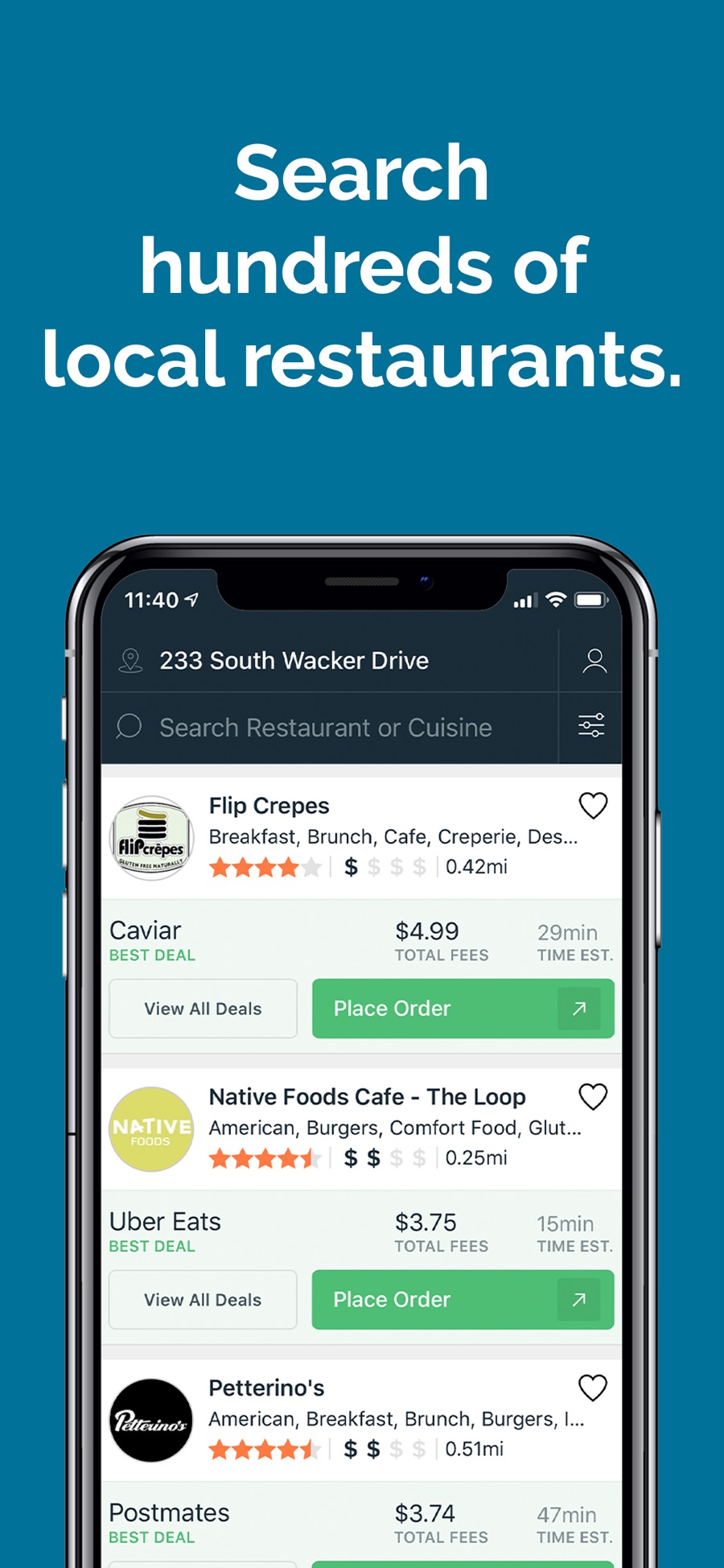
The first name was Bootler, a playful bit of branding for a digital servant. The proposition was sober. Gather restaurant listings from delivery providers. Normalize the options. Show the customer which service covered which restaurant, what delivery cost, and how long it might take. Then let the customer choose. The company was not cooking the food or carrying it down the block. It was organizing the argument before the order.
The three-screen dinner
FoodBoss organizes the choice; the selected ordering provider handles the transaction and fulfillment.
02 / The comparison layerMake the hidden difference obvious
Comparison products live or die on the differences they reveal. DiBenedetto offered a blunt example: the same basket of food might carry a $12 delivery fee on one service and a $3 fee on another. Before aggregation, discovering the difference demanded enough effort that many diners would never bother. After aggregation, the difference became a bar, a label, a reason to click elsewhere.
The price of not comparing
Illustrative founder example for the same amount of food, not a live quote. The gap is $9 before the first bite.
This was the quiet leverage in the model. FoodBoss did not need every provider to become cheaper. It needed customers to see when one already was. Transparency turns a private pricing decision into public competition. Time mattered too. A lower fee may lose its charm when dinner arrives after bedtime. Putting money and minutes side by side acknowledged that “best” depends on the person ordering.
The company mixed online and offline promotion as it expanded. In its Bootler period, DiBenedetto spoke about billboards, flyers, and public transit ads entering new markets. The message was simple enough to survive a bus shelter: compare first. By 2017, he said the service had reached more than 20 major metropolitan markets. In the summer of 2018, Bootler became FoodBoss, and the descriptive new name arrived with a redesigned site.
Funding followed the growing footprint. In 2019 FoodBoss announced more than $2 million in a round led by Cleveland Avenue, the Chicago investment firm founded by former McDonald’s president and CEO Don Thompson. For DiBenedetto, the industry knowledge carried particular weight. A delivery comparison company sits among parties with thin margins and strong opinions. Backing from someone who understood restaurant economics validated more than a consumer interface; it validated the position between diner, restaurant, and marketplace.
03 / The direct routeA better index includes the door everyone overlooks
FoodBoss still had an incompleteness problem. Early results emphasized third-party services such as Uber Eats and Postmates. Yet restaurants increasingly built their own pickup and delivery checkout systems, particularly as the economics of marketplace commissions became harder to ignore. A restaurant could invest in direct ordering and still remain invisible to a diner who began inside a familiar app.
Restaurant Direct, launched in 2020, put those first-party options into the comparison. Lou Malnati’s, the Chicago pizza company, was the first participating restaurant; Sbarro was announced for multiple markets. The integration work grew more varied because restaurant ordering systems are varied. FoodBoss could connect through application programming interfaces in some cases and work with restaurant technology teams in others.
The strategic choice was more interesting than the plumbing. DiBenedetto insisted that FoodBoss remain agnostic about where the customer ordered. The point was to present the route that matched the diner’s priorities, not to pretend that every useful path belonged to a marketplace. Restaurants gained another way to attract customers to their own ordering systems. Diners gained a more honest result. The aggregator strengthened its claim to neutrality by including an option that could bypass its larger partners.
“Everybody wants to be profitable on delivery.”Michael DiBenedetto on the shared pressure across the market
His language around the company reflected this balancing act. FoodBoss, he said, considered restaurants and third-party services partners, while treating broad advertising channels as the competition. A person arriving through comparison search had already expressed intent to order. Sending that qualified diner to a restaurant or delivery provider could be cheaper than finding the same person somewhere between vacation photos and dance videos.
04 / Inheritance and restraintThe ambition to expand, with a hand on the brake
By 2021, DiBenedetto was discussing adjacent possibilities. FoodBoss had added alcohol delivery to its search offering. Patents, he said, could support expansion into grocery delivery and pickup. The founder of a comparison engine can see new verticals everywhere because fragmented choices are everywhere. Groceries, prescriptions, local services: modern life is generous with tabs.
Yet his public answer carried an unusual second clause. The opportunities existed, but the company needed to remain diligent, focus on food delivery and pickup, and expand accordingly. This is less cinematic than promising to organize every purchase on earth. It is also closer to the daily work. Aggregation is a maintenance business disguised as a search box. Listings change. Fees move. Partners alter systems. Restaurants open, close, and choose new providers. The cleaner the interface looks, the more untidy labor it conceals.
FoodBoss continued developing the consumer proposition with rewards and updated mobile software. Its public iOS history shows releases through 2023, while a 2024 trademark filing by Bootler, LLC covered mobile software for searching, comparing, and ordering food or beverage delivery and pickup. The corporate paperwork retained the old name even as the product wore the new one, a small reminder that startups shed brands more easily than legal entities.
DiBenedetto’s durable insight is not that food delivery needed one more destination. It is that abundance without comparison feels like work. The delivery economy had restaurants, drivers, apps, coupons, subscriptions, menus, and maps. What it lacked was a calm moment before checkout, where the diner could see what convenience actually cost.
There is a lesson here for founders who keep notebooks full of grand problems. Watch instead for the small task people repeat with visible annoyance. Count the tabs. Listen for the sigh. Ask whether the useful differences can be arranged without owning every piece beneath them. DiBenedetto did not make dinner. He made dinner easier to decide, which is how a late-night complaint became a company and a crowded browser became, at last, one menu.