The founding idea arrived with all the dignity of cold office takeout. Michael DiBenedetto was a consultant working late, opening delivery services one by one and trying to answer a question that should have taken seconds: which company could bring dinner from the restaurant he wanted, soonest, without turning a reasonable meal into a small appliance purchase? Booking a flight already had metasearch. Ordering noodles had app hopping.
DiBenedetto left consulting in 2015 and began building the answer. In 2016 he teamed with engineer Liam Hession, now FoodBoss's CTO, and formally founded the Chicago company. The first name was Bootler, a goofy little tuxedo for the idea. After a beta and a summer 2018 redesign, Bootler became FoodBoss. The legal entity kept the old name, which is why court papers now introduce it as Bootler, LLC, doing business as FoodBoss. Startups shed brands more easily than paperwork.
The product is the decision, not the dinner
FoodBoss does not employ the driver, prepare the pizza, or own the checkout. It indexes ordering options. A customer searches by location, restaurant, or cuisine; sees which services can fulfill the order; compares estimated fees and arrival times; and leaves FoodBoss to place the order with the chosen provider. Pickup and restaurant-direct choices can appear beside services such as Uber Eats, Postmates, and delivery.com. It is a marketplace-shaped business that declines to own the messiest side of the marketplace.
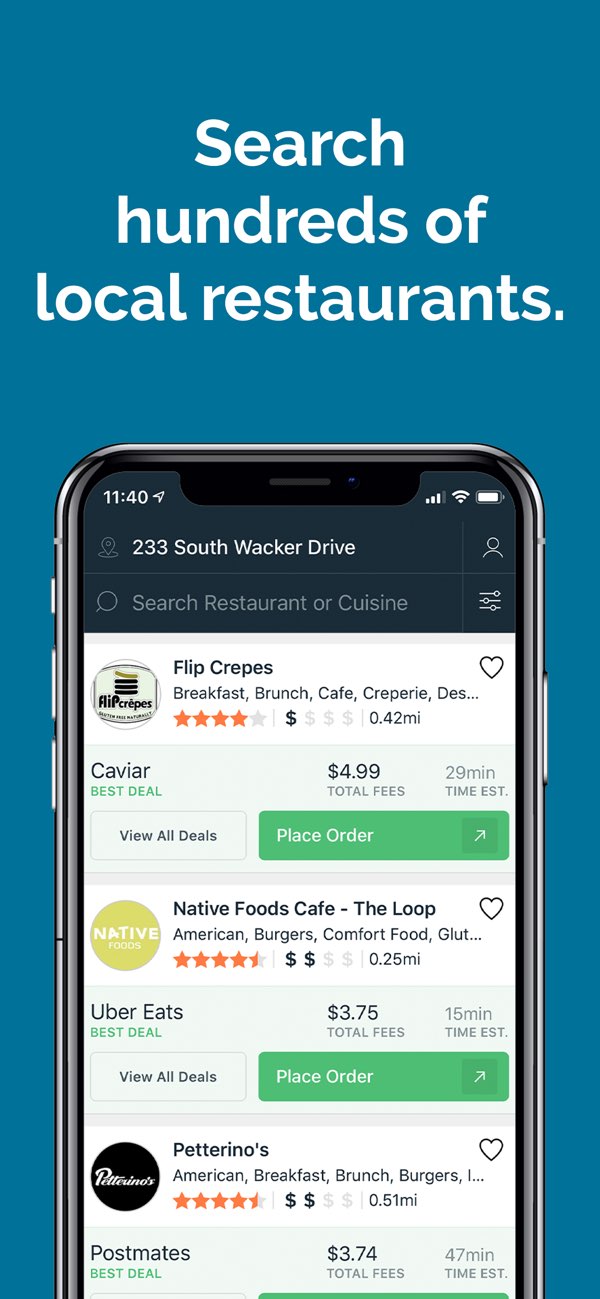
That separation explains the customer promise. FoodBoss can remain free to the diner because its commercial value appears farther down the funnel. Someone comparing three ways to order from the same restaurant is not casually admiring a sandwich. That person is close to buying. DiBenedetto framed FoodBoss as a competitor to broad advertising channels rather than an enemy of restaurants or delivery apps. In other words, the company sells concentrated intent.
We are partners to the restaurants and the third-party companies and competitors against the other digital advertising channels.Michael DiBenedetto, co-founder and CEO
Public accounts of the model describe commissions tied to orders or qualified referrals from participating businesses. The company does not publish its rates. The more important constraint is visible: delivery already runs on thin margins. Adding a fresh fee for consumers would spoil a product built to help them avoid fees; leaning too hard on restaurants would make FoodBoss another hungry mouth at the table. Lower acquisition cost is the pitch that keeps the triangle from collapsing.
The first crack was hiding in plain sight
The original comparison was incomplete. FoodBoss covered third-party services, but not a restaurant's own checkout. That mattered more in 2020, when restaurants rushed to improve direct pickup and delivery. A direct order could preserve the restaurant's customer relationship and reduce marketplace fees, yet customers might never discover the option. A restaurant could build a handsome ordering site and still watch demand arrive through somebody else's app.
Restaurant Direct was the correction. Launched in November 2020 with Chicago pizza fixture Lou Malnati's, it placed first-party ordering alongside the familiar marketplace buttons. Sbarro was announced as a planned multi-market addition. The plumbing was harder because restaurants use varied ordering stacks; FoodBoss said it would work through APIs and restaurant IT teams. But strategically, the move restored the company's claim to neutrality. “All the options” could not mean only the platforms already good at buying attention.
This is the most stealable move in the story. When an aggregator discovers that suppliers have started building direct channels, it should not treat those channels as betrayal. Index them. The aggregator keeps the broad selection users want, the supplier gains a route to direct demand, and the comparison becomes harder for a closed marketplace to imitate honestly.
Retention arrived wearing a gift card
Metasearch has a habit problem: once it answers the question, the user leaves. FoodBoss later added a rewards program to make departure less final. Its public rewards page offers points for enrolling, signing in, and placing an order, regardless of which available service the user chooses. It states that 1,000 points equal $1 and that points do not expire. An iOS release in September 2023 listed rewards and new locations.
The numbers are less interesting than the mechanism. FoodBoss cannot control whether the courier arrives smiling, but it can reward the act of starting the purchase with FoodBoss. This is a modest loyalty layer laid over other companies' transactions. It works best for regular delivery customers who do not already have a subscription, coupon, or favorite app strong enough to end the comparison before it begins.
A good feature meets a giant
FoodBoss raised more than $2 million in March 2019 in a seed-plus round led by Cleveland Avenue, the food-focused investment firm founded by former McDonald's chief Don Thompson. Company databases also record a $750,000 convertible note in February 2022. The money supported a product whose scale claims grew from more than 165,000 restaurant listings and 50 metropolitan markets on LinkedIn to more than 250,000 restaurants across 60-plus cities in its App Store copy.
Then the comparison layer became a Google feature. In 2024, FoodBoss sued Google, alleging that Google Food infringed two FoodBoss patents and violated federal and Illinois antitrust law. The patents concerned aggregating restaurant and delivery-service information into searchable results. In September 2025, a federal judge granted Google's motion to dismiss. The court found the asserted patent claims directed to an abstract idea without the inventive concept required for patent eligibility, and found FoodBoss had not plausibly alleged an antitrust injury. The judge allowed time for an amended complaint.
It is the first clearly documented failure in the FoodBoss arc, and it reveals the weak joint in any “Kayak for X” company. A comparison interface can be valuable without being legally defensible. If a platform with default distribution can reproduce the view, the smaller company needs more than the view: exclusive supply, unusually fresh data, a trusted brand, repeat behavior, or economics the platform does not want to match.
FoodBoss therefore occupies a strange market position. It competes with Google at the moment of discovery, with delivery apps for the customer's starting screen, and with habit itself when a diner taps the same subscription-backed service every Friday. Yet it also needs those delivery apps to provide useful inventory, and it needs restaurants to keep their direct information current. That is less a conventional marketplace than a diplomatic post with an API budget. The expertise is not moving meals. It is reconciling restaurant identities, menus, ordering channels, variable fee structures, geographic coverage, and time estimates quickly enough that two unlike services can sit in the same row. The comparison looks obvious only after somebody has done the normalization.
Comparison loses power when one provider dominates a city, a restaurant has only one ordering route, or subscriptions and personalized coupons change the price at checkout. It also fails quietly when menus, fees, and estimates arrive late. A neutral answer built from incomplete data is still incomplete.
What changed, and what remains useful
FoodBoss's evolution shows a company repeatedly widening the answer. Third-party delivery was not enough, so it added direct restaurant ordering. A one-off utility was not enough, so it added rewards. Restaurant data access remains a bottleneck, so a documented 2026 Toast integration now lets eligible Toast customers surface their Toast Online option in FoodBoss. The integration is read-only and restaurant onboarding follows through Toast's partner system. That is unglamorous infrastructure, exactly the kind that makes a comparison product more complete.
For diners, the practical use remains delightfully narrow: check before paying. Search one restaurant, compare the visible total fees and estimated times, then choose. For restaurants, the pitch is discovery without surrendering the direct channel. For delivery services, FoodBoss is an acquisition source populated by people who have already decided to eat. Each customer buys a different version of the same thing: fewer wasted clicks.
Founders can copy the shape, with conditions. Pick a purchase where users already consult multiple sources. Normalize the few variables that decide the purchase. Send the customer to suppliers instead of rebuilding fulfillment. Monetize the qualified lead without corrupting the ranking. Then add direct suppliers, because marketplaces should not be allowed to define the whole inventory.
Do not copy it where data is closed, prices personalize too quickly, or the purchase happens too rarely to form a habit. Do not mistake a clean interface for a moat. FoodBoss's decade is a reminder that the comparison table can be the product, the acquisition channel, and the battleground all at once. The customer, meanwhile, just wants the pizza before it gets cold.
Keep going
Try the comparison engine, inspect the mobile product, or watch the short product walkthrough.