A restaurant dashboard is an unlikely place to contemplate the philosophy of order. Yet there it was: 25 top-level pages, each doing something useful, together threatening to become a small republic of menus. A restaurant operator could update a website, edit a menu, issue a refund, manage reviews, check devices, change opening hours, connect a domain and export reports. The product worked. Working, however, is only the beginning of a product's manners.
Tucker Hawkinson had joined the Owner dashboard project by July 2021. In his portfolio, he describes the application plainly as a large Vue and Vuex system that served as the content-management center for restaurant owners. He also describes its early condition with the useful bluntness of an engineer who has no interest in pretending the first version was the final one: it was functional, but neither modern nor polished.
The problems appeared on both sides of the screen. Operators did not read the business hierarchy the way the navigation represented it. Engineers could share components that carried hidden assumptions about application state. Pages crowded unrelated numbers into the same visual plane. Even buttons exposed so many styling decisions that consistency required little private rituals in JavaScript. The interface had become an archaeological site of perfectly reasonable earlier choices.
“This problem fascinated me.”Tucker Hawkinson, on the scaling problem created by unsafe component sharing
First, learn what kind of machine it is
Hawkinson arrived at software by a route that helps explain his taste for structure. He studied mechanical engineering at Embry-Riddle Aeronautical University. Between 2015 and 2020, he moved from intern to engineer in the United States Federal Government. For five months in 2017, he was a production intern at SpaceX. These are environments where an interface is not merely the arrangement of pixels. It is the boundary between parts, people and consequences.
By 2020, the medium had changed. He joined Spathe Systems as an application developer and advanced to senior application developer. He also began publishing small lessons on Medium. The sequence opened with “So You Want to Learn How to Program” and continued through four installments of “HTML For Humans.” The title was cheerful; the teaching was delightfully literal. One lesson begins with the difference between a text editor and a word processor. Another shows a beginner how to rename a text file index.html. No mysticism, no priesthood, just the next useful thing.
In 2021, while that professional transition was underway, Hawkinson began computer science studies at Vanderbilt University. The move did not erase the mechanical engineer; it gave him another set of materials. His public work ranges across TypeScript, JavaScript and Vue, but also Java, Go and Rust. Even the repository list has the air of a workbench: experiments in desktop applications, authentication, databases, graphics and deployment sit beside the more polished portfolio. Curiosity is easier to believe when it leaves sawdust.
That instinct - make the next step visible - carried into his product work. The dashboard navigation treated locations as if they were independent objects. Restaurant operators tended to think of a location as belonging to a brand. The distinction sounds small until a customer has several locations and the left navigation becomes a thicket. Hawkinson and the team moved brand and location selection to the top of the experience. The page below could then inherit the selected context. The software began speaking the user's grammar.
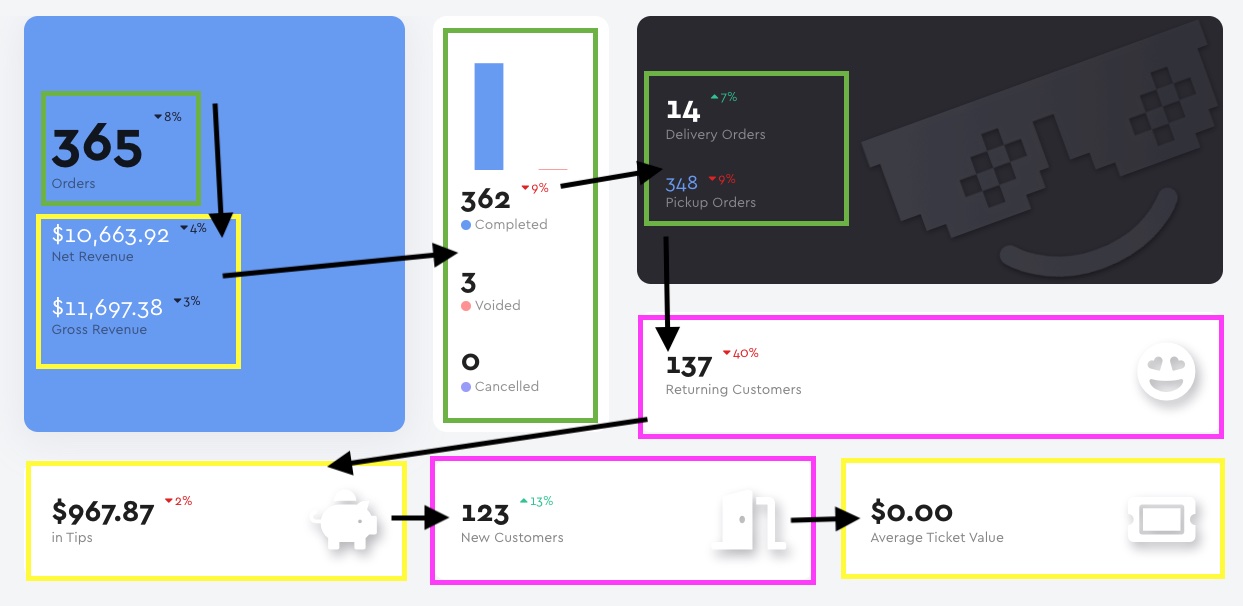
The annotated screen is revealing because none of its numbers is individually absurd. Orders, revenue, returning customers, tips and ticket value are all reasonable things to show. Their collision is the problem. Hawkinson traced the reader's eye across six changes of context, converting a vague complaint - “this feels busy” - into something a designer and engineer could discuss. The resulting email-builder example still carried plenty of information, but its hierarchy gave that information a queue. Density had not been defeated. It had been given manners.
The front end has a backstage
Information hierarchy was only the visible half of the puzzle. Behind it sat components organized by type: customer tables near customer cards, views in one place, routes in another. That arrangement behaves nicely while an application is small. Then an orders page wants only the customer heading. Is the heading safe by itself? Does it expect the customer store to have been prepared elsewhere? A reusable-looking component can be a trap door with good typography.
Hawkinson's answer was a domain-based system he called feature modules. Each module gathered components around shared data and exported only the parts judged safe to use elsewhere. It was an architectural fence, but a friendly one. The fence did not prevent engineers from building. It told them where the ground was firm.
He applied the same principle to the design system. An early button component exposed raw colors, hover colors, outlines and dark-mode settings. Technically flexible, it made every engineer a part-time brand committee. The revised version asked for two meaningful things: a variant and a color. The base component handled the styling. A smaller API produced a stronger boundary and fewer opportunities for the product to dress itself in the dark.
This is the useful overlap between design and engineering. Both disciplines decide which choices should remain choices. Good navigation removes the need to remember where a location belongs. A good component removes the need to remember the correct hover shade. The achievement is not maximum freedom. It is carefully placed freedom.
A career measured in better questions
Intern to engineer, United States Federal Government
Production intern, SpaceX
Application developer to senior application developer, Spathe Systems
Founding engineer, senior to staff, Owner.com
Founder and CEO, stealth startup
Hawkinson's current career page compresses the next chapter into two concurrent lines. Since 2023, he has been a founding engineer at Owner.com, progressing from senior to staff. Since 2026, he has also listed himself as founder and CEO of a stealth startup. He offers no public name or product for the new company. The restraint is almost comic in an industry fond of announcing a revolution before choosing a domain.
Meanwhile, Owner has expanded far beyond the dashboard he first documented. In August 2026, the company announced a $240 million Series D at a $2.3 billion valuation. Its public ambition now reaches beyond restaurant websites and ordering into mobile apps, CRM, support, point of sale and AI phone ordering, with other kinds of local businesses on the horizon. Large financing rounds make noise. The work underneath them often sounds like a quiet conversation about whether a component should be exported.
That contrast matters. A restaurant owner does not buy a feature module. The owner buys fewer headaches: an order that arrives, a menu that can be changed, a customer who can return without surrendering the relationship to a marketplace. Architecture earns its keep indirectly. It lets a product add jobs without asking every new job to renegotiate the whole system. Hawkinson's portfolio is valuable precisely because it records that invisible exchange rate between code discipline and an ordinary user's afternoon.
There is a temptation to read Hawkinson's path as a tidy conversion story: mechanical engineer discovers software, software engineer discovers startups, founding engineer becomes founder. It is neater to see one craft changing materials. Production systems, government systems and restaurant systems all require a person willing to inspect the joints. The object changes. The question stays recognizable: where should the complexity live so that everyone else does not have to carry it?
“I build software, lead teams, and write about engineering and the craft of shipping in the AI age.”Tucker Hawkinson, personal site
The human in the loop
Hawkinson's public archive is modest. There are no grand theories bearing his name, no conference reel full of choreographed certainty. There is a beginner being shown how file extensions work. There is a restaurant dashboard with arrows drawn all over it. There is praise for a designer who helped clean up a dense email builder. There is an engineer admitting that an earlier component structure worked well until the scale changed.
Those details reveal a working personality better than a slogan could. He likes systems, but not at the expense of their users. He values abstraction, but only when it clarifies responsibility. He writes proudly about an API-first initiative, then demonstrates it with a button. This is technical leadership in its less photogenic form: establish the pattern, explain why it exists, and make the sensible action easier than the dangerous one.
His next company may eventually supply a new product and a public thesis. For now, the stronger statement is already present in the work behind him. Complicated things do not become simple because their complexity vanishes. They become simple because somebody decides where each part belongs. Hawkinson has spent a decade practicing that decision - first around machines, then around code, and increasingly around teams.