The most instructive thing about Rivers Agency is a number it did not hide: $25,000. That is roughly what a candy company paid the Chapel Hill firm to redesign its WordPress site and move its store to Shopify. The client had asked about a dozen development agencies for proposals. Rivers won, the client later said, because its portfolio was persuasive, its communication was clear and it did not overpromise. The job arrived on time and within budget.
Agency profiles usually offer a fog machine of creativity, culture and results. This one starts with a disclosed price because it explains the enterprise more neatly. Rivers is a creative business that has lasted since 1993 by making uncertainty feel manageable. It does not sell a packaged product. It sells a sequence: ask, define, make, deploy, measure - with enough disciplines in-house that the idea is less likely to get lost between vendors.
The generalist's wager
Lauren Rivers founded the agency on a remarkably unfashionable proposition: high-quality work, hard work and a fair price. No grand theory. No invented category. In the early years, generalism was practical. A client needed a logo, a brochure, an ad and eventually a website. Rivers built Capel Rugs' first site in 1996 and First Bank's in 1998, back when simply having a corporate website counted as digital strategy.
The modern version is more technical but follows the same logic. The agency now spans research, positioning, naming, identity, copy, public relations, paid and organic social, media buying, video, e-commerce and full-stack development. Its 2026 rebuild of MCNC.org used object-oriented user experience to map the nonprofit's people, programs, services and resources before it mapped pages. The front end runs on Next.js; WordPress operates behind it as a headless content system. The point was not to advertise a fashionable stack. It was to turn a large body of technical information into paths that teachers, hospitals, libraries and government visitors could follow.
We're asking bigger questions upfront about the business, the audience and what the work actually needs to accomplish.Sarah Owens, Chief Creative Officer
The project that had to learn how to listen
The more revealing client story is larger. Grubb Properties hired Rivers in 2017 to brand a 70-acre Chapel Hill development. A logo would not be enough. The assignment grew to include the overarching concept, names for buildings, a video-rich website, press releases, social media and community outreach. Roughly ten Rivers people touched the work; the client disclosed spending about $250,000 by mid-2020.
What failed first was communication. At the beginning, the client said, both sides took time to learn how to talk and listen without carrying a fixed answer into the room. That is the ordinary, expensive failure hiding inside complex creative work: everybody is responsive, everybody has ideas, and nobody has yet agreed on the shape of success.
What changed their minds was not a clever presentation. It was cadence and clarity. A core group began meeting regularly. Information kept moving among departments. The agency offered many ideas; the client got more precise about the result it wanted. The relationship continued. The lesson is portable: collaboration becomes useful only after enthusiasm has been converted into decision rights, meeting rhythms and a definition of done.

Continuity is the product
Rivers occupies an awkward and useful place in the market. It is smaller than a global holding-company agency, broader than a boutique design studio and more creative-led than a software consultancy. A client can hire it for a product launch or hand over a wider system. First Bank chose the latter. Rivers has been its agency of record since 1998, working across brand, websites, SEO and campaigns. In one reported year, the bank said its website generated more than $1 million in new deposits and loans.
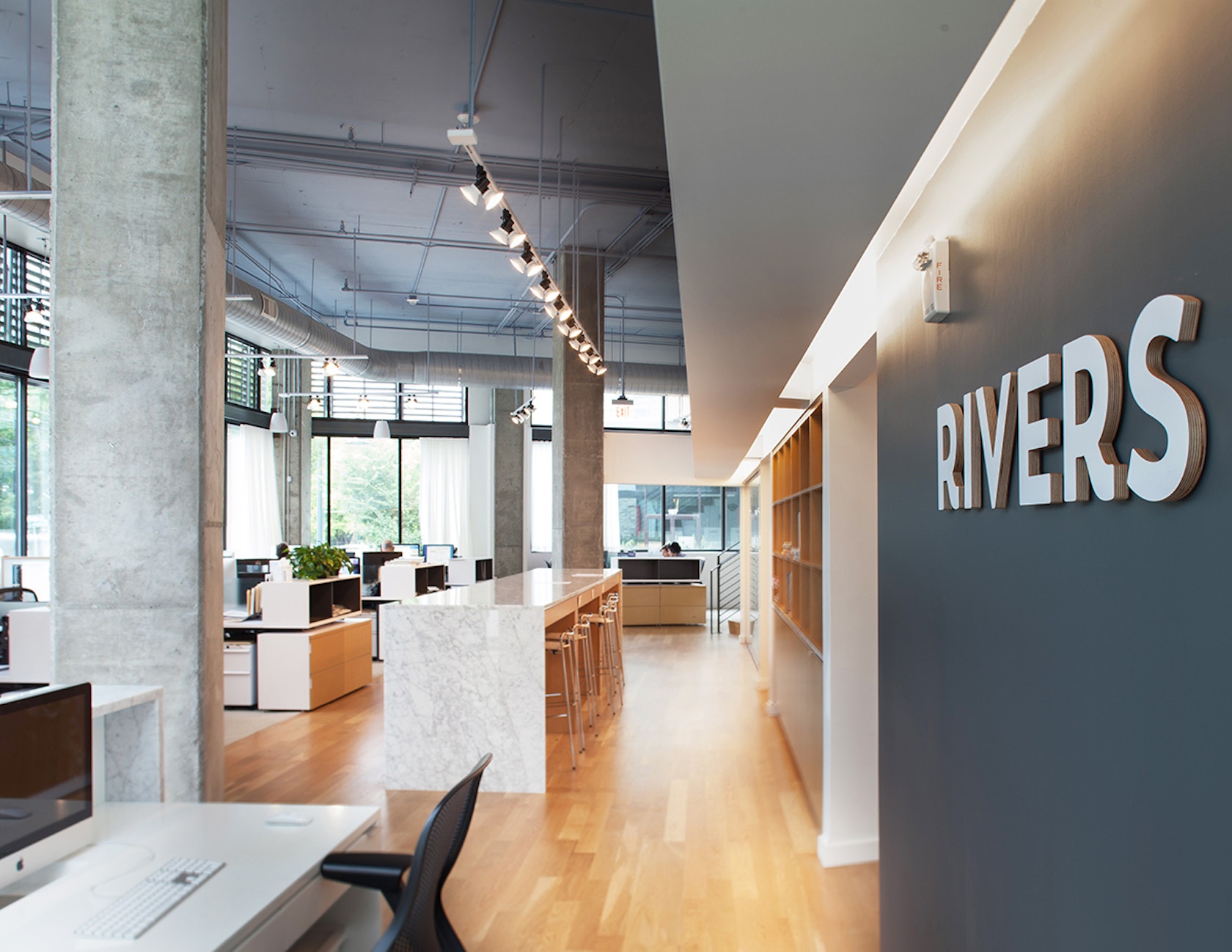
That continuity matters because most marketing problems are relay races. The strategist hands a document to the designer, the designer hands files to a developer, the developer launches something the media buyer did not shape, and the analytics team explains the result after the money is gone. Rivers' difference is less romantic: fewer handoffs. The person mapping an audience can sit near the person writing the copy and the person deciding how the component behaves on a phone.
Its client list makes the range visible. There are banks and car washes, mixed-use developments and technology organizations, an ostomy brand and the Dian Fossey Gorilla Fund. Recent work includes Truliant Federal Credit Union, Trillium Health Resources and Salesforce's Dreamforce. Fenton's social campaign combined cinematic video, a repeatable content framework and a network of creators. Revel Ostomy's holiday work used warmth in a category more accustomed to clinical language. Both won Platinum MarCom recognition.
What another team can steal
The Rivers playbook is not “offer every service.” Breadth without coordination is merely a longer menu. The useful pieces are more specific, and they work for an in-house team as well as an agency.
Before designing pages or ads, list the people, services, places and decisions the audience is actually trying to find.
State what is included, what approval changes it and what the finished work must accomplish.
Put strategy, creative, distribution and development in the room before production begins.
On complex work, regular meetings are not bureaucracy. They are how a shared language gets built.
The model is a poor fit when a company wants the cheapest commodity execution, requires a narrow technical specialty the agency does not hold, or cannot give one team enough access to its decision-makers. It also depends on candor. If the client cannot say what success looks like, or the agency cannot admit when communication is failing, integration becomes expensive proximity.
Rivers' longevity offers a quieter conclusion. The agency has changed tools repeatedly - print to websites, websites to e-commerce, traditional campaigns to creators, conventional CMS builds to headless platforms. Yet its founding promise is recognizable. Make strong work. Do not overpromise. Charge fairly. Keep the people solving the problem close enough to disagree productively. In an industry devoted to reinvention, continuity can look surprisingly inventive.