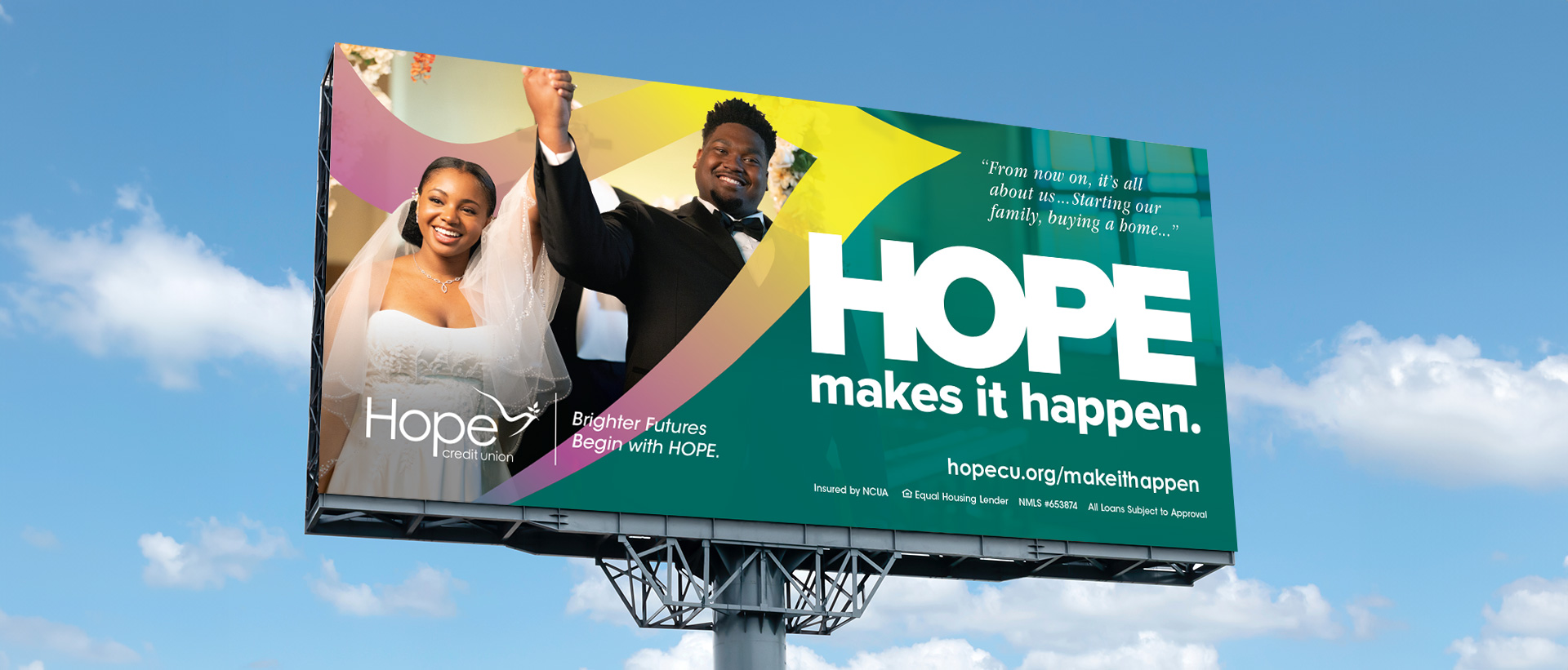
The billboard shows a bride and groom, hands raised, caught in that expensive second when a wedding becomes a marriage. The type beside them says HOPE makes it happen. It is warm, human advertising for a credit union whose territory includes some of the most economically distressed communities in the American South. But the revealing part of the campaign is not on the billboard. It is in the five-month report: 5,800 new leads, 4,300 new members and $16.7 million in new deposits.
Austin Williams, the agency behind the work, likes this second set of numbers at least as much as the first set of pictures. The firm is based in Hauppauge, about an hour east of Manhattan when the Long Island Expressway is feeling charitable. Its office is dog-friendly. Its staff calls itself Creative Warriors. Its website has plenty of the familiar agency ingredients - handsome films, bold typography, people who enjoy saying they are curious - but it keeps returning to an unfashionably blunt claim: creative work is not creative unless it sells.
The agency with a second audience
Every advertisement has an official audience and a secret one. The official audience is the person who might open an account, book an appointment or apply to college. The secret audience is the executive who approved the budget and must later defend it. Austin Williams designs for both. One gets a story that feels true. The other gets a result that can survive a finance meeting.
That combination matters because the agency has chosen categories where persuasion travels with paperwork. Financial institutions operate under compliance rules. Hospitals sell expertise to anxious patients. Universities make a promise whose cost can follow a family for decades. The work cannot merely interrupt; it must clarify, reassure and move somebody toward a consequential decision.
The agency's service list is broad: research, positioning, identity, campaign development, media planning and buying, public relations, content, paid search, paid social, SEO, analytics, UX and web development. That breadth is not a decorative menu. It is the business model. An institution can hire one shop to study the audience, frame the promise, make the campaign, build the landing page, place the media and watch the conversion. For a client with a lean marketing department, the attraction is coordination. For Austin Williams, the advantage is access to the whole chain between idea and outcome.
Sameness fails first
Look across the agency's portfolio and the first problem is often not bad advertising. It is category camouflage. A credit union has inherited a meaningless name after several mergers. An orthopedic practice has skilled doctors but a website that makes them hard to find. A college becomes a university and risks sounding like every other newly renamed school. The first thing to fail is distinction.
For United Trades Federal Credit Union, research with members led to a name that said who the institution was for. The visual identity travelled onto hard hats, turning a familiar object into both media and membership badge. Ten months later, the credit union reported double-digit deposit growth, 2,000 new accounts and loans, and a 2.5 percent increase in out-of-market membership.
For Orlin & Cohen, the change was functional. The orthopedic practice's running-person icon became a navigation device: tap the body part that hurts and find the relevant specialist and office. In the first months after launch, online appointment requests doubled, mobile visits rose 43 percent and conversions increased 34 percent. It is a small lesson with large consequences. A brand device becomes valuable when it does a job.
Emotion, with its shoes tied
The HOPE campaign makes the method visible. Hope Credit Union had already served more than three million people across the Deep South. The abstract proposition was financial inclusion. Austin Williams went looking for the human version. Member stories supplied the emotional center; concrete evidence supplied the authority. The agency and HOPE then distributed the idea through five cinematic commercials, radio, streaming audio, print, digital media, bus shelters and billboards that generated nearly 74 million impressions.
Local production mattered. Austin Williams worked with New Orleans production company Elephant Quilt and director Abraham Felix, a choice that helped the films feel located rather than imported. The creative did not treat underserved communities as a demographic row. It showed people buying homes, building businesses and moving forward, with the institution cast as an enabling force. The public responded. So did award judges: the campaign collected 13 Telly Awards, including four golds.
The useful sequence is easy to copy and hard to fake. Start with the decision a person is trying to make. Find testimony that exposes the emotional stakes. Add proof strong enough to discipline the promise. Choose the conversion before choosing the channel. Then build the media system around that action. The work becomes less about broadcasting a message and more about removing reasons to hesitate.
A direct marketer's ghost
The firm's founder, Bill Pesce, came out of the Mad Men period but wanted more feedback than traditional advertising allowed. He was an early practitioner of direct marketing, when response arrived by mail instead of pixel. He moved his office from New York City to Long Island for a shorter commute and a better life. After a few naming iterations, he became the Williams in Austin Williams. The company dates its founding to 1992.

That direct-response instinct survived every technical change around it. Under president Eva LaMere, who took the reins in 2014, the agency expanded web design, development, digital marketing, photography and video while growing its account base. Today CEO and chief creative officer Rick Chiorando supplies the expressive side of the partnership; managing partner Andrew Catalano has said he can spend 30 to 40 percent of a day analyzing campaign performance. Art and arithmetic share the same office.
Austin Williams has also moved into conversational AI. Austin AI, introduced in 2023, is a website chat agent configured around a client's content, voice, desired outcomes and compliance concerns. Humans review conversations and refine the rules. The pitch is consistent with the rest of the company: new technology is useful when it helps a visitor do something and gives the organization evidence about what visitors need.
Where the argument holds
The model is best suited to organizations with a definable audience, a meaningful conversion and enough access to data to connect the two. It is particularly persuasive when a client wants one accountable partner across brand, media and digital delivery. It is less naturally suited to a tiny business that needs a single specialist, a company unwilling to share performance data, or a campaign whose only agreed objective is fame. Measurement cannot rescue an unclear offer. Integration can become excess when the problem is narrow.
There is an amusing tension here. Advertising people like mystery; dashboards do not. Austin Williams has made that tension its position. The emotional story earns attention. The functional design makes action easier. The numbers decide whether either one mattered. The billboard with the newlyweds is still lovely. The $16.7 million is what gives it a plot.
Find the agency