In 2010, a Buffalo advertising agency bought a company that, by the usual arithmetic, barely qualified as a company. Praxis had no clients of record. It had no active projects. Crowley Webb acquired it anyway and handed the operation to an account executive whose first years at the agency had included “a series of miserable projects” and one dream client that produced the worst client interaction of her career.
Her name was Tricia Barrett. She had considered leaving. James Hettich, then the agency's CEO, persuaded her to stay. The assignment that finally caught was Praxis, a specialist in recruiting patients for clinical trials. Barrett built a team around it, and the empty acquisition began producing something more valuable than a tidy case study: new capabilities. The growth of Praxis helped prompt Crowley Webb to form user-experience, analytics, video, and public-relations departments. Barrett became CEO in 2023. The agency became woman-owned that year.
This is the more revealing Crowley Webb origin story. The official one starts in 1986, when Joe Crowley and John Webb stood in a phone booth on Chippewa Street with an idea for an agency. The consequential sequel begins with almost nothing and a manager who had already learned that an attractive logo on a client list does not guarantee attractive work.
What the agency actually sells
Crowley Webb calls itself full-service, a phrase roomy enough to conceal almost anything. Here it means strategy and brand positioning; campaign ideas, design, and copy; qualitative and quantitative research; media planning and buying; PR and reputation work; user experience and web development; social content; and an in-house production team that can script, cast, film, animate, edit, and finish video. Praxis sits under the same roof but serves the specialized needs of pharmaceutical and biotechnology companies trying to connect the right patients with clinical trials.
The customers make the range legible. M&T Bank and Wilmington Trust bring financial services. Highmark and Evergreen Health bring healthcare. Moderna and Ultragenyx sit in the clinical-research orbit. Niagara University brings enrollment. ESAB brings manufacturing. The Strong National Museum of Play, Sullivan Tire, Upstate Niagara Cooperative, United Way, AAA, and the Buffalo Zoo make the roster difficult to reduce to one vertical. The common purchase is not an ad. It is an outside team asked to investigate a business problem, choose a position, then make and distribute the evidence for it.
The difference is visible after the idea
Plenty of agencies can draw the same menu. Crowley Webb's distinction is the machinery behind it. It employs more than 100 people, reports more than 2,000 awards, operates its own production studio, and maintains a data-science practice. Through AMIN Worldwide, it can also borrow local knowledge and capacity from more than 50 independent agencies in nearly 30 countries. That gives a Buffalo independent some of a network's reach without turning it into a branch office of a holding company.

The numbers in the firm's case studies are more instructive than its trophy count. For Niagara University, the agency began with primary qualitative and quantitative research. It found that the school's differentiator was a nurturing environment for self-discovery, built the “Find Your Wings” platform, then carried it through television, paid social, display, and outdoor. Niagara reported a 15 percent year-over-year increase in enrollment, alongside 75 percent more website clicks and 40 percent more conversions.
Evergreen Health presented a different problem: Western New Yorkers did not understand the inclusive care it already provided. Research verified the gap. Crowley Webb named the position “Unconditional” and expressed it in social, outdoor, television, original music, and other media. Aided awareness rose 171 percent; unaided awareness rose 56 percent; extremely positive brand perception increased 25 percent. The idea worked because the organization was already delivering the experience. Advertising gave an existing truth a memorable handle.
A two-hundred-year-old product launch
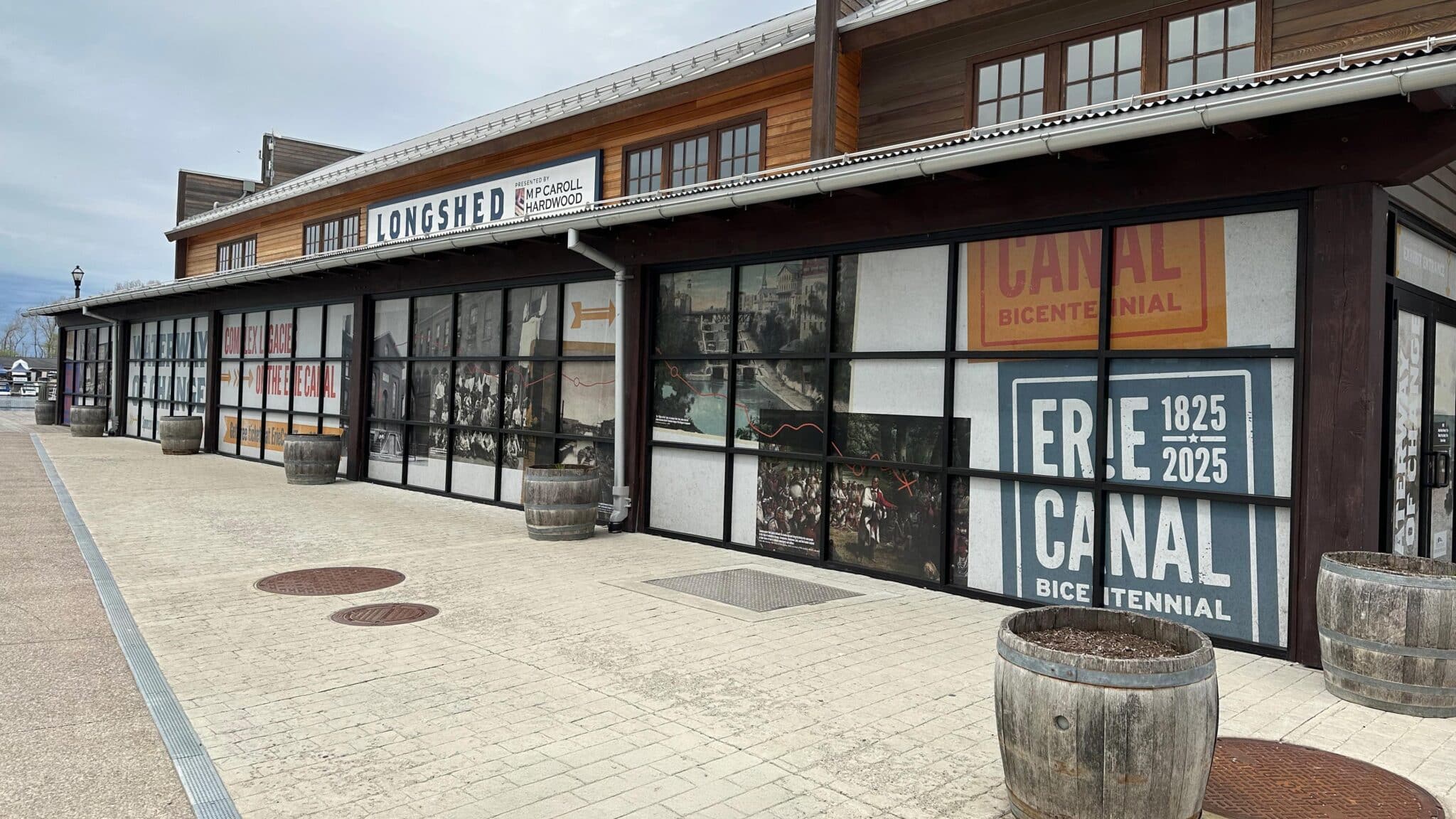
The Erie Canal bicentennial shows the same system at public scale. Crowley Webb had to make a complicated history inviting without sanding off the history. Its team created a visual identity, outdoor work, television, radio, social content, on-site signs, and a website where visitors could reserve free tickets. The summer program drew more than one million visitors. The campaign logged 21.1 million paid-media impressions, 1.1 million organic social views, and 88,900 website clicks.
A marketer can copy the sequence, though not necessarily the outcome. Begin with research before choosing a slogan. Turn the findings into one position that an ordinary person can repeat. Build the channel plan around the audience rather than around departmental territories. Measure a ladder of effects: exposure, response, conversion, and - where the client can disclose it - business results. The least glamorous part is also the most transferable: give the creative team a verified human truth instead of asking it to decorate a brief.
Where the model earns its keep
Crowley Webb earns money the conventional agency way: clients pay for people, ideas, production, technology, PR, research, and media services. Buffalo Business First reported $17.69 million in 2024 gross advertising income and ranked it first on the publication's 2025 list of Buffalo agencies. The supplied company estimate of annual revenue is $25 million. Those are different accounting ideas, but together they describe a substantial regional independent rather than a boutique.
Its market position lives between two obvious alternatives. A small specialist may know one industry more intimately but lack in-house breadth. A global holding-company agency may offer enormous scale but route work through a more complicated machine. Crowley Webb's answer is a broad team in one Buffalo office, a true specialty business in Praxis, and international backup through AMIN. That combination is most useful for clients with a complicated story, a need for multiple channels, and enough access to customers and performance data to let research guide the work.
Research before positioning; one clear idea; channel choices tied to audience behavior; measurement that follows the customer journey.
The product experience has to support the promise, leadership must tolerate a pointed position, and the organization must share enough data to learn.
The approach is less persuasive when a client wants a fast cosmetic refresh, cannot expose the team to customers, or treats every stakeholder preference as equally important. Research cannot rescue a service that contradicts the claim. An integrated agency also carries more machinery than a client needing one narrow deliverable may require. The Praxis story itself is a warning against copying the visible move - acquisition - without the invisible conditions: a capable operator, patience, and a niche difficult enough to teach the parent company something new.
Forty years, no museum glass
In 2025, Crowley Webb became media agency of record for Sullivan Tire, agency of record for The Strong, and a broad communications partner for Upstate Niagara Cooperative. It won 34 AAF Buffalo awards, including Best of Show for a mobile Highmark Stadium “TaleGate” that invited Bills fans to record their memories. The year before, it had collected 40 awards across work for 15 clients. Awards are imperfect evidence, but the variety matters: banks, welding equipment, healthcare, museums, dairy, football.
At 40, Crowley Webb still repeats its founders' rules: “The more you dig, the more you dig up.” “Good enough isn't good enough.” “Sometimes, the greatest risk is not taking one.” Agency principles are easy to print and hard to audit. This firm's most convincing audit remains that peculiar 2010 decision. It bought an operation with no work, trusted a person who had almost walked out, and allowed a demanding specialty to change the general business. There was nothing in the box. The useful part was learning how to build what belonged there.