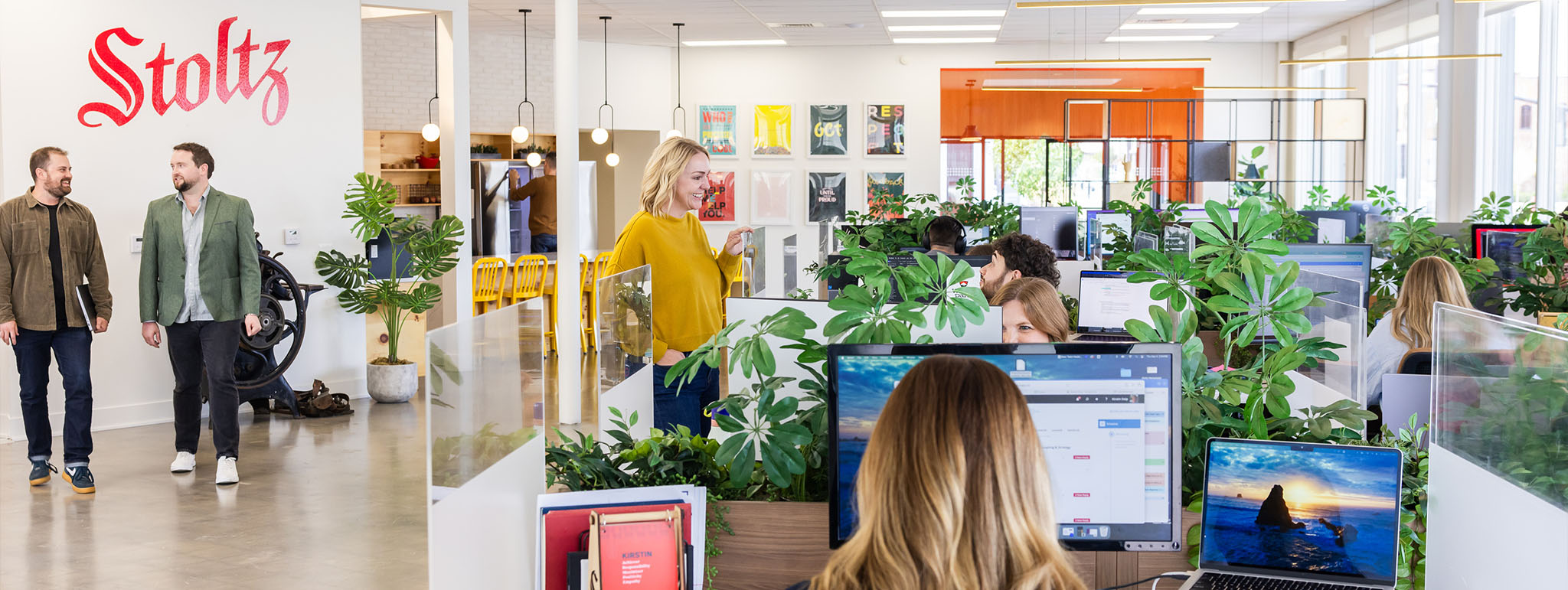
There is an old letterpress in the new Stoltz Marketing Group office, stationed a few steps from rows of large monitors and an improbable quantity of green plants. It is a good machine for explaining the company. The press belongs to a world in which making an advertisement was a physical act. The monitors belong to a world of conversion pixels, streaming video and dashboards. The plants suggest that somebody intends to remain human while moving between the two.
Stoltz is a 23-person independent agency in Boise. It makes brands, campaigns, websites, media plans, public relations, content and video. Its client list wanders pleasantly across American life: urgent care, public buses, pet insurance, schools, banks, beef, ski festivals, software and an airport. The firm describes itself as full-service and intentionally small. Usually, one of those phrases cancels the other. Here, the contradiction is the business model.
The succession nobody put on the whiteboard
Ken Stoltz founded the agency in 1996. His ambition was not empire. He wanted to create good work, have fun, have a life and work with excellent people. The headcount settled around 13 to 15 for most of the next two decades. His daughter, Jaime Ekman, absorbed advertising at family dinners but did not plan to inherit the shop. She earned an MBA, then built a sales and marketing career with consumer companies including Nestlé and Merrick Pet Care.
Then the neat version of succession failed first. In early 2018, two senior leaders abruptly left, opening a hole at the top. Ken had been diagnosed with brain cancer. Jaime returned to help manage the business, and her father died roughly six months after she stepped into leadership. She purchased the agency that year and became president and CEO. This was less a ceremonial passing of the torch than being handed a torch in a dark room and discovering that the map belonged to somebody else.
“If you take care of your people, they take care of your clients and your business.”Jaime Ekman, President and CEO
Ekman spent about five years resetting the team. She kept her father's faith in trust and independence, then made the people-first idea more literal. Stoltz added sabbaticals. It built a 12-week returnship for people who had been out of the workforce for at least three years. Employees received two paid service hours each month. The firm offered travel reimbursement for reproductive health care unavailable in Idaho. In 2023 it published a code of ethics developed over months rather than borrowed over lunch.
The result was growth that did not look very small. By 2022, the team had moved from 13 people to 24. By the 2024 opening of its new west-downtown office, revenue had risen 150 percent since Ekman took over and the staff had roughly doubled. The interesting choice was what Stoltz did not do next. It did not confuse growth with a race to build every specialty under one roof.
A small room with a very long table
Stoltz had joined Worldwide Partners, a network of independent agencies, in 1999. It left in 2010, then changed its mind and returned in 2019. The reason was practical. A small-market shop can preserve the close working relationships clients like while borrowing geographic reach, specialist knowledge and pitch capacity when a brief expands. Ekman has said the network helps the agency scale regardless of an opportunity's size. It is the benefits of a long table without employing everybody seated around it.
Inside the Boise core, strategy, creative, web and media work together. That matters because the agency's best work tends to begin where a communications problem is masquerading as something simpler. Valley Regional Transit and the City of Boise, for example, offered free summer bus rides to young people. Free sounds like the whole proposition. It was not. Parents in a car-oriented city had to trust the bus.
Stoltz created Lil Rider, a friendly, pudgy guide who appeared on passes, posters, social posts and eventually as a plush toy. More than 800 young people signed up in two weeks. Riders downloaded the transit app 757 times in two months. In the first 81 days, the program carried them on more than 4,400 rides. The creative move was not making free look cheaper. It was making public transit feel legible and safe.
The same pattern shows up in health care. Idaho Falls Community Hospital needed East Idaho residents to believe expert emergency care was available close to home. Instead of leading with the usual hospital corridors, the “Keep On, Idaho” campaign showed Idahoans living their lives. During the continuing campaign, emergency patient volume rose 4 percent, medical-surgical volume 16 percent, ICU volume 7 percent and intermediate care 24 percent. Visits to the Patient & Visitors page rose 170 percent. Marketing cannot claim every admission. It can show that the intended behavior moved in the intended direction.
The numbers hiding inside “we care”
Agency culture is often described using foggy nouns. Stoltz uses some of those nouns too, but it occasionally pins them to a spreadsheet. Its Creators for Change program gives one Idaho nonprofit 150 hours of marketing services, an estimated value of $25,000. Earlier versions donated more than 500 hours between 2018 and 2022. In 2023, the agency recorded 597 hours of community engagement alongside 21,264.94 hours spent on 244 projects.
The decimal is charming. Nobody invents “.94” for a manifesto. It comes from a time sheet, which means the good intention has entered operations. The program also puts a boundary around generosity: one partner, a fixed pool of hours, agreed goals, and work designed so the nonprofit can maintain it after the agency leaves. Care, in this version, has scope.
That mixture of warmth and constraint is also what clients buy. Primary Health has worked with Stoltz since 2018 through new clinics, changing audiences and a pandemic. Valley Regional Transit describes an eight-year relationship spanning websites, electric-bus launches and brand campaigns. These are not one-off logo drops. The agency operates as an extension of a marketing team, earning project and ongoing service fees while planning and buying media in-house.
The bits worth stealing
There are four useful ideas here, none of which requires a letterpress or a wall of tropical foliage.
- Turn values into policies. A returnship, paid service time and a sabbatical are decisions. “People first” is only copy until payroll and calendars can see it.
- Find the emotional barrier behind the obvious offer. Youth Ride Free did not have a price problem. It had a trust problem. The mascot solved the second one.
- Use a network instead of pretending to contain the world. Stoltz keeps the daily client relationship close and reaches outward when geography or expertise demands it.
- Measure behavior, then keep the caveat. Rides, visits, downloads and patient volume make stronger evidence than impressions alone, provided the agency does not claim sole credit.
The model is not universal. It depends on clients who value sustained collaboration more than an army of interchangeable specialists. It needs leaders willing to cap programs, document principles and decline work that strains the culture. A global network only helps when the local team is comfortable sharing credit. And an integrated shop becomes ordinary very quickly if strategy, creative and media merely occupy the same building.
In 2026, Stoltz collected ten regional awards for work ranging from a gleeful urgent-care campaign to a magazine about American Wagyu. The cleverest item may have been its own pitch for Spokane International Airport: the team invented “Stoltz Air,” packed the proposal into a vintage travel case with boarding passes and snacks, then flew to Spokane to deliver it. The pitch won the account. It also explained the company. Small enough to carry its own bag. Serious enough to track the flight.