There is a moment in every successful advertising campaign when the client asks for more. More reach. More frequency. More leads. Robertson+Partners can point to the rarer moment when a client asked for less. Pulte Homes had opened Reverence, a new community in Summerlin, with an awkward proposition: the home across the street could be bought for 40 percent less. The agency built the name, identity, place, advertising and media around a premium future instead of a floor plan. Opening weekend brought 2,500 visitors. Forty-six homes sold in two weeks, another 12 were pending, and prices went up twice. Pulte asked for the media to stop while its people caught up.
That pause contains the whole Robertson+Partners argument. Advertising is not a decorative layer applied after the important decisions. At its best, it changes the load on the rest of the business. Someone has to answer the phone.
The obstacle is the brief
Robertson+Partners is a privately held advertising agency headquartered on South Fort Apache Road in Las Vegas. Its legal roots reach back to 1979. Scott Robertson joined the predecessor shop, Merica Dickerson, in 1995, rose from traffic manager through the creative ranks, and eventually bought the agency. Today he is managing partner and executive creative director. The current team page reads like a compact full-service shop: creative, design, digital, media, measurement, accounts, finance and production leadership.
The service list is broad - research, positioning, naming, identity, web development, apps, film, virtual reality, media buying and analytics. The portfolio is more revealing. Again and again, the agency begins with a resistance that other people might edit out of the presentation.
For Reverence, the resistance was price. For Allegiant Stadium, it was the belief that 65,000 seats had arrived without a transportation plan. For the Regional Transportation Commission, it was the orange cone, that plastic monument to delay. For McDonald’s after the recession, it was a breakfast business described as shaky and a Hispanic audience living through job losses and role reversals at home. For flood-safety officials, it was the stubborn fact that teenagers do not arrange their lives around public-service announcements.
“People don’t buy homes, they buy inspired, idealized futures.”Robertson+Partners, on the Reverence strategy
The maneuver is consistent but not formulaic: do not hide the objection. Promote it to main character. The traffic cone became the bringer of jobs and progress. The stadium campaign explained distributed parking instead of pretending parking anxiety was silly. McDonald’s “Rise and Shine” treated changed household roles as the emotional truth of the morning. The campaign won a Telly and McDonald’s national recognition for Hispanic marketing; the agency’s case study says the Las Vegas market led the country in cash-flow growth.
A small shop with a long receipt
The company sits between two familiar alternatives. A client can hire a large network agency, buying scale and specialist depth at the price of more layers. Or it can assemble a group of boutiques for brand, production, web and media, then become the person responsible for making the pieces agree. Robertson+Partners sells integration from a team LinkedIn places in the 11-to-50-person range. Its public team page lists 12 people. The pitch is proximity: senior creative judgment, production and distribution under one roof.
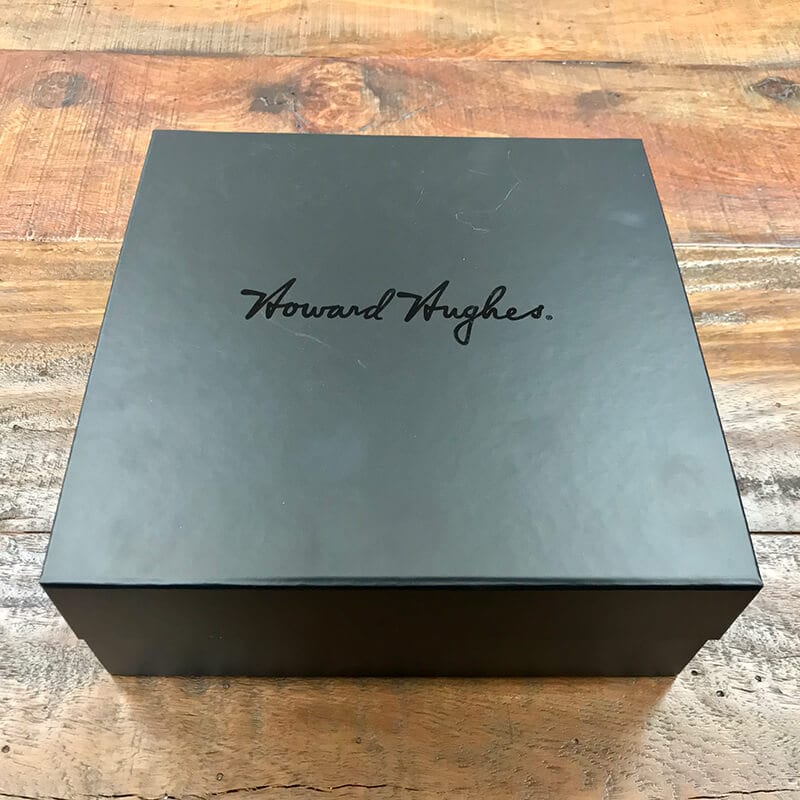
That integration is visible in the 1700 Pavilion campaign for Downtown Summerlin. A new 267,000-square-foot office project needed tenants during a short launch window. The agency made live-action film and CGI, teased a URL on outdoor boards, counted down to a Las Vegas Chamber event, and delivered gift boxes with “boarding passes” whose QR codes opened a mobile-first experience. Supported by social video, YouTube and email, the campaign produced 500,000 impressions, a reported 3.8 percent click-through rate and nearly 20,000 visits. Leasing-call volume exceeded the client’s goal.
- Name the audience’s real objection.
- Turn that objection into the story.
- Match the medium to the behavior.
- Measure the next action, not applause.
When the medium does the persuading
Flood safety is where the agency’s choices become especially instructive. Telling a newly licensed driver not to enter floodwater is sensible. It is also easy to ignore. Robertson+Partners built a five-minute virtual-reality experience of being trapped in a car carried by water, then demonstrated it with Oculus headsets in Las Vegas high schools. The idea was not to make a safety rule louder. It was to make the consequence briefly felt.
A later campaign faced a related problem: young people exploring storm drains and washes. The risk is real, but a stern campaign could accidentally make the locations feel forbidden and therefore interesting. “Drainger Danger” borrowed the form of TikTok dance challenges, using music and animation across social platforms, television and streaming video. The campaign delivered 20 million video impressions and reported awareness between 75 and 95 percent during its run.
The 40,000 letters and 1,300 petition signatures came from “Every Baby Counts,” created with Sunrise Hospital when neonatal intensive-care funding was under pressure. Staff and parents told their stories in video; a mobile-friendly site made it easy to petition or write elected officials. This is another Robertson+Partners pattern: emotion opens the door, but the experience gives the audience a handle to pull.
What the work costs
There is no public rate card, and the available numbers belong to government procurement, where media, production and agency fees can share one contract. They still show the width of the business. Clark County records list $3,660 for website hosting and support, $25,000 for desert-tortoise license-plate advertising and $400,000 for a branding project. A Nevada Department of Wildlife agreement allowed up to $500,000 across four years for photography, television and digital media. An RTC budget schedule listed a $1.3 million advertising and marketing agreement running from 2022 into 2024. None is a useful “starting price.” Together they say that Robertson+Partners can sell a narrow assignment or an integrated public campaign.
Love is a business model, too
The company’s slogan is “Love Your Agency.” Its website insists that excellent craft is merely expected; being a joy to work with is the “secret sauce.” Agency copy often makes culture sound like a scented candle. Here, the line has practical weight. Integrated work asks a client and agency to survive research, rewrites, production, approvals, launches and measurement together. The Downtown Summerlin testimonial mentions months of preparation, late nights and working through a holiday. Lovability, in that setting, means reducing the friction around hard work.
Scott Robertson’s own biography explains some of the appetite for odd angles. Before advertising, he was a bartender in Dublin, an English teacher in Taipei, a comedy-club emcee, a game designer and a stand-in for Quentin Tarantino. That is a suspiciously complete education in audiences: serve them, teach them, hold their attention, give them rules, and know when the star is somewhere else.
The agency’s most transferable lesson is smaller than its service list. Begin with the thing people resist. Give it a part in the story. Choose a medium that lets the audience experience the argument. Then connect attention to a next step that can be counted. A home visit. A leasing call. A signed letter. A safer decision in a storm.
And before buying even more attention, check whether the people answering the phone are ready.