In a Tennessee procurement file, among the hourly rates and clauses and boxes checked “not applicable,” there is a wonderfully candid explanation of why an old agency can be difficult to fire. Walker & Associates already knew the grant objectives. It knew the earlier media buys. It knew the Tennessee market. And it possessed the templates, prototypes and commercials that a replacement would have to make again.
This is not the usual advertisement for an advertising agency. There is no mood board. No adjective doing push-ups. It is an argument about memory - the slow, unphotogenic accumulation of what parents say in a focus group, which messages a student ignores, which radio market reaches which county, and which artwork can be used one more time without feeling used up.
Walker & Associates has been accumulating that sort of memory in Memphis since Vernon Deloss Walker founded the firm in 1965. The agency now describes itself as woman- and minority-owned, with Ceil Walker as president and CEO. Its menu runs from research and strategy to identity, public relations, websites, social media, video, events and media buying. The menu is broad. The method is narrower: learn first, make second, place third, measure afterward.
The glamorous part came last
Consider McDonald's. The Mid-South Co-Op hired Walker to advertise across West Tennessee, East Arkansas, North Mississippi, Missouri's bootheel and parts of Kentucky. The visible work included television, promotions and community events. Behind it sat focus groups and business analysis: who the local customer was, what that customer bought, where the money moved and what experience the restaurants were actually delivering.
For a time, Walker said it managed 128 Facebook pages for individual restaurants plus a central regional Twitter account. That is a comic amount of local conversation for a small agency. It also reveals the business it was really in. National brands arrive with rules; neighborhoods arrive with exceptions. Walker's job was to keep the arches recognizable while making the voice belong to the place.
“It all starts with the customer.”Walker & Associates, explaining the McDonald's account
The neatest execution happened on October 6, 2015. McDonald's was launching All Day Breakfast. At 10:31 a.m. - one minute after the old breakfast cutoff - a Memphis operator ceremonially served the first all-day biscuit. Walker brought breakfast and press releases to television and radio stations in three markets. The stunt lasted a morning. The knowledge that made it locally legible took years.
A diagram of the workflow - sequence, not performance data
Six was hiding in plain sight
RAPAC, a Ring Container subsidiary, presented a different puzzle in 2009. It had molded foam packaging made from recycled material that could itself be recycled. The product was technical, useful and in danger of receiving the sort of brochure that makes useful technical products disappear.
Walker interviewed people inside and outside the company. Then it recommended a name, an identity and a national introduction. Polystyrene carries the resin identification code 6. The agency called the product EcoSix. The name let an industry fact do two jobs: insiders recognized the number; buyers heard the environmental proposition. The logo's “O” became a device for the manufacturer's broader environmental practices.
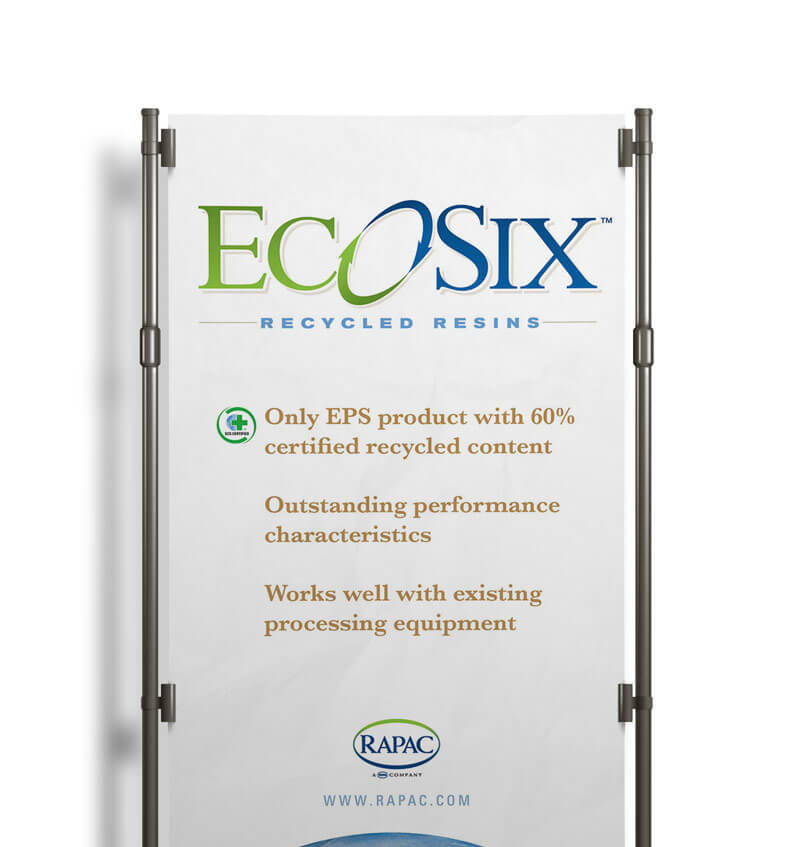
What changed the approach was not a clever font hunt. It was the recognition that manufacturing marketing was often emotionally anaemic. The agency paired business and technical information with the appeal of environmental responsibility. RAPAC later reported technical trials at customer plants and sales measured in hundreds of thousands of pounds. The public case study does not disclose the campaign's cost, so the honest lesson is about the mechanism, not return on investment: find the fact native to the product and make it carry the story.
When the state priced continuity
The Tennessee Higher Education Commission hired Walker through a competitive process in 2008 to encourage college access. The work was unusually comprehensive: annual strategy, research, television, radio, web, print, media buying and continuing evaluation. It eventually encompassed GEAR UP TN, CollegeforTN.org and messages for adults returning to higher education. Elsewhere in state government, Walker helped name and launch TNStars, Tennessee's first 529 college-savings program, and developed Timewise for adults converting prior learning into college credit.
What did it cost? The 2013 contract began with a maximum liability of $1.063 million and was later raised to $1.363 million as its term extended into 2019. The state did not promise to spend the ceiling. The payment schedule separated research, plans and reports from reimbursed media and printing, with an 8 percent placement fee on approved costs. That is a more useful view of the agency business than a guessed annual revenue: thinking is priced, making is priced, and distribution is priced.
What failed first? The public record does not identify a failed campaign. It identifies a looming handoff problem. A fresh procurement for the next project was not ready when a new seven-year federal grant arrived. Tennessee needed the current work to continue and the new work to begin. Changing suppliers immediately would have meant rebuilding creative assets while relearning objectives, purchases and geography. The state extended Walker while preparing a competition.
The thing another agency can copy
Nobody can copy sixty years. They can copy the architecture. Put research beside creative instead of upstream from it. Keep the media buyer close enough to the strategist to report what the audience actually did. Save the templates and campaign logic, not merely the final files. Make evaluation part of the scope rather than a victory lap. And when a client renews, explain the economic value of retained context without pretending that longevity itself is a result.
This approach is best suited to complicated regional accounts, public campaigns and organizations with repeated messages across years. It is less persuasive for a one-off logo, a product with no stable audience or a client whose strategy changes every quarter. It also depends on disciplined documentation. Institutional memory locked in one employee's head is not an asset; it is a departure notice waiting to happen.
Walker competes with larger integrated firms, specialist boutiques and clients assembling their own stack of researchers, designers, publicists and media buyers. Its difference is not that it invented any one service. It is that the information can survive the trip between them. A parent comment can become a campaign theme. A spending pattern can redirect a media buy. A plastic numeral can become a name.
Deloss Walker began in an era of political campaigns, radio and television. Ceil Walker carried the agency through websites, streaming and social feeds. The formats changed. The durable product did not. It is the answer to a plain question asked before the brief becomes artwork: what do we already know that the next person would have to learn?