There is a particular kind of problem that is almost impossible to advertise: the problem everyone can see but nobody notices. Charlotte has trees. People like the trees. The city is nicknamed the City of Trees. Yet its canopy has been thinning, steadily enough to matter and quietly enough to ignore. TreesCharlotte had planting events, educational material and partnerships. What it lacked was public urgency. How do you make absence visible before the thing is gone?
SPARK Strategic Ideas answered with a wonderfully literal piece of media planning. It put the message on the trees. More than 400 vinyl signs appeared around parks, greenways, libraries and neighborhoods, fastened with bungee cords. “Money doesn’t grow on trees, but property values do,” read one. Stumps got their own signs. Digital trucks carried the campaign to Panthers games and college football crowds. The central question was pointed but playful: What would Charlotte be without its trees?
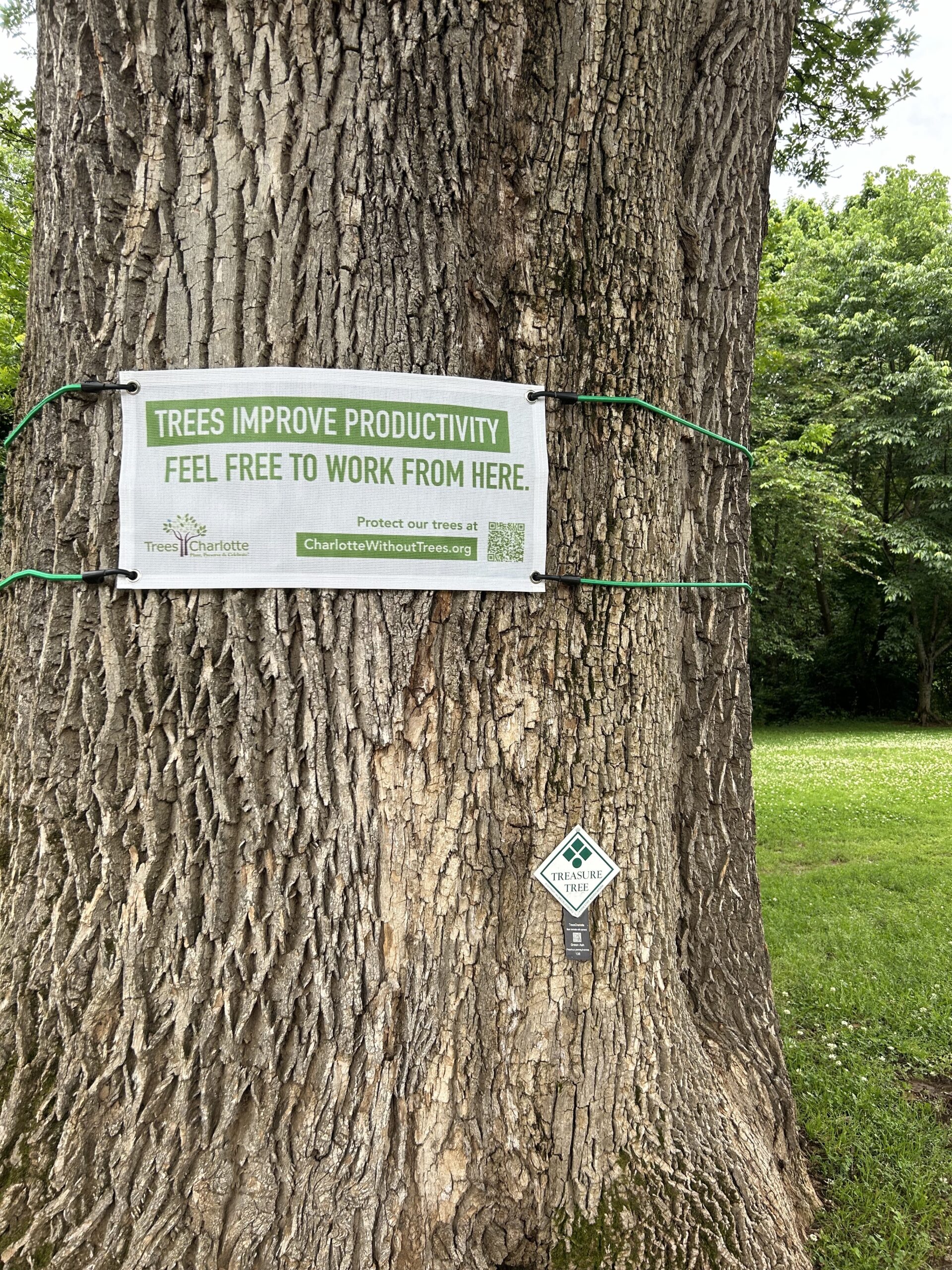
The local joke is the strategy
The campaign, developed with TreesCharlotte and Imperative Partners, did not speak in generic environmental copy. It imagined Charlotte without its familiar props: BBQ without slaw, the airport without rocking chairs, South End without breweries, NoDa without the cool kids. Those lines work because they flatter the audience a little. You have to know a place to get the joke. Then the joke hands you a problem.
Underneath the charm was careful segmentation. Homeowners, renters, students, business leaders, developers and gardeners received tailored calls to action. A microsite turned concern into pledges, volunteer opportunities and donations. Search, display, social, short videos, physical signs and community partners all pointed toward the same behavior. The clever line was the invitation. The system behind it did the work.
SPARK reports that the campaign passed its goal of 500 pledges. Organic engagement reached 4.5 percent on Facebook and 3.7 percent on Instagram. Website engagement time rose 165 percent. Paid search converted at 46.5 percent. Some of those numbers measure attention, some measure action, and none should be confused with the number of trees saved. But together they show a campaign doing what public-awareness work often fails to do: moving people from “yes, trees are nice” to a specific next step.
A lighter backpack
Anne Marie Holder started SPARK in January 2008 after ten years inside larger agencies and an MBA at UNC-Chapel Hill. For the first year, the office was a coffee shop. The company’s own origin story describes a “lighter backpack,” which is more than campfire copy. It explains the business model. SPARK does not present one fixed department chart to every client. It assembles planners, designers, developers, media buyers, public-relations specialists and social managers around the assignment.
Today the menu stretches from research, positioning and naming through identity, advertising, media buying, websites, paid search, social engagement and PR. That breadth puts SPARK in the integrated-agency market, competing both with Charlotte full-service firms and with specialists in each discipline. Its pitch is that the disciplines should not arrive as separate invoices with separate theories of the customer. Strategy chooses the mix.
A declining canopy. A dormant feed. A brand name that no longer fits the mission.
Interview people, learn the product, borrow the audience’s own landmarks and language.
Set KPIs before choosing channels, then adjust when the evidence changes.
The customers are a mixed table: consumer brands, B2B companies, nonprofits, restaurants, tourism organizations and institutions. Public work includes Schleich toys, No nonsense apparel, SEA LIFE Charlotte-Concord Aquarium, DreamKey Partners, Visit York County, Perry’s Diamonds & Estate Jewelry and The Salvation Army of Greater Charlotte. What joins them is not industry. It is a need for several kinds of marketing to behave like one plan.
“Think of social media as a virtual coffee shop.”Anne Marie Holder
The first failure is usually silence
No nonsense hired SPARK after its Facebook page had been inactive for six months and Instagram for two years. Unaided awareness had fallen. This was not a glamorous failure. Nothing had exploded; the brand had simply stopped participating. SPARK began in December 2019 with audience, voice, goals, KPIs, trends and an annual calendar. Three months later, the pandemic changed both the wardrobe and the customer-service load. Comfortable clothing surged. A new mask line brought daily questions and backlash.
The agency’s response was not a single viral stunt. It was regular content, comment management, product launches, user-generated material, contests, Instagram Stories and a small monthly ad buy. Four years later, SPARK reported Facebook engagement up 168 percent, Instagram engagement up 1,568 percent and Facebook product-page clicks up 96 percent. Paid social accumulated 44 million impressions and 220,000 web conversions.
This is the copyable part: define “working” before posting, learn the audience’s language, build a calendar that can survive ordinary Tuesdays, assign someone to respond and reserve enough paid budget to place good work in front of the right people. It sounds obvious. Many useful things do after somebody has written them down.
The moment headquarters changed its mind
A second case makes the method clearer. In 2013, European figurine maker Schleich hired SPARK to start its North American social presence. The team toured the warehouse, played with the products, interviewed management and sales, researched purchase decisions and agreed on KPIs. It built a yearly calendar around products, seasons, launches, events and trade shows. Contests asked fans what a T-Rex would text and sent Snoopy around New York.
The German corporate office was not initially interested in social media. By the end of 2015, the Facebook audience had grown beyond 85,000, with more than 2,000 followers each on Twitter and Pinterest. Headquarters then took ownership of the channels worldwide. That handoff is the most interesting result. SPARK did not win an argument about the future of media. It made the argument unnecessary.
Candor, with a client filter
Agency websites are full of values that would offend nobody. SPARK’s list contains the usual worthy ideas - passion, curiosity, collaboration - but two details have teeth. The firm says it practices “candor with love,” and it has a strict “no meanies” policy. It wants brands it believes in, companies committed to strategy and long-term initiatives, and clients seeking a partner rather than a vendor. The joke is memorable because the boundary is real.
That boundary also describes the conditions the method needs. Integrated work is a poor fit for a company seeking an isolated deliverable, an overnight fix or approval without access. Research requires people to talk. Local language requires someone to know the locality. Community management requires a human who can answer after the scheduled post goes live. Measurement requires agreement about the goal. Without those things, the custom-team advantage collapses into an expensive list of services.
SPARK’s awards include a 2015 PRSA Silver Anvil Award of Excellence for SEA LIFE’s six-month pre-opening campaign. In 2025, it announced North Carolina HUB and SBE certifications and national certification as a Women’s Business Enterprise. Those credentials expand the procurement doors it can enter. But its sharper competitive asset is visible in that tree photograph. The work recognizes the medium already sitting in the landscape, finds the sentence only that city would say, and attaches a measurable action.
A tree wrapped in an ad is still an ad. Yet for one second it also rearranges the scenery. You notice the trunk, then the sign, then the canopy above you, and finally the possibility that it might not always be there. That sequence - attention, recognition, consequence - is the small mechanism SPARK keeps rebuilding for very different clients. The agency’s name suggests ignition. Its better trick is noticing where the kindling has been all along.