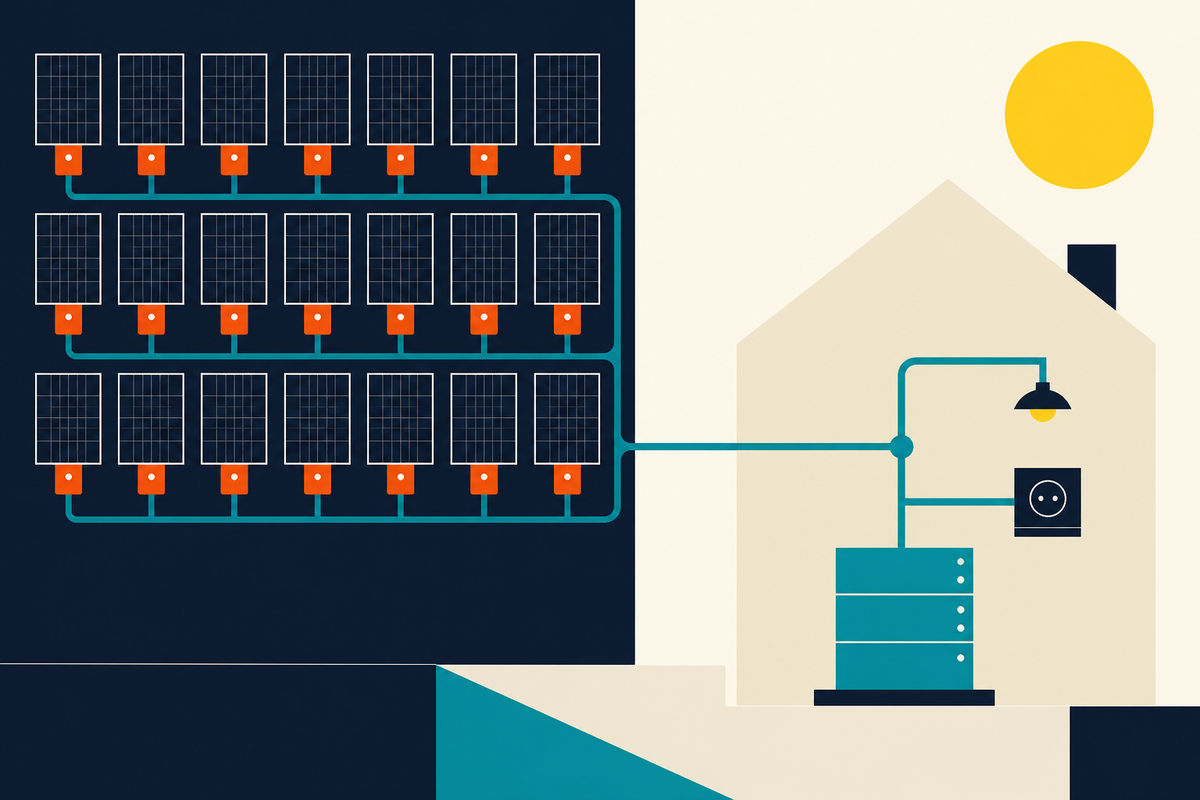
Most of a rooftop solar system performs in plain sight. Panels line up in glossy ranks, angled toward the sun like obedient blue-black windows. Enphase Energy built its business around the piece almost nobody sees: a paperback-sized box fastened beneath each one. The microinverter takes the direct current made by a single panel and turns it into alternating current a house can use. Small job, small object. But repeat it across a roof and the design changes the behavior of the entire system.
Traditional solar arrays commonly send the output of several panels through a central string inverter. That arrangement is economical and familiar, but it links their fortunes. Shade, debris, a mismatch, or a fault can constrain a string. Enphase distributes the conversion. Each panel operates as its own little power plant, with its own electronics, monitoring, and point of control. The idea came from co-founders Raghu Belur and Martin Fornage, telecommunications veterans who believed the logic of distributed computer networks belonged on the roof.
A roof that behaves like a network
Fornage's complaint was practical: the central inverter on the solar array at his ranch was underperforming. The founders' answer was architectural. Move intelligence to the edge, isolate failures, and make each endpoint observable. Enphase introduced its first commercial microinverter system in 2008. By the end of 2025, it had shipped about 86.4 million microinverters, and more than 5.1 million Enphase residential and commercial systems had been deployed in over 160 countries.
Panel-level conversion has several consequences. A weak panel does not have to dictate the output of its neighbors. Installers can see performance module by module. Expansion is modular. High-voltage DC is not carried across the roof in the same way it is in a conventional string design. And the system avoids one central inverter as its sole conversion point. None of that makes hardware immortal, or installation quality irrelevant. It does give Enphase a coherent answer to reliability, visibility, and awkward roofs.
“The real Enphase product is a rule: distribute the intelligence, then let software gather the pieces back into a system.”YesPress analysis
The hidden hardware becomes a household system
A microinverter company could have remained a component supplier. Enphase instead widened the circle. Its IQ Battery 5P is a 5 kilowatt-hour, AC-coupled lithium iron phosphate battery containing six embedded grid-forming microinverters. With the proper system controller, it can provide backup power. Multiple units can be combined, which allows storage to grow with a household's needs. The battery carries a 15-year limited warranty, a long promise in a category where replacement cost matters as much as first-day performance.
The rest of the catalog fills in the connective tissue: IQ Gateways, combiners, system controllers, meter collars, EV chargers, and the Enphase App. The app shows solar production, home consumption, battery state, and grid flows. Energy-management software can schedule storage around variable rates and coordinate selected third-party loads such as heat pumps, water heaters, and chargers in supported markets. The result is not merely solar on a house. It is an attempt to make household electricity legible and programmable.
That pairing also explains who the customer really is. Homeowners use the system, but Enphase usually reaches the roof through solar distributors and installers. It sells equipment through distribution and directly to large installers, original-equipment manufacturers, strategic partners, and, for some products, its online store. Installers design, sell, mount, commission, and service the equipment. Enphase trains and certifies them, supplies design and diagnostic tools, and maintains the cloud connection after the truck leaves.
This is principally a hardware business with a software-shaped moat. A new installation can generate revenue from microinverters, cabling, gateways, control gear, and batteries, while monitoring and fleet tools make the same brand easier to keep specifying. Replacement and upgrade programs create another route back to older rooftops. The arrangement is useful but delicate: distributors hold inventory, installers influence brand choice, and homeowners judge the whole system by the weakest service call. Enphase cannot treat the channel as plumbing. Its training, warranty response, remote diagnostics, and supply availability are part of the product even though none appears in the equipment photograph.
A premium position in a rough market
Enphase is often compared most directly with SolarEdge, whose optimizers sit at each panel while conversion still happens in a central inverter. Conventional string-inverter makers including SMA and Fronius offer fewer conversion devices and can compete aggressively on system cost. Tesla, Generac, FranklinWH, Huawei, and Sungrow approach the household from batteries, inverters, charging, or integrated energy systems. The alternatives are not interchangeable, and the right choice depends on roof shape, shade, local codes, installer familiarity, backup goals, and budget.
Enphase's differentiation is the combination: panel-level optimization and monitoring, distributed conversion, long warranties, modular storage, installer software, and one homeowner interface. Its semiconductor expertise matters because power electronics must survive years of heat beneath panels while communicating reliably. Its software expertise matters because a box that reports its condition is easier to service than one that merely fails. Its channel matters because the cleverest roof device is useless without a trained person willing to specify it.
The business remains exposed to a notoriously uneven market. Residential solar responds to interest rates, electricity prices, incentives, tariffs, permitting, and installer inventory. Enphase revenue fell from roughly $2.29 billion in 2023 to $1.33 billion in 2024, then recovered to $1.47 billion in 2025. The company reported $172.1 million in GAAP net income for 2025. Those figures describe a profitable enterprise, but also one whose demand can swing well before the sun does.
Enphase uses a largely outsourced manufacturing model and works with contract manufacturers, including U.S. production in Texas and South Carolina. That keeps the company focused on design, semiconductors, software, quality systems, and channel support, while leaving it dependent on supply-chain execution and policy rules around domestic content. At the end of 2025 it employed 2,872 people. More than 1,700 were in India, the center of gravity for a workforce that is more geographically distributed than the California headquarters suggests.
When a battery gets a second job
The next layer is the grid. A home battery ordinarily serves one household: store midday solar, avoid an expensive hour, or hold a reserve for an outage. Connected in a virtual power plant, thousands of those batteries can also respond together when a utility needs capacity. Enphase supports grid-services programs in North America and Europe, working with utilities, retailers, and aggregators. Participating homeowners may receive incentives while retaining limits for backup needs.
Partnerships show the model. Octopus Energy can pair Enphase systems with retail tariffs and its Kraken control platform in the United Kingdom. Ensol offers French households a battery subscription and aggregates enrolled systems for demand response. Swell Energy has connected Enphase-equipped homes to U.S. virtual power plants. These arrangements move Enphase beyond the sale of hardware and toward a place in the operating layer between a home and the grid.
The product map is still spreading. In 2026 the company rolled out GaN-based IQ9 microinverters, advanced a bidirectional EV charger, opened pre-orders for a portable power station and smart thermostat, and began discussing an IQ solid-state transformer for AI data centers. Some of those markets are far from the original roof. The common thread is power conversion controlled by software. The risk is sprawl: every additional category brings new rivals, certification work, support demands, and reasons to lose focus.
“The boring box won because it solved a roof problem. The platform will win only if it keeps solving household ones.”The test ahead
Where Enphase fits
Enphase sits between semiconductor manufacturing, residential solar equipment, smart-home software, and distributed grid infrastructure. It is not a panel maker, not an installer, and not a utility. It supplies the conversion and control layer that lets all three interact. That position can be valuable because energy gets more complicated as a home adds solar, a battery, an EV, dynamic rates, and backup priorities. Complexity creates demand for a system that can make the pieces cooperate.
The useful lesson is easy to borrow. Enphase found a central bottleneck, broke it into many intelligent endpoints, and then built tools to manage the resulting network. It paired a technical design with a channel strategy: make the installer more capable, give the homeowner visibility, and give partners a way to coordinate the fleet. The microinverter remains the physical signature. The larger bet is that millions of separately owned rooftops can act like dependable infrastructure without feeling like infrastructure to the people who live beneath them.