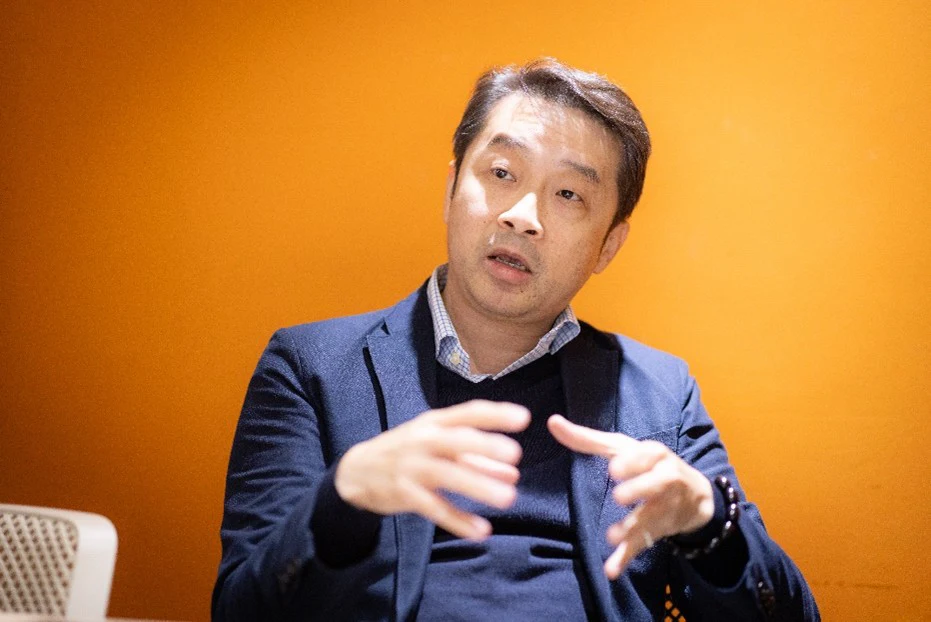
The Founder Who Turned a Fruit Into a Theory of Power
Steve Huang was supposed to become a doctor. Born in Taipei into a medical family and educated in Canada, he had a place waiting for him in medicine. What changed his path was not a plan but a moment - watching a patient die during an internship. He walked away from the hospital and toward computers and business, and eventually toward the least glamorous, most stubborn problem in clean energy: not making green electricity, but deciding when and where it should flow.
That decision set up a career that runs through some of the biggest names and hardest lessons in tech. In 2000 he joined NVIDIA, rising to a senior channel marketing and operations role across the Asia-Pacific region, absorbing the pace and ambition of Silicon Valley before the phrase “energy transition” was common. He co-founded the silicon wafer company Danen Technology, which later went public. He worked across the solar value chain - wafers, cells, inverters - long enough to earn the label he still uses for himself: a serial green entrepreneur.
Then came the venture that nearly ended all of it.
The Price War
In 2011 Huang launched an independent company building one of Asia-Pacific's first micro-inverters paired with a smart energy management system. For a while it worked spectacularly. The business sold more than 100,000 units across over 30 countries. He had a team of roughly 100 people and a product ahead of its market.
In 2014 the market changed under him. Chinese manufacturers including Huawei and GoodWe entered with aggressive pricing, eventually pushing prices down to about a quarter of his own. Hardware margins evaporated. Over three years his workforce shrank from 100 to somewhere between 10 and 15. By 2016 the company was closed, and Huang has said he was left with only about NT$3,000. He has described that stretch plainly as unbearably bleak.
What he did next is the hinge of the whole story. He did not take a comfortable job at an established firm, which was available to a man with his resume. He decided to start over. The refusal to work for someone else's dream was not bravado - by his own account it was the only thing keeping him moving when the numbers said stop.
A Kiwi on a Walk
The name for the new company arrived without ceremony. On a post-dinner walk during what he counts as his fourth venture, Huang was eating a kiwi when the metaphor assembled itself in his hand. The brown skin was the Earth. The bright green flesh was renewable life and vitality. And the two letters at the front of the word - K, W - happened to spell the unit that measures electrical power: the kilowatt.
The Kiwi, Decoded
KiWi New Energy launched in 2017, co-founded with Gary Hsiang and Paul Garrity, and registered on two continents - Taipei and San Mateo, California. The first version of the company leaned into the era's enthusiasm: a blockchain-based platform for solar project investment and financing, complete with a KIWI token meant to let ordinary people invest small amounts in solar and receive returns across borders. In 2018 that vision earned KiWi a place on CIO Review's list of Top 20 Blockchain Technology Solution Companies.
Software Was the Missing Layer
The lesson Huang carried out of the price war was specific. Hardware, however good, could be copied and undercut. The durable value was somewhere else. As KiWi matured it dropped the token-first framing and rebuilt around a single, sharper claim: the most valuable layer in the energy transition may not be another solar panel, but the AI dispatch layer that sits between generation and consumption.
Today the company describes itself as “the operating system for global renewable energy.” Its core product is an AI-Driven Energy Datacenter that connects clean supply with retail and small-to-medium business demand, then manages the flow in real time. The system runs a loop with five stages - Collect, Profile, Predict, Optimize, Execute - making autonomous decisions roughly every minute. KiWi cites a matching engine with better than 90% prediction accuracy, a virtual power plant tying together more than 10,000 power meters, and blockchain-based certificates meant to make green power traceable end to end.
The customers are not abstractions. KiWi reports more than 3,000 active subscribers and partnerships with familiar retail names - FamilyMart, with a target of thousands of stores, and Decathlon among them. The pitch to a convenience chain is not idealism; it is a lower, smarter electricity bill, achieved by shifting consumption to the cheapest and cleanest moments without anyone behind the counter having to think about it.
Taipei to Silicon Valley
Huang's ambition for KiWi is deliberately large. He talks about building the “Amazon of green energy” and expanding from Taiwan into the United States, Japan, and Australia. In 2026 the company drew attention for pushing that argument into Silicon Valley and for work to open up Tesla's energy storage system - a sign of a small team trying to sit on top of much larger platforms rather than compete with them head-on.
The team itself reflects the founder's own scattered, resilient path. It is remote-first and international: a chief technology officer from Scotland, AI engineers based in India, colleagues bound less by a shared office than by a shared history of startups and a belief in circular-economy principles. It is the kind of company you build after you have learned exactly how a company can fail.
Huang's story is unusual not because it has a comeback - plenty do - but because he leads with the collapse instead of hiding it. The shuttered business, the NT$3,000, the years he calls bleak: he keeps them in the frame. They are the reason he stopped betting on hardware and started betting on intelligence. And they are why, when he cut open a kiwi on an evening walk, a man who had lost a company saw not a snack but a working model of the world he still wanted to build.