The first Rob Gonzalez startup ended with smoke. In 1999, while studying computer science and mathematics at Williams College, he and his collaborators were attempting something that now sounds both prophetic and wonderfully antique: wireless restaurant payments, conducted by Bluetooth through an application on PalmPilots. Then one of the participating restaurants burned down. The prototype was inside. The company went with it.
It is the kind of origin story that tempts a writer to declare destiny. Resist. Gonzalez did. He did not sprint straight into another company, buoyed by the romance of a dramatic failure. He spent years learning how commercial information behaves when it meets the internet: where it breaks, who repairs it, and why an apparently simple purchase can depend on an absurd number of systems agreeing about a single object.
That apprenticeship took him through IBM's advanced internet technology group in Cambridge, then Endeca, the ecommerce search company that powered search and navigation for major retailers. At Endeca he was a senior product manager, working in the terrain between a shopper's vague intention and a retailer's exact catalog. Oracle bought the company in 2011 for more than $1 billion. Gonzalez later ran product management and marketing at Cambridge Semantics, another Boston-area startup. By then, he had learned both sides of the translator's desk: how software works and how a market comes to understand what the software is for.
Thirteen years before “go”
Gonzalez and his Williams classmate Jeremy Redburn had talked about starting a company since college. The late-1990s Williamstown startup scene cheekily called itself “Silicon Village,” and the prospect did not seem exotic. Still, the pair waited. In September 2012, they finally joined with another Endeca alumnus, Jason Purcell, to found Salsify.
The delay was not indecision so much as accumulated eyesight. The three founders understood an awkward split in ecommerce. Retailers were building sophisticated ways for consumers to search, filter, and compare. Brand manufacturers, meanwhile, had to push descriptions, dimensions, images, prices, ingredients, and countless other attributes into a growing forest of retailer systems. The pipes were often spreadsheets, FTP sites, and supplier portals. Every destination wanted something slightly different. Every change multiplied the chores.
Salsify's first proposition was practical: give manufacturers a cloud system for turning scattered internal facts into consumer-ready product content, then distribute that content to retailers. The company piloted with one customer. The problem proved considerably larger than one customer, and Gonzalez's career inside Salsify expanded with it - business development, marketing, category creation, retail alliances, and now strategy and innovation.
“Focus is the really short answer there.”Rob Gonzalez, on why Salsify sometimes turned away customers
Turning down revenue sounds like founder folklore until Gonzalez explains the product consequence. A multichannel commerce platform could, in theory, sprawl in every direction. Each eager customer could drag the roadmap toward a private concern. Focus kept the early system coherent enough to become a platform instead of a cabinet of bespoke favors.
The spreadsheet was the incumbent
Traditional Product Information Management promised a “golden record,” one canonical version of each product. Gonzalez came to regard that idea as tidy but insufficient. Amazon's requirements are not Walmart's. A product can need different copy, imagery, taxonomy, and validation rules for Kroger, Chewy, or a brand's own store. The market does not sit still long enough to admire a pristine database.
Salsify began using a broader term, Product Experience Management, or PXM. The distinction was not merely branding polish. PXM joined the database to digital assets, workflow, retailer syndication, analytics, and the work of tailoring an experience for each destination. It described what ecommerce teams were already doing around their supposed system of record, frequently in spreadsheets.
Gonzalez's three shopping interfaces
Creating a category required more than naming it. Gonzalez wrote long essays about the evolution of PIM, delivered whiteboard talks, appeared in interviews, and became a co-host of Unpacking the Digital Shelf. In 2019, Salsify helped establish the Digital Shelf Institute as a place where brand manufacturers could learn from peers. Retailers had conferences and communities; manufacturers needed a room of their own.
His method is unmistakably that of a product manager who wandered into marketing and decided to bring his diagrams. Concepts arrive with mechanisms attached. When he explains “land and expand” in enterprise software, he supplies the numbers: Salsify designed relatively frictionless entry points, kept an average sales cycle around 90 days, and watched some customers grow from roughly $65,000 to $70,000 initial contracts into multimillion-dollar relationships.
The scale eventually changed the financial nouns around the company. In 2022, Salsify announced a $200 million investment at a $2 billion valuation, after reporting $111 million in annual recurring revenue. In July 2026, private equity firm Cinven agreed to acquire Salsify. The terms were not disclosed. The announcement said the platform supported more than 70,000 active users and global operations spanning North America, Europe, and Australia.
Gonzalez marked the agreement by thanking employees, investors, and board members. He also resisted the neat finality of an exit caption. “A lot more yet to build,” he wrote. It was an apt line from someone whose titles have changed while the underlying assignment has remained stubbornly unfinished.
The chat window still needs a catalog
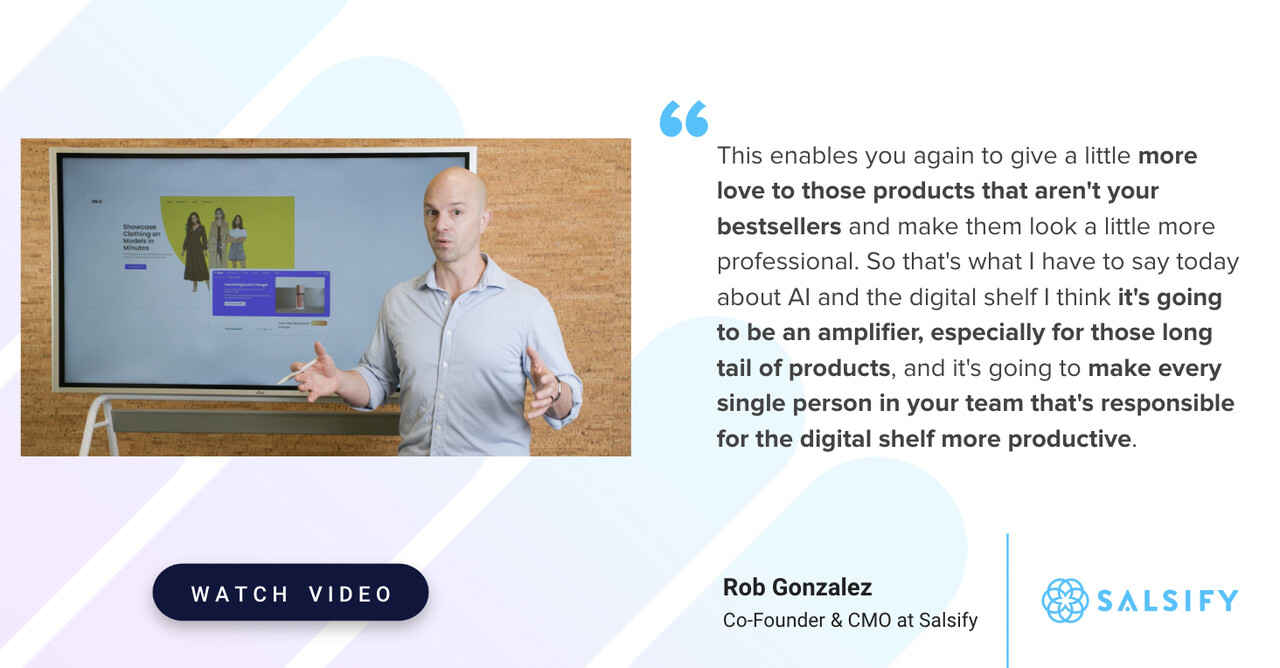
His current subject is AI shopping, and his position is agreeably grounded. Ecommerce replaced the physical shelf with search and product detail pages. AI, he argues, introduces a third interface: a shopper can discover, compare, and perhaps purchase inside a conversation. For the first time since ecommerce, the method of finding and selecting a product is genuinely new.
Yet a conversational interface does not repeal product facts. It becomes another hungry destination for them. An assistant cannot reliably distinguish two nearly identical chargers, recommend a compatible replacement part, or respect a shopper's material preference if the underlying information is incomplete, inconsistent, or trapped inside systems that do not communicate. Fluency at the top of the stack can disguise disorder underneath it, but cannot cure it.
“AI is different because the experience is different.”Rob Gonzalez
This is where the PalmPilot story circles back without becoming a fable. Gonzalez has spent his career around interfaces that promise an easier transaction: wireless payment, ecommerce search, cloud syndication, an AI conversation. Each polished surface depends on unlovely coordination behind it. The consumer sees a shelf, a search result, or a sentence. The operator sees schemas changing hundreds of times, assets moving between departments, and a catalog that is never finally finished.
The same systems instinct appears in his approach to company culture. Asked what mattered most, Gonzalez chose empowerment: decisions pushed as far outward in the organization as possible. It is a useful preference for a founder drawn to networks. Centralize what must be shared; let the edges respond to their context. Product content works that way. Healthy software platforms work that way. On a good day, companies do too.
There is humor in his explanations, often deployed to rescue infrastructure from abstraction. Ecommerce personalization, he notes, is the experience of buying one toilet seat and then being recommended toilet seats all day. The joke lands because everyone recognizes the machine's confident obtuseness. Better recommendations require more than more computation. They require context, accurate product information, and the humility to know that a person who just bought a toilet seat may be finished shopping for toilet seats.
The patient translator
Gonzalez is not a conventional celebrity founder. His public footprint is heavier on transcripts, technical essays, industry podcasts, and annotated whiteboards than on lifestyle mythology. Even his older writing reaches toward practical education. He co-created Semantic University to make semantic technologies accessible to people without forbidding technical backgrounds. In 2015, he published a three-part TechCrunch series about employers and coding-bootcamp graduates.
The consistent ambition is translation. At Endeca, it was between human searches and retail catalogs. At Salsify, between manufacturers and every place their products appear. In category building, between a chaotic set of tasks and a name that lets an organization budget for them. In AI commerce, between the astonishing interface and the stubborn data requirements beneath it.
A category creator's work can resemble saying the same thing for years, each time in the dialect of a newly attentive audience. Gonzalez has been doing that since “ecommerce” was still a side team inside many manufacturers. The repetition looks less like self-promotion than maintenance: the shelf keeps changing, so the explanation must keep changing with it.
Salsify's next chapter arrives with a new owner and a market enchanted by agents. Gonzalez remains at the familiar junction of product, strategy, and explanation. The PalmPilots are museum pieces now. The original problem - getting many systems to agree well enough for one ordinary purchase - is very much alive.