Imagine two perfectly respectable advertising headlines. Both are grammatical. Both mention the product. Both have survived the meeting in which everyone offers a small improvement. One will attract more customers. The other will consume the same budget with less to show for it. The awkward question is which one. Anyword has built its business around getting an answer before the bill arrives.
- Generates marketing copy and ranks variations before publication.
- Uses campaign data and brand context across its editor, API and other AI tools.
- Starter costs $39/month with annual billing; enterprise plans are quoted.
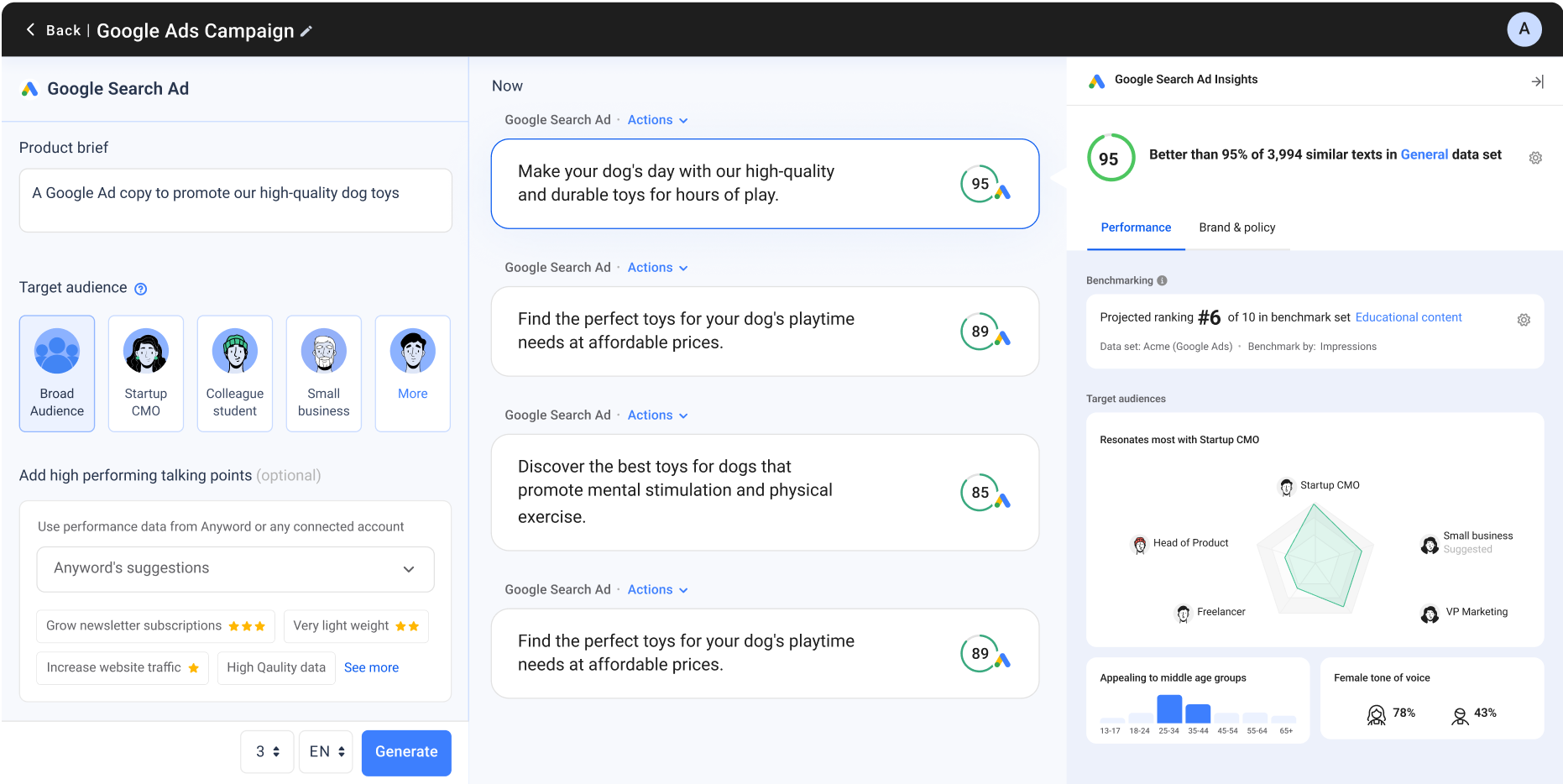
The New York company generates marketing copy, but its more interesting proposition is selection. Its software assigns predictive performance scores to variations, using marketing data to estimate which message will work better for a particular audience, channel and goal. The sentence comes with a second opinion. For a team swimming in AI drafts, that may be more useful than another bucket of sentences.
Before it wrote the words, it found the readers
Anyword began as Keywee in 2013. Its early business tackled distribution: analyzing content and finding audiences likely to respond. Publishers and brands had stories to tell, but finding the right readers was another matter. That background matters because the company approached language through the machinery of marketing: audiences, channels, outcomes. A beautiful paragraph could still be an unsuccessful advertisement.
In March 2021, Keywee introduced the Anyword marketing language platform. The product brought generation and optimization to websites, social channels, emails and ads. Later that year, a $21 million funding round led by Innovation Endeavors took disclosed financing above $30 million. The shift was from finding audiences for existing content toward helping marketers choose the content itself. Distribution knowledge had become a writing ingredient.
This history gives Anyword a different starting point from a general chatbot. A chatbot can produce ten plausible headlines in seconds. Anyword wants to help decide which of those ten should go into the campaign. The bottleneck, in this account, moves from producing options to judging them.
A score beside the draft
The Data-driven Editor packages that idea into a working interface. Marketers can use templates for ads, email and social posts, define audiences, generate variations and compare new copy with connected historical content. They can also build templates around their own briefs. The practical attraction is a shorter path from a product description to a handful of candidates worth reviewing.
Other tools address the less glamorous chores surrounding those candidates. Brand voice centralizes tone, messaging and guidelines. Blog Wizard handles longer articles. Content Intelligence examines published material for opportunities to improve subsequent work. Website Automation supports messaging tests. Together, these products serve demand generation, content, social, product marketing and email teams: people whose words eventually meet a spreadsheet.
For organizations with their own applications, the API makes performance prediction and brand context available inside existing workflows. Anyword also offers an extension for working across other writing tools. Its expertise sits at the junction of natural language processing and campaign measurement. It is selling a marketing judgment system with writing attached, although the quality of that judgment remains something a customer should evaluate.
The company selling picks starts selling the referee
In August 2024, Anyword announced its Gen-AI Performance Platform, an offering designed to work across models rather than require every team to use one generator. The launch named Shopkick, Bio-Rad and TrueCar among early adopters. It also introduced Omer Rabin as co-founder and chief revenue officer. The company was moving toward the role of an intelligence layer above a scattered collection of AI tools.
CEO and co-founder Yaniv Makover explained the premise to AdExchanger: organizations would use multiple AI applications. His argument was that Anyword could help them do so while keeping brand voice and performance evaluation consistent. This is a revealing response to competition. General models are useful inputs as well as alternatives; their growing presence gives Anyword another place to put its scoring.
The broader alternatives include dedicated marketing writing platforms and a team using a general chatbot alongside ordinary campaign experiments. Anyword occupies the measurement end of that market. Its advantage is most legible when choosing copy is a frequent, measurable task. Someone seeking an occasional polished paragraph has a different problem from an enterprise producing variations across audiences, brands and channels.
“We think you’re going to be using multiple AI applications and platforms”Yaniv Makover, speaking to AdExchanger, August 2024

What the numbers actually buy
Anyword says its platform is trusted by more than one million marketers. That is a reach claim, not a count of paying enterprise accounts. Its current website also reports 82% accuracy in identifying the better of two content variations. Pairwise prediction is the relevant task here: choosing a likely winner. It is not a promise that any individual ad will convert 82% of its readers.
Customer testimony offers a more concrete glimpse. In a testimonial published by Anyword, automotive marketing director Freya Smale reports email click-through rates moving from an average of 2.5% to 8%. Another testimonial, from growth marketer Christopher Ingrao, reports 23% more clicks at roughly the same cost per conversion. These are customer accounts selected by the vendor, rather than controlled evidence of a universal effect.
The entry cost is visible. The published Starter plan is $39 per month when billed annually; Data-Driven is $79 on the same basis. Business and Enterprise use custom pricing. Higher tiers bring campaign data, custom models and organizational controls into the equation. The buying decision is therefore about recurring software expense, integration work and whether better copy selection pays for both.
Keep the feedback loop
The useful habit to borrow is straightforward: define the audience, name the outcome, assemble several messages and record what actually happens. Use predictions to narrow the field, then compare them with live results. Keep click-through rate separate from conversion and revenue.
History also has limits. A new offer, unfamiliar audience or changed channel may differ from the campaigns supplying the evidence. That makes a score a reason to investigate, rather than permission to abandon judgment. Human review still has to ask whether claims are accurate, the brand sounds like itself and the message deserves to be sent. A ranking cannot settle those questions.
Anyword’s story follows a durable marketing frustration: producing language is easier than knowing what it will do. Its answer has evolved from audience matching to scored copy to a layer across other AI systems. The appeal is less the romance of a machine writing an advertisement than the possibility of fewer expensive guesses.