The first version of WIECK was a room barely larger than a parking space. It held a leased imaging computer, a matrix switch and the peculiar anxiety of people who knew that a newspaper page would not wait. A publication would telephone the desk, ask for a picture, connect its receiving equipment and wait while the staff switched the call into the machine. One black-and-white photograph took about ten minutes. In 1991, this counted as distribution.
The founders understood the wait because they had lived on the other side of it. James F. Wieck, Travis M. Hughs, Margaret Ann Boatright and Tim Roberts were wire-service people - editors, executives, sales hands and a photographer. The New York Times News Service became the first client. The operation opened on May 1 under the name Wieck Photo DataBase, and its immediate product was not glamour. It was fewer minutes between a picture being chosen and a picture reaching a newsroom.
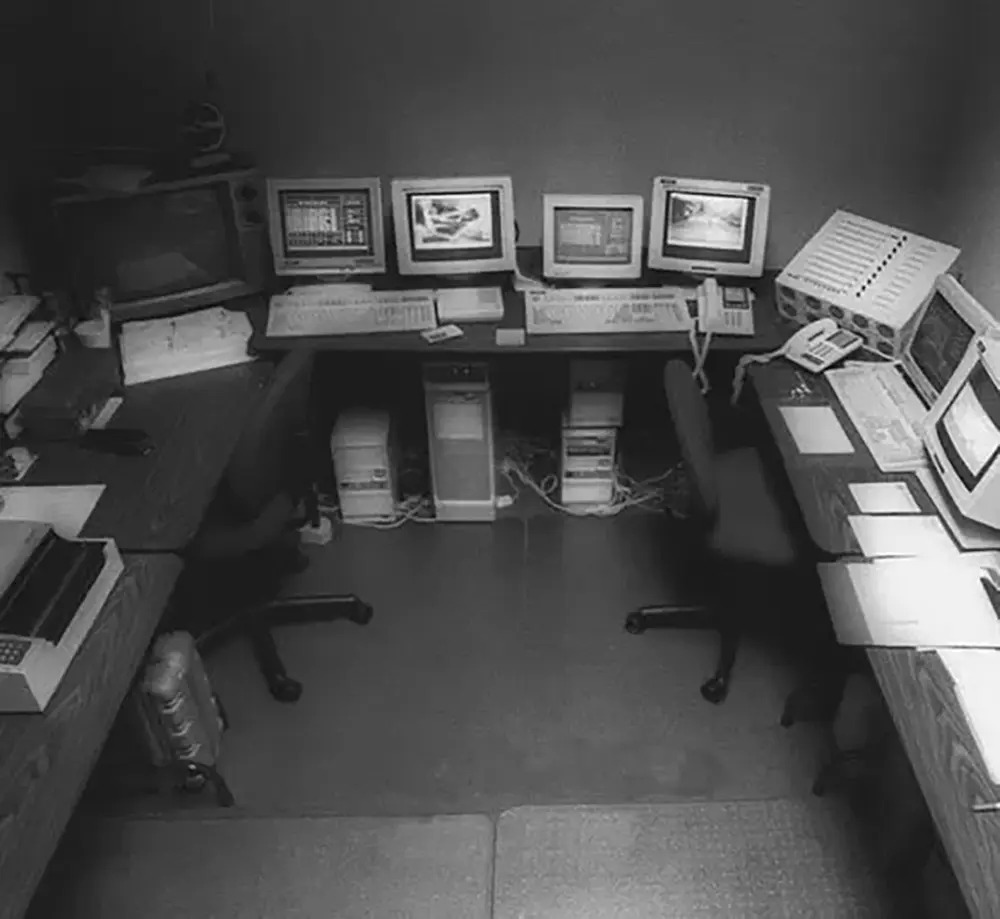
The product hiding inside the product
Within six months, Roberts had developed a digital method that let newspapers and magazines dial in and download a file in less than one-third of the old time. Then the web arrived. WIECK moved the process into the browser, where editors could browse a database themselves and pull down an image in seconds. The original analog arrangement was the first thing to fail - not because it stopped functioning, but because it made its own delay impossible to ignore.
“They had a need. We built it.”WIECK, on its first New York Times assignment
This is the useful distinction in WIECK's history. The company could have mistaken the matrix switch for the business. Instead, the arrival of the internet changed its mind about the machinery while confirming the job: help professional communicators move accurate material quickly. By the late 1990s, that meant corporate media libraries and distribution platforms. In the early 2000s, it meant social-media services, advice and on-site event desks. Today it means enterprise newsrooms, digital asset management, APIs, syndication, AI-assisted workflows and custom websites.
A newsroom is not a cupboard
The ordinary corporate newsroom behaves like a cupboard where press releases go after approval. WIECK treats it as working infrastructure. A journalist should be able to find the announcement, the publication-quality image, the broadcast clip, the executive biography and the correct permissions without initiating a six-email treasure hunt. A global communications team needs the same material governed across languages, markets and time zones. The difficult part is rarely the publish button. It is everything that must be true before somebody presses it.
What changed was the machinery
Its customer list explains why customization matters. WIECK publicly names Nissan, Infiniti, Honda, Mitsubishi, Mercedes-Benz, The New York Times, Baylor Scott & White Health, Hess, Southwest Airlines, Canon, American Airlines and Allstate, among others. These are not teams shopping for a pleasant blog theme. They have media assets that multiply, markets that disagree and announcements that happen while the home office sleeps.
The Nissan effect
From roughly 90,000 to nearly 574,000 monthly unique visitorsAn awards submission for the WIECK-managed Nissan and Infiniti newsroom reported that increase after a multi-market, multilingual relaunch. In the latest measured month, journalists downloaded more than 85,000 publication-quality assets.
At Baylor Health Care System, the interesting feature was the site nobody wanted to use. WIECK prepared a “dark site” with material for floods, fires, tornadoes and other crises before a crisis occurred. It also built a shopping-basket approach to asset downloads. During one reported twelve-month period, the newsroom received 153,406 visitors from more than 130 countries and recorded 3,495 downloads. The practical achievement was not traffic alone. It was reducing improvisation at precisely the moment improvisation becomes dangerous.
The person still awake at 3 a.m.
Plenty of vendors can sell a content-management system or a digital asset manager. WIECK's distinction is the combination: purpose-built technology plus WIECK Desk, an editorial operation that publishes, updates and watches client sites around the clock. The company says every solution includes 24/7 human support. Its people include software developers, content managers and former journalists, all close enough to the workflow to know that “urgent” is sometimes a technical status and sometimes a trembling voice on the telephone.

Roberts, now chairman and CEO, spent a decade photographing Super Bowls, the Olympics, disasters and the final days of the Branch Davidian standoff for United Press International and Agence France-Presse. It is difficult to invent a better education in deadlines. Founder Jim Wieck supplied a complementary management rule: “Find the best employees and then get out of the way.” The present company describes its team as intentionally small. That can make collaboration quick, but it also places a premium on experienced people and disciplined systems.
The price of buying time
WIECK does not post a menu of current prices. Its model is custom B2B work - software, implementation, integrations and continuing editorial support - rather than a self-serve subscription with three tidy tiers. One rare public number appears in an Australian government annual report: A$79,420 paid to Wieck Australasia for an online newsroom in the 2008-09 financial year. That figure is historical, regional and not a current quote. It does reveal the kind of purchase involved: less “install an app” than “commission a communications system.”
One disclosed 2008-09 Australian government newsroom engagement. Useful as evidence of project scale, useless as a modern price list.
An estimated annual revenue figure of about $3.275 million circulates in third-party company data, but WIECK does not publicly report financials. There is no disclosed venture funding. The visible evidence points to a privately held services-and-software company built through client work, with repeat relationships rather than fundraising rounds as the notable currency. The New York Times relationship, begun in 1991, still appears in WIECK's account of its business.
Copy the diagnosis, not the architecture
Most communications teams do not need WIECK's full machinery. A regional organization with a few releases, a clean website and no overnight media demand may be better served by an off-the-shelf newsroom, a standard asset library or careful folders. Bespoke systems make sense when the complication is real: many markets, controlled assets, unusual integrations, constant publishing or genuine reputational risk. Custom work without custom complexity is merely an expensive way to own maintenance.
Watch the handoffs. The waiting between writer, approver, asset owner and publisher is often the real product problem.
Prepare crisis pages, permissions and contact paths before anyone needs them. Calm is easier to engineer in advance.
Track whether the intended user found and downloaded the right material, not merely whether a release was posted.
Automate tags, formats and routing. Keep a person available for ambiguity, context and the announcement that breaks the template.
WIECK now calls the broader category “CommTech” - communications plus data, automation and human expertise. The label is new; the instinct is old. In 1991, a deadline exposed ten minutes of avoidable friction. The company removed some of it, then followed the remaining friction from dial-up lines to browsers, from browsers to asset libraries, and from libraries to machine-readable publishing for search and AI systems.
The charming part is that the business still resembles its first room. There is content coming in, a professional waiting somewhere else and a machine in the middle that ought to hurry. WIECK has replaced the machine many times. It has been more reluctant to replace the person watching the clock.