A hotel starts making promises long before anyone reaches the reception desk. Its photographs suggest a mood. Its name proposes a personality. Its website asks a stranger to believe the whole thing will be worth the journey. The Madison Melle Agency works on that stretch of anticipation, where a place becomes a brand and a brand has to persuade someone to act.
The Los Angeles firm combines a creative design studio with performance marketing and technology-related services. Hospitality supplies much of its vocabulary, and an unusually useful part of its founder’s résumé: Cara Federici ran hotel operations and held sales and marketing leadership positions before announcing her own consultancy. The result is an agency whose service list can move from typography to revenue management without changing companies.
That combination gives Madison Melle a clear position in a crowded business. It serves owners and operators who need the visual story, the digital experience and the commercial plan to make sense together. Boutique hotels are an obvious audience. Real estate developers, restaurants, wellness businesses and other lifestyle brands also appear in its portfolio. The common thread is a purchase influenced by how an experience feels before it can be tried.
A canyon is a better brief than a mood board
Open Sky Zion makes the proposition tangible. For the Utah property, Madison Melle developed a brand identity and website that took their cues from the physical setting. A site visit informed the work: restrained lines, warm neutrals, natural textures and blues drawn from the sky. Here was something more specific than the usual instruction to make a hotel look luxurious.
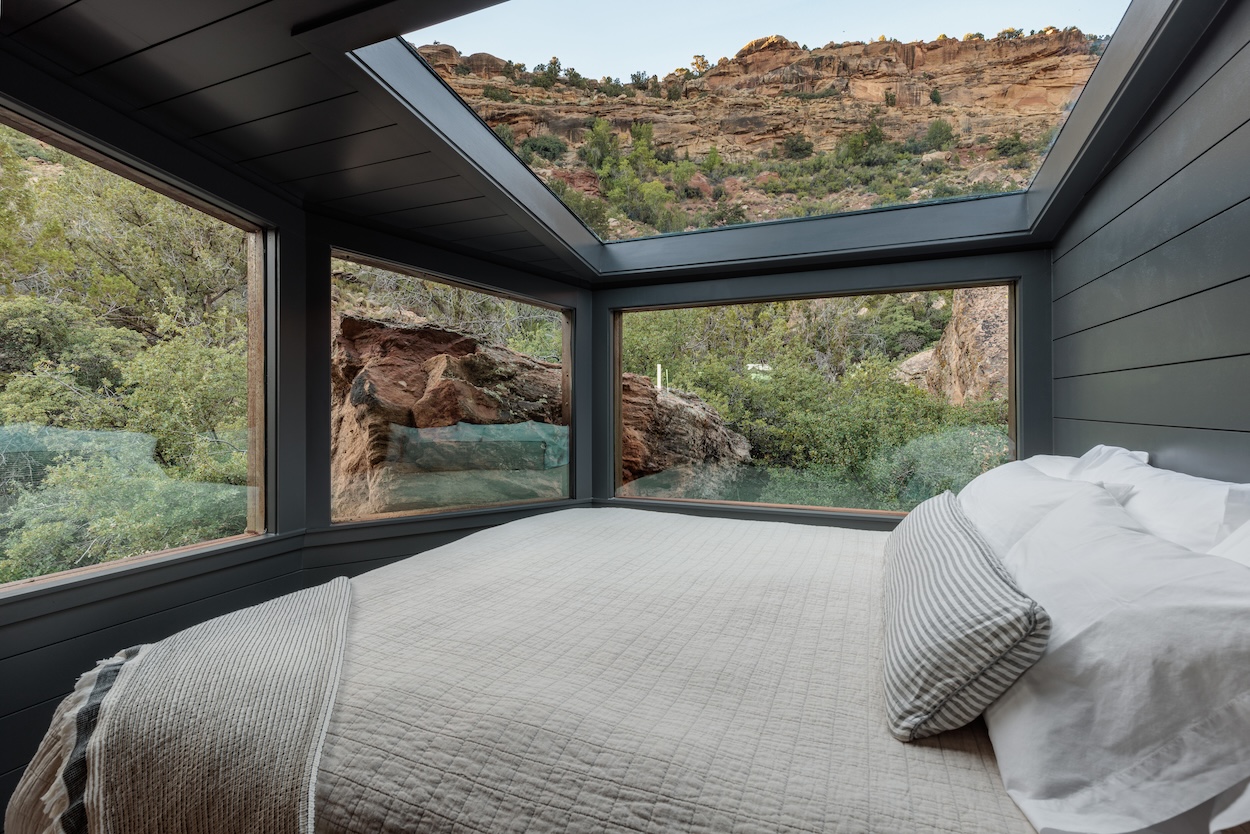
During the visit, co-founder Bygnal Dutson showed the team concealed storage and solar panels. The branding assignment involved understanding what made the place work, including the things a guest might never notice.
“Even these less glamorous elements are built in an extremely thoughtful way.”
Cara Federici, on Open Sky Zion’s concealed infrastructure
For another business, the useful lesson is to collect evidence before choosing an aesthetic. Walk the space. Notice what its owners protect, hide or spend time explaining. A color palette becomes more convincing when it belongs to somewhere. Madison Melle’s documented contribution here was the identity and digital presence; the property’s architecture and interiors had their own designers.
The founder had already worked the other side of the desk
The agency identifies 2017 as its founding year. Its public launch followed in April 2018, when Federici arrived with experience as vice president of Americas operations at Cachet Hotel Group and vice president of room sales and marketing at Paligroup Management. The original pitch covered four phases: development, pre-opening, operations, and sales and marketing.
The early service list had the texture of an operator’s notebook. It included budgets, recruitment, training, equipment, owner representation and process documentation alongside branding and digital marketing. Those are consequential neighbors. A launch campaign depends on an opening plan; a guest promise depends on people and systems capable of delivering it.

Her academic background crosses similar boundaries. Federici studied at Parsons, graduated from Tulane and holds a Cornell certificate in hotel real estate investments and asset management. It is a plausible foundation for moving between a creative discussion and an owner’s business questions. The agency’s advantage is that combination of experience, applied to a particular kind of buyer.
When the PR agency needs a new introduction
A second assignment shows the work without the scenery. In 2021, CIIC PR marked its 25th anniversary with a corporate refresh and hired Madison Melle to help. The deliverables were concrete: a refreshed logo, a website and associated collateral. Research, brand pillars and imagery shaped the process, with the client involved throughout.
This was an established communications business reconsidering how it presented itself. The anniversary supplied the occasion; its experience and mission supplied the material. For Madison Melle, it also demonstrated a market beyond hotels: a professional-services company could need the same disciplined translation from business identity to public presentation.
There is a useful commissioning lesson here. A rebrand can begin with an occasion, but it needs a reason that survives the celebration. What should customers understand more clearly? Which parts of the business have become difficult to explain? Coordinating the logo, website and supporting materials makes the answer easier to recognize wherever someone first encounters the company.
An editorial map of the services, not a claim about project results.
What the client actually buys
Madison Melle’s design studio lists naming, voice and tone, copywriting, logos, typography, visual identity, collateral and website design. It also offers work for artists and galleries. These are tools for making a business recognizable and intelligible: the words it uses, the visual decisions it repeats and the way it introduces itself.
The performance-marketing division covers Google Ads and analytics, search, social media and public relations, alongside launch strategy, sales and revenue management. Workflow mapping, web and app design, interface design and infrastructure design extend the offer into implementation. The agency explicitly offers both full-service and à-la-carte engagements.
The business model is therefore a tailored professional-services relationship. A buyer can commission a defined piece of work or bring several connected needs into the same engagement. The distinction matters when writing a brief: a new identity, a website rebuild and ongoing acquisition work involve different deliverables, decisions and measures of success.
The portfolio includes Hotel Chelsea, Casetta, Calabash Grenada and Brookfield Properties, alongside retail and food-and-beverage names. These listings show the firm’s chosen territory across hospitality and lifestyle. For prospective buyers, the most useful next step is to ask for work resembling their own assignment, including who did what and how the finished work was used.
The price detail hiding in a hotel directory
One concrete commercial detail sits in Preferred’s 2026 alliance-partner brochure: members receive 30 percent off Madison Melle’s standard pricing for branding, digital strategy, website design and performance marketing. The agency became a Global Alliance Partner in 2025. The offer gives eligible hotel buyers a specific starting point for a conversation about scope.
Off standard pricing for specified services, as listed in Preferred’s Q1 2026 alliance directory.
A percentage discount still needs a carefully specified assignment behind it. Buyers should line up the proposed deliverables, implementation responsibilities and ongoing work before comparing offers. The same directory places Madison Melle alongside GCommerce Solutions and Milestone, making clear that hotels have several specialist routes to digital marketing and website services.
The agency’s argument is the connection between creative and commercial work. That is especially relevant when a property needs several disciplines to move together. For a tightly defined, isolated production task, a narrower supplier may be sufficient. The purchasing question is how much coordination the project actually requires.
Technology was already in the room
Federici launched Tech Theory Group in 2020. The technology advisory business describes a motivation rooted in the frustrations of buying services: obscure pricing and difficult implementation plans. Its proposition centers on clearer, more accessible technology support. Madison Melle’s relationship with it adds a technical counterpart to the creative agency.
In September 2020, Madison Melle also announced an official partnership with Mews, the hotel property-management software company, with client access and implementation support among the stated benefits. This history helps explain why technology features so prominently in a firm that also designs identities. Software decisions can change the experience a brand is trying to sell.
The agency’s institutional footprint has grown around those interests. It reports WBENC certification and remote teams across the globe, alongside its Los Angeles and New York offices. Its sponsorship of scholar tickets to the 2022 Indie Congress Miami event was a modest, concrete investment in bringing newer hospitality participants into the conversation.
Now the brand has to explain itself to AI
On May 19, 2026, Madison Melle and Tech Theory Group announced citerya, an AI search and discoverability intelligence platform for luxury and lifestyle brands. The stated aim is to help businesses understand and improve how AI systems interpret, cite and recommend them. Brand voice and positioning sit at the center of the pitch.
The agency describes visibility analysis, competitive mapping and work on the signals that help establish a brand’s authority. Its service page also lists content architecture, structured data and technical SEO. These are vendor-described capabilities. The commercial ambition is to extend the agency’s role from designing a brand’s own presentation to influencing how it is represented elsewhere.
The idea has continuity with earlier work: Madison Melle was publishing about AI in hospitality in 2021. Its 2026 L.E/Miami workshop listing put originality and discoverability on the same agenda. The agency is carrying a familiar concern, how to make a business distinctive, into a newer channel with different gatekeepers.
For a buyer, the sensible test remains specific. Define the audience and the questions that matter. Agree on what will be measured, over what period, and how that relates to the business. A useful recommendation should describe the right experience to the right person. That standard serves a hotel website, an advertising campaign and an AI-facing brief equally well.
Madison Melle’s most persuasive story still begins with a place and an attentive visit. The lesson travels: learn what is distinctive about the business, express it consistently and make the next step easy. A guest will eventually arrive. The experience should feel like the one they were promised.
Step inside the work
Explore the agency website, its portfolio and citerya. Follow the studio on Instagram, LinkedIn, X and Behance, or browse its essays and news.
Listen to Federici on Travel With Meaning, episode 94, or visit the Mews CONNECT discussion featuring Federici.