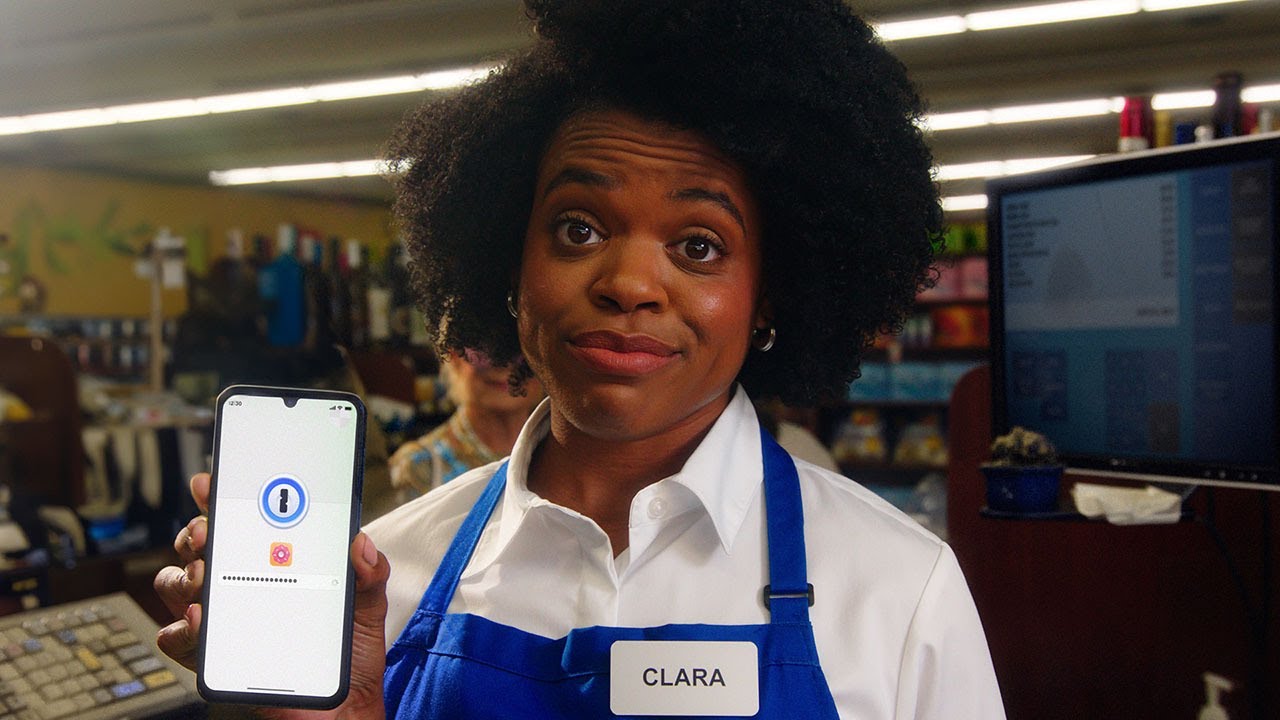
The woman in the supermarket is named Clara. She wears a blue apron, holds up a phone and tells us something no password manager would normally want dramatized: her password is a bad one. The joke in Something Massive's commercial for 1Password is not that Clara is foolish. It is that she is familiar. We have all watched someone treat a private credential as if it were a grocery-list item.
This is the peculiar work of a modern advertising agency. The client sells encrypted software, but the agency must sell recognition. A lecture on credential security would be accurate and invisible. A loud confession in aisle seven gives the danger a face, a name and comic timing. The campaign, released around the Presidents Cup, generated more than 12 million impressions; 1Password reported a 14 percent lift in account creation during the tournament window.
Something Massive has been doing versions of this translation since 2009. The Los Angeles agency was formed by Rebecca Coleman, Chris Gibbin and John Moshay, veterans of DNA Studio. It is privately held, employs somewhere between 11 and 50 people, and works from Santa Monica Boulevard. Its name suggests spectacle. Its real product is compression: strategy, writing, shooting, editing, distribution and measurement squeezed close enough together that an idea does not dissolve in the handoff.
The phrase aged. The bet did not.
In 2012 the agency acquired Circ.us, a New York creative technology shop known for augmented-reality work. Something Massive announced itself as a “post-PC advertising agency.” This sounds quaint now, like a magazine cover promising that tablets will change breakfast. But the underlying observation was sharp. Advertising had escaped the desktop. A story might begin on television, continue in a social feed, become a creator's conversation and end in a search box or checkout.
That change explains the agency's unusually broad menu. It develops brands and campaigns, makes films and social content, manages communities, buys media and watches performance. There is a 10,000-square-foot production space with a green screen, editing bays, sound equipment and set-building gear. For a challenger brand, the appeal is not simply that these services exist. It is that the people arguing about the insight can walk over to the people building the prop.
The agency's best work begins with a question more useful than “What should we post?” It asks: “What are people already doing?”
Consider Buffy the Vampire Slayer. Sinclair Broadcast Group wanted younger viewers for a Halloween airing of the show's lone musical episode. The obvious plan was to advertise the rerun. Something Massive instead treated fandom as the medium. It recruited Twitch creators, built three days of watch parties, arranged cast interviews and produced the calendars, visuals and copy around them. Viewers kept one screen on Twitch and another on the episode. Roughly 10,000 people were watching at one point, and Sinclair reported a 10 percent ratings increase, though its executive carefully noted that the campaign could not claim all of that lift.
The execution cost $75,000. This matters because agency case studies are fond of revealing outcomes and shy about revealing invoices. Here we can see both. The money bought a five-person agency team, the creator program, production and campaign management. It also bought a reusable idea: Sinclair said it was already working with the agency on another event for Star Trek.
Three budgets, three different machines
The public record offers two other useful prices. Gimme Seaweed spent about $90,000 on a four-month engagement that began with 10 to 15 recipes and a two-day Los Angeles shoot. Something Massive turned the production into photography, a brand video and website material, then helped refine the company's manifesto and messages. Gimme said its average search position improved from around 25 to the top 15, aided by a recipe library that grew beyond the initial assignment.
Melissa & Doug's contract was much larger: $750,000 for a year of organic social strategy, quarterly shoots and daily community management. The initial failure was not a campaign. It was an old production grammar. TikTok's rise taught every feed to reward creator-led, vertical, phone-shot work. The agency moved the toy maker away from immaculate editorial images and toward faster short-form video, placing TikTok at the top of the planning hierarchy because assets that worked there could travel elsewhere.
Publicly reported engagement value

These are not three sizes of the same product. They are three operating systems. One creates a cultural event. One builds a search asset that compounds. One runs an always-on publishing room. Something Massive's business model accommodates all three through projects and retainers. Its publicly listed digital advertising packages run from $14,000 to $50,000 a month; reviewed projects range from $75,000 to $750,000.
Small enough for the principals to stay
Large agencies sell access to armies. Something Massive sells the absence of a parade. Clients repeatedly describe senior people remaining involved after the pitch. A Gimme executive said the work did not get passed down to a junior team. Sinclair valued direct access to the principals. A production client praised the agency for allowing unusually intimate collaboration across nearly nine shoots.
The tradeoff appears in the same reviews. Melissa & Doug praised the depth of the work but sometimes had to chase status and timing. A honey brand that achieved record click-through rates wanted clearer charts for tracking spend and suggested that the agency say no when side requests piled up. Sinclair experienced the reverse problem: updates arrived more often than needed. The common thread is capacity. A compact team is intimate because it is compact. Clients who cannot prioritize, approve quickly or tolerate candid limits can turn closeness into congestion.
The useful client brief
Bring a precise business problem, access to decision-makers and a number everyone agrees to watch. Leave the channel open. The agency's strongest ideas have appeared when a client knew the desired behavior but had not already prescribed the format.
What another marketer can steal
The repeatable lesson is not “hire a Los Angeles production studio.” It is to organize the work around learning. Something Massive's IMAX campaign for Queen Rock Montreal ran across YouTube, Meta, TikTok, search and programmatic display. The team optimized by market as ticket-sales velocity changed. The agency reports that the film produced $2 million at the domestic box office and became the largest launch of an IMAX-exclusive concert film at the time.

That sequence also explains where Something Massive sits in the market. It is more strategically involved than a production vendor, more production-heavy than a consultancy and more performance-minded than a traditional creative boutique. Its sweet spot is a brand with enough budget to run and learn, but not enough patience for layers of agency traffic. Better-for-you food, consumer products, entertainment, healthcare and technology recur because each needs translation: unfamiliar benefits made ordinary, old properties made current, serious products made human.
There is a pleasant contradiction in the agency's name. Something Massive is not massive. Its claim is that mass is the wrong unit. The better measurement is the distance between the problem, the idea, the thing made and the signal that comes back. Shorten that distance and a password lecture becomes Clara in a supermarket. A rerun becomes a live fandom event. A concert recorded in 1981 becomes a real-time media problem. The screens keep changing. The work is to notice what people do between them.