At Valley National Bank, the trouble was almost entirely innocent. WorkFusion’s account of the deployment describes more than 100,000 monthly wire transactions, roughly 20,000 sanctions alerts and a false-positive rate above 99%. Imagine a doorbell that rings all day, with almost nobody at the door. Someone must still get up and look.
- WorkFusion reviews alerts produced by existing financial crime systems.
- Its agents have specific assignments: payments, names, news and customer checks.
- Named customers report less manual work; the figures describe particular deployments.
- UiPath acquired the company in February 2026.
This is a peculiar kind of business opportunity. A bank needs to catch dangerous activity. Its employees also need to establish, repeatedly and carefully, that an ordinary transaction is ordinary. The first task gets the dramatic name: fighting financial crime. The second gets the queue.
WorkFusion, now a UiPath company, has made that queue its specialty. Its proposition is unusually easy to picture: put software into some of the first-line analyst work, gather the evidence, clear supported false positives and send the difficult cases onward. The interesting question is how much useful judgment can be packaged into a repeatable job.
01The bank that kept hearing the alarm
Valley had already tried suppressing alerts, without significant impact, according to the customer case study. It wanted an alternative to hiring more people. The change came through Tara, WorkFusion’s payment sanctions screening agent. The published result was automation of 65% of sanction hit reviews.
Reported in WorkFusion’s Valley Bank case study. A customer result, not a promise for every bank.
The detail worth copying is the audition. Valley’s compliance leaders involved model risk management and information security early, then ran parallel proofs of value using the same data. The test was attached to a real workload, with the people who would have to approve it already in the conversation.
A software demonstration is a courteous occasion. Everybody brings their nicest examples. A comparison on the same data is a less obliging host. That is why this small operational detail matters more than a handsome slide about the future.
“Tara has been a huge win for us.”Christopher Phillips, Director of AML Compliance, SVP, Valley National Bank
02A colleague with an oddly precise job description
Tara has a name and a face. So do Evelyn, Evan, Isaac and Kayla. WorkFusion says it gave the agents these identities because they perform work associated with Level 1 analysts. There is a mildly comic charm to software arriving with the manners of a new colleague. Its usefulness, however, depends on the assignment beneath the portrait.
The company’s roster divides the work. Evelyn reviews name sanctions and politically exposed person alerts. Evan handles adverse media. Isaac supports transaction monitoring investigations. Kayla works on KYC, or Know Your Customer. Edward addresses enhanced due diligence and high-risk reviews. A compliance leader can begin with a particular backlog rather than a general invitation to automate the office.
Simplified illustration of Tara’s documented role.
Tara’s technical documentation makes the boundary clear. She ingests alerts from an institution’s sanctions screening system, examines payment information and routes potential true hits to a designated team. The workflow gathers research and produces reports. It describes analysts serving as checkers. The upstream screening engine remains part of the arrangement.
That division is commercially important. A bank need not throw away the machine that finds possible matches to improve the work that follows. WorkFusion is selling a layer of review between the alarm and the analyst’s next decision.
03From the crowd to the compliance desk
WorkFusion’s origins were broader. Founded by Max Yankelevich and Andrew Volkov, the business was known as CrowdComputing Systems before its 2014 rebranding. Its early offering combined automation, crowdsourced workers and employees on web workflows. The underlying ambition was to move repetitive knowledge work into a more efficient mixture of people and machines.
In 2018, a $50 million Series E supported AI-powered robotic process automation. The offering covered data-heavy work across banking, insurance and healthcare. By March 2021, Georgian was leading a $220 million Series F for industry-specialized intelligent automation, including document-heavy financial services processes.
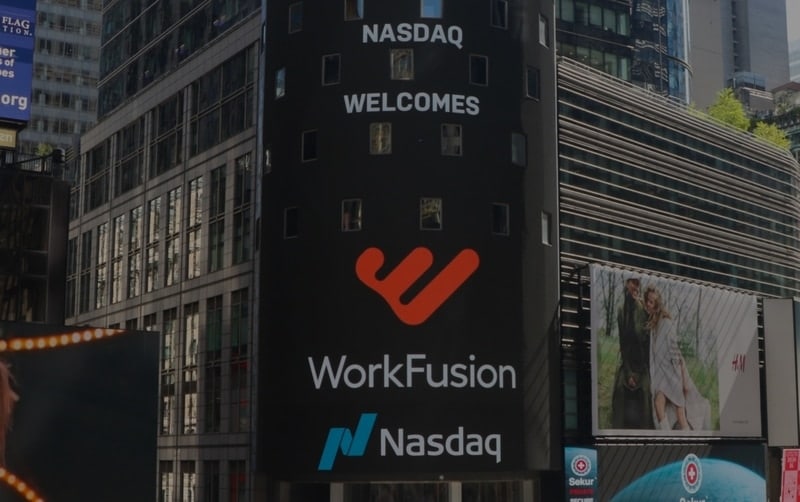
The consequential turn came in 2022. CEO Adam Famularo later described a “hard pivot” toward AI agents for financial crime compliance. Instead of asking customers to imagine everything a general automation platform might do, WorkFusion began offering a more definite purchase: software prepared for a named role in a named department.
Read that progression as a lesson in specificity. A platform can possess many capabilities and still leave the buyer with the most difficult work: deciding what to build. An agent with a defined assignment gives that buyer a starting point, an owner and a way to measure the result. That is an interpretation of the strategy, rather than evidence that every earlier product failed.
04The distinction hiding inside 52%
Raymond James offers another useful example. Its financial crime team faced rising alert volumes and capacity pressure. It had access to internal RPA expertise, but did not want to wait months, potentially years, for a custom solution. It chose Evelyn for watchlist review, connecting the software to its case manager and using additional data for entity comparisons.
WorkFusion reports that 52% of alerts no longer required manual review. The remaining cases also took less effort, producing a reported 70% overall reduction in manual work. Those numbers describe different things. One counts alerts; the other measures the work around them.
The deployment also included real-time sampling for ongoing model validation. That detail belongs beside the efficiency numbers. Once work is automated, the institution still needs a way to check how the work is going.
For a buyer, the practical lesson is to measure both coverage and effort. An automated case count can overlook the value of a better-prepared escalation. Equally, a percentage saved says little about the remaining cases’ importance. The tedious work and the consequential work may arrive in the same queue.
05What the buyer actually buys
WorkFusion sits at the intersection of enterprise automation and financial crime compliance. Its expertise combines machine learning, document processing and workflow execution. Current platform documentation uses the Work.AI name; its Intelligent Automation Cloud heritage supplies the machinery for moving information through a business process.
The obvious alternatives include more analysts, outsourced operations and an internal automation project. Broad automation platforms offer building tools. WorkFusion’s distinguishing proposition is the pre-built compliance assignment, with the integration and review workflow around it. Which route makes sense depends on the institution’s data, existing systems and ability to maintain its own solution.
External information remains essential. WorkFusion lists partnerships with Thomson Reuters for sanctions and adverse media data, and LexisNexis Risk Solutions for activities including onboarding and ongoing screening. Software can organize research, but it still needs something useful to research.
The business sells enterprise software through a demo and sales process. Its lighter LT agents are advertised as monthly subscriptions with volume limits, cancellation flexibility and a first month free. That offers a smaller initial step than a full enterprise integration. A trial result, however, should not be mistaken for proof that the surrounding bank workflow is ready.
A sensible cost comparison includes the software, integration, validation, data access and continuing human review. The relevant question is what it costs to complete an acceptable review. A cheap first answer becomes an expensive purchase if somebody must rebuild its evidence afterward.
06A narrow job meets a larger machine
In September 2025, WorkFusion raised $45 million led by Georgian. It said its agents were deployed at 10 of the top 20 banks and automated more than one million alert hits daily. These are company-reported scale claims. The named customer stories provide the more concrete view of how an individual deployment operates.
UiPath completed its acquisition on February 5, 2026. Its subsequent quarterly filing put purchase consideration at approximately $190 million: $160 million in initial cash and about $30 million in acquisition-date fair value of contingent consideration. That is the acquisition accounting figure, not an annual subscription price or a new funding round.
UiPath’s announced rationale was to combine WorkFusion’s compliance agents with its automation and orchestration platform. The intended fit is straightforward: specialized software does the compliance work, while a larger platform coordinates agents, systems and people across the process.
The limits are equally practical. This approach needs accessible data, defined procedures, validation and an escalation path that somebody owns. A team with little repetitive volume may have less to gain. A team unable to check decisions has a more basic problem to solve before handing over a queue.
What another company can copy is the shape of the decision: choose one recurring job, compare alternatives on the same records, involve the reviewers early and count the human work that remains. WorkFusion’s interesting wager is that useful AI can earn its place by becoming very good at an assignment people already understand. Somewhere, an innocent payment is waiting for precisely that.
Visit the working parts
Explore WorkFusion, its agent roster, customer stories, company news and compliance blog.
Product demos and customer interviews · YouTube · LinkedIn · X · Facebook · Automation Academy samples on GitHub