Banking software has a comic flaw: it frequently asks the banker to serve the software. A customer walks in with one identity and one relationship, while the institution may greet that person through a thicket of separate systems - one for deposits, another for loans, another for compliance, another for the core. Each has its own appetite for data. Each demands a little ceremony. By the time the customer has been recognized, several computers have politely forgotten them.
Glenn Bolstad has spent most of his career inside that contradiction. His résumé moves from Chemical Bank and Smith Barney to IBM, Microsoft and Appway, then into the founder's chair at Vikar Technologies. The path is unusually well suited to noticing what happens between the polished customer screen and the machinery behind it. Banks want control, regulators require precision, employees need a usable process, and customers would rather not explain themselves for the fourth time.
Bolstad's response is less a taste for disruption than a dislike of the unnecessary handoff. Vikar, which he founded in 2017 with Adam Bieser, Amruta Dongre and Nancy Schneier, was built around one platform spanning account opening, lending, KYC and KYB, treasury and wealth management. The proposition is architectural. The ambition is personal: make the institution feel like one institution to the person using it.
A career in the plumbing
Bolstad studied international finance at BI Norwegian Business School from 1991 to 1993. His early work put him close to the bank itself - procurement at Chemical Bank, followed by a senior vice president role at Smith Barney. The next stretch moved him toward the companies that supply the machinery: IBM, Mainline Information Systems and Microsoft. In 2011 he became general manager for Appway in North America, helping build the market for wealth-management onboarding software.
It is the kind of career that teaches a person where a tidy sales diagram goes to acquire complications. A platform can be elegant in isolation and still make a banker's day worse when it collides with a legacy core, a compliance process and three lines of business. Vikar's own account of its beginnings says the four future founders kept seeing the same gap. Community banks and credit unions were caught between heavyweight platforms designed for the largest institutions and lighter tools that could not stretch across the organization.
The founders had worked together before. They brought relationships, scar tissue and, eventually, clarity. Their question was not whether a bank should become digital. It was whether digital work could fit the bank rather than forcing the bank to contort itself around the product. Bolstad has repeatedly argued that established workflows should shape the software. In a sector fond of imposing a new operating model along with every new login, that is almost a courtesy.
“Give your staff their time back so they can spend it on customers and judgment.”Glenn Bolstad on practical AI adoption
The octopus on the whiteboard
One Vikar project makes the problem wonderfully visible. When the company began working with Peapack-Gladstone Bank, the bank's customer onboarding and KYC processes stretched across retail, commercial and wealth management. An executive later recalled Vikar's diagram of the existing environment: it resembled an octopus - perhaps spaghetti on a particularly ambitious evening. The following slide proposed one portal and one place for KYC information.
The joke carried a serious operational cost. A customer opening a second kind of account could be asked to begin again. Information moved between teams with manual dropouts. Every dropout was a chance for delay, repetition or error. Vikar set out to preserve the necessary differences between lines of business while giving them a common interface and reusable customer information.
Peapack reported that a branch process that had taken about 30 minutes could fall to three. Its broader onboarding process moved from days to minutes, with customers able to complete it online, in a branch or through a mixture of both. Speed was only part of the change. The bank could run KYC once, keep documents inside an automated workflow and send higher-risk cases to a senior analyst. The software handled repetition; people handled exceptions.
From branch ritual to short conversation
Reported by Peapack's technology leadership for an in-branch account-opening workflow.
Bolstad seems to enjoy the moment when resistance flips. He has described employees who had used the same process for decades, watched the new one with understandable unease and then became its strongest proponents weeks later. It is a revealing anecdote. Digital transformation is often narrated as a contest between the enlightened and the obsolete. In practice, the wary employee may simply know exactly how many promises a previous system failed to keep.
When the customer was Vikar
The company's argument for community banking became personal during the PPP period. Bolstad wrote that Vikar had encountered hurdles with large banks and was ultimately turned down. A small community bank approved and processed its loan. The vendor selling automation to local institutions had become the small business depending on one. The symmetry is almost too neat, but its lesson is useful: speed matters because someone is waiting on the other side.
Vikar responded to the lending surge by automating loan-forgiveness applications and preparing software for a new round of originations. The pandemic made front-end digitization urgent. Banks that had concentrated on back-office efficiency suddenly had to serve borrowers remotely and at volume. Bolstad wrote that working harder was insufficient; the systems had to work smarter. His phrasing is familiar. The circumstances gave it teeth.
Yet his writing about community banks avoids treating automation as a replacement for local knowledge. He has praised what he calls their flexibility, familiarity with small businesses and relationship model. In another essay, he framed banking as a hospitality industry. Customers want the convenience they receive online, but beneath convenience sits recognition - the feeling that an institution knows who has arrived.
The technology is useful precisely when it leaves more room for the banker's attention.The operating idea behind a unified platform
That gives Bolstad's work a productive tension. Vikar sells straight-through processing, rules and automation. Its founder speaks about relationships, judgment and the customer experience. The two ideas can look opposed only if automation is mistaken for the final service. For Bolstad, it is closer to stagecraft: move the scenery efficiently so the human performance can begin.
The practical AI test
By 2026, the fashionable question for every bank had become what to do with artificial intelligence. Bolstad's answer began at ground level. Find where manual work and disconnected systems slow the staff. Apply AI to a specific task where the difference can be measured. Give the employee time back for customers and judgment. The advice resists the grand transformation memo in favor of a queue that is shorter on Friday than it was on Monday.
That pragmatism also appeared in a February podcast conversation about why lending still feels clunky. Bolstad described lending as an orchestrated journey: application, underwriting, decisioning, closing, onboarding and integration into the core. A collection of excellent point solutions can still produce a poor journey when each throws work over a wall. Complex commercial lending exposes every seam.
The seams are where Vikar continues to expand. A Series A round announced in early 2025, led by Btech Consortium Fund and Verde Technology Ventures, was intended to support hiring, product development and scale. Datos Insights later recognized the company's unified account-opening and loan-origination platform. In 2026 Vikar announced work with Onsetto, Machias Savings Bank, BCB Bank and Plaid, extending its connections around business activation, identity, funding and onboarding.
The partnership language is revealing too. Bolstad says business banking transformation cannot stop at opening the account. An account that exists but has not become the customer's operating relationship is an administrative victory and a commercial shrug. The software has to follow through: deposits, lending, treasury, wealth, operations. Completion is not the same as activation.
A room, at last
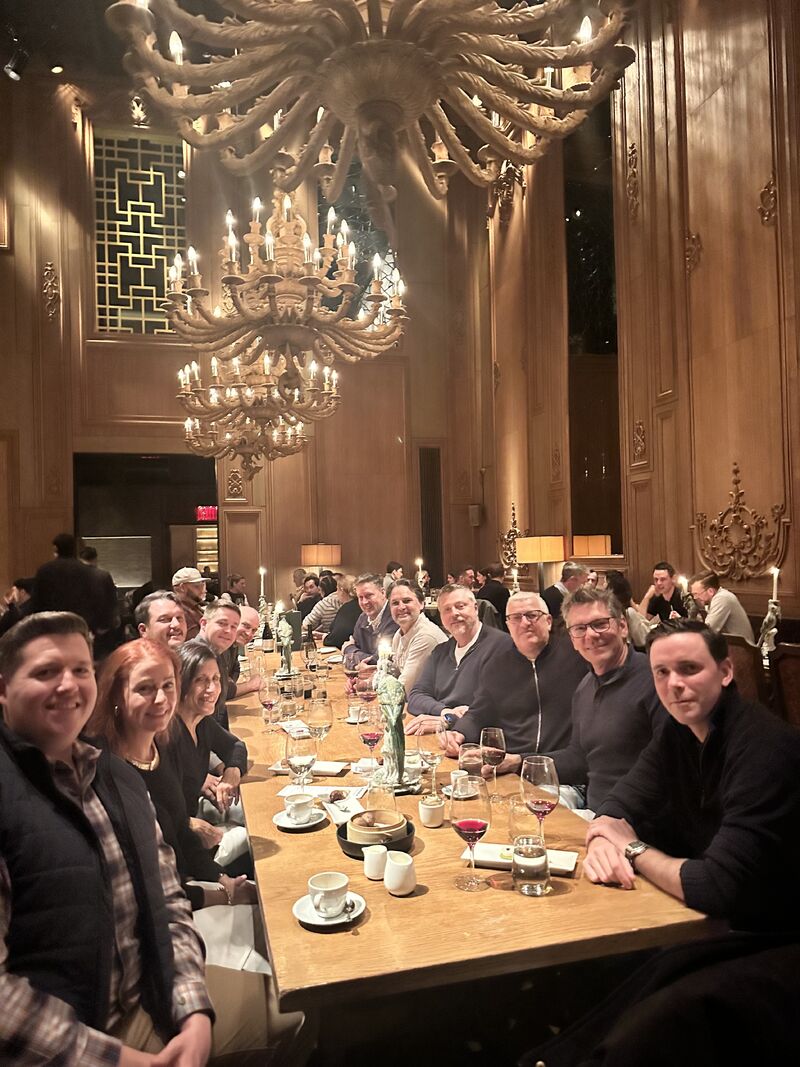
In 2025, years after Vikar's founding, its distributed team held a first company-wide offsite in New York. Bolstad described two days of product discussions, roadmap work and face-to-face team building. The photograph from dinner has the charm of people who ordinarily occupy rectangles on one another's screens finally sharing a long table.
There is a pleasing echo between the company and its product. Vikar tries to give customers, lenders, branch managers, underwriters, compliance teams and operations a shared view. Its own people travelled across the country to acquire one. Software can distribute information; a room distributes context. Both help a group understand what everyone else has been doing.
Bolstad's story remains less about a dazzling interface than about coherence. He has worked in enough corners of the banking stack to know that the front end is only as graceful as the handoffs behind it. The founder's task, as he frames it, is to join those handoffs without flattening the institution that uses them.
Community banks do not need technology to become less local. They need it to spend less of their local knowledge on repeated forms, document hunts and avoidable re-entry. Bolstad's bet is that a unified system can make an old banking virtue - knowing the customer - easier to practice at modern speed. Somewhere, a banker closes one fewer tab and has time to ask one better question. It is not a dramatic ending. It may be the useful one.